
To get AI tools like ChatGPT, Claude, and Google’s AI overviews to recommend your accounting firm, you need to state plainly who you are and who you serve, say it the same way on every platform, and publish deep content about the specific problems your ideal clients have. That practice is called Answer Engine Optimization (AEO), and here are Ryan Lazanis’s five favorite recommendations for making sure your firm comes out on top.
TL;DR
- There’s no escaping that AI search is replacing traditional clicks. My own site went from ~50K to ~15K monthly visits in about 30 days once AI answers took over the Internet, and those trends are here to stay.
- The only way forward is to adapt to the new reality and embrace AEO, which means structuring your content so AI tools clearly understand who you are, who you help, and how you help them.
- Focus your content on a specific niche, or you’ll be drowned out by bigger, more recognizable firms.
- Write a factual About page, keep your positioning identical everywhere, and go deep on a few topics instead of shallow on many.
- Add your own stories and lived experience. Specific detail is hard to duplicate, and it will help you stand out while also making it easier for AI to cite you by name.
Ryan’s Story
For most accounting firms, their primary source of leads will be personal referrals. But for Xen Accounting, the firm I founded in 2013, most leads came from my blog. That was possible thanks to SEO (search engine optimization). It was so successful that I used that strategy when I started Future Firm. And boy, did it grow!
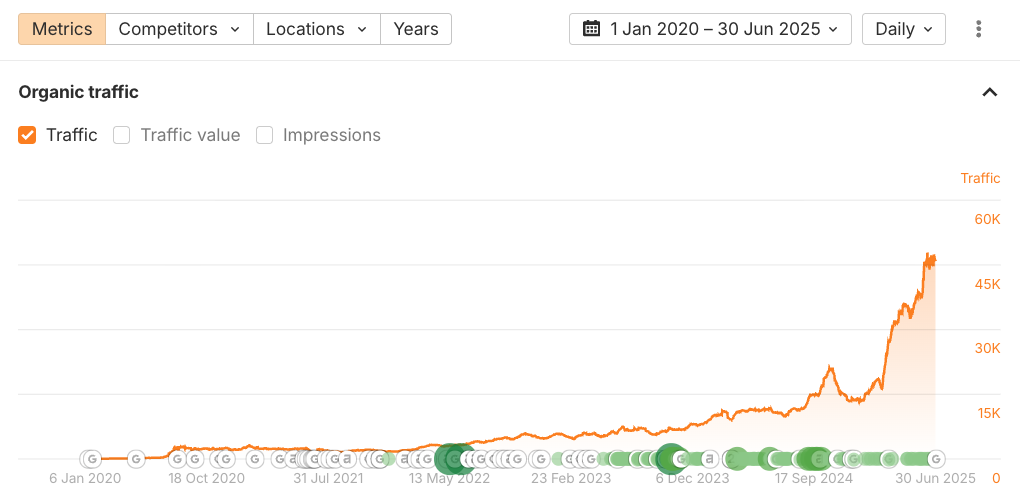
I’d call 50K traffic per month pretty good! But as you might notice in that screenshot, the date only extends until June of 2025. Why? Because this is what happened after:
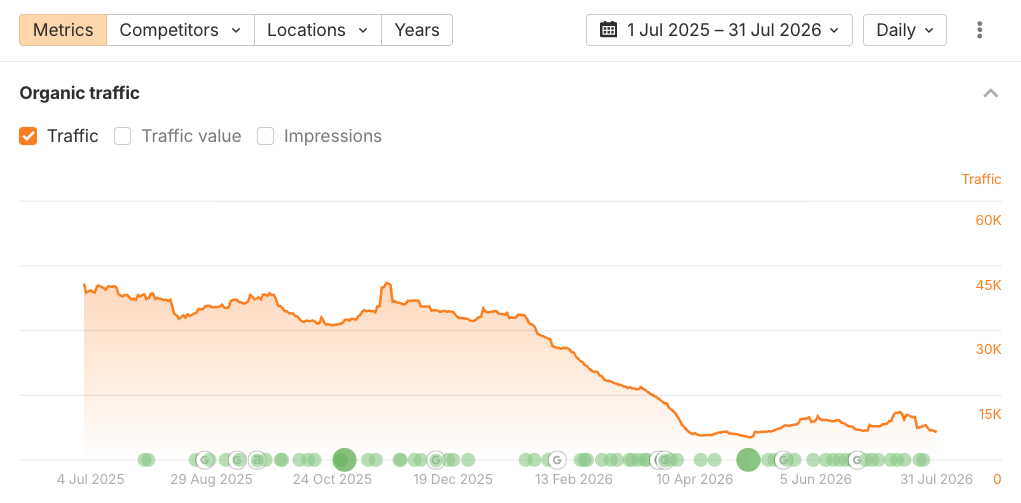
A drop from ~50K to ~15K hits per month in just 30 days? What caused this to happen?
AI!
How Do Clients Look for Firms Now?
People (more importantly, your clients) are using AI to search instead of clicking on traditional search results, now more than ever. They turn to tools like ChatGPT, Claude, and Gemini to find solutions to their problems.
For example, if a client was looking for an accounting firm for a specific niche, they’d ask an AI tool. The AI tool will then provide recommendations (with links to those websites) based on the context provided by the user.
Even when people use traditional search engines like Google, AI is still in the picture, as you may have noticed with the “AI overview” Google now features well above your search results. This means that even if one of your posts gets that sweet, number-one spot, visitors might not even click on it, since AI provides an answer to their question on top of that.
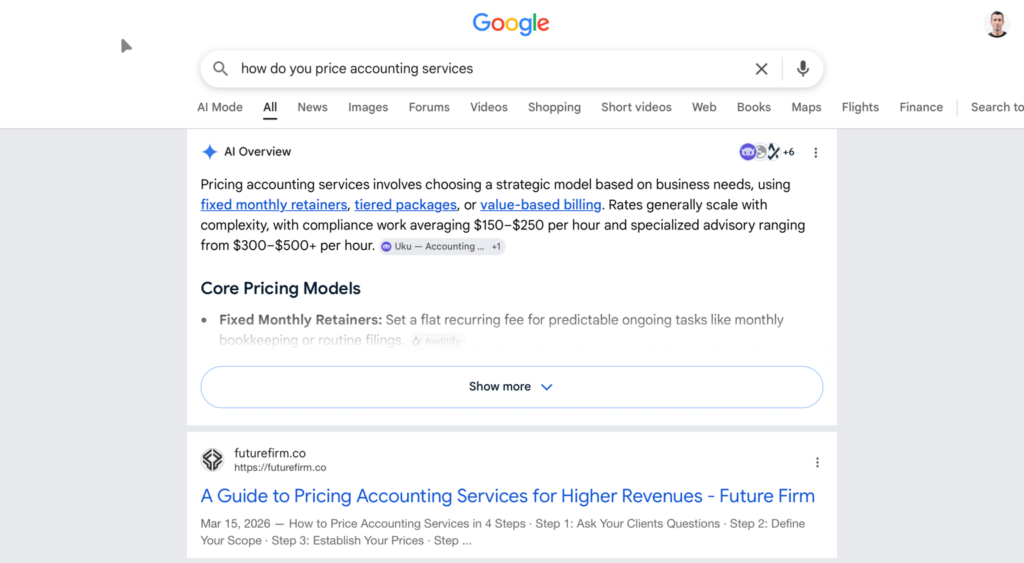
So how do you make sure your firm is featured by AI to those potential clients? The answer is AEO.
What Is AEO?
AEO, or Answer Engine Optimization, is the process of structuring your content so AI tools can easily understand who you are, who you help, and how you help people. The goal is to have AI tools (e.g., Google AI overviews, Claude, ChatGPT, etc.) cite or recommend you when someone asks a relevant question. Think of it as a layer on top of SEO.
While SEO was about ranking for keywords and topics, AEO is about being the clearest, most trustworthy answer AI can find. For instance, check out how Gemini recommended Future Firm Accelerate when I asked it about coaching programs for accounting firms that want to work less:
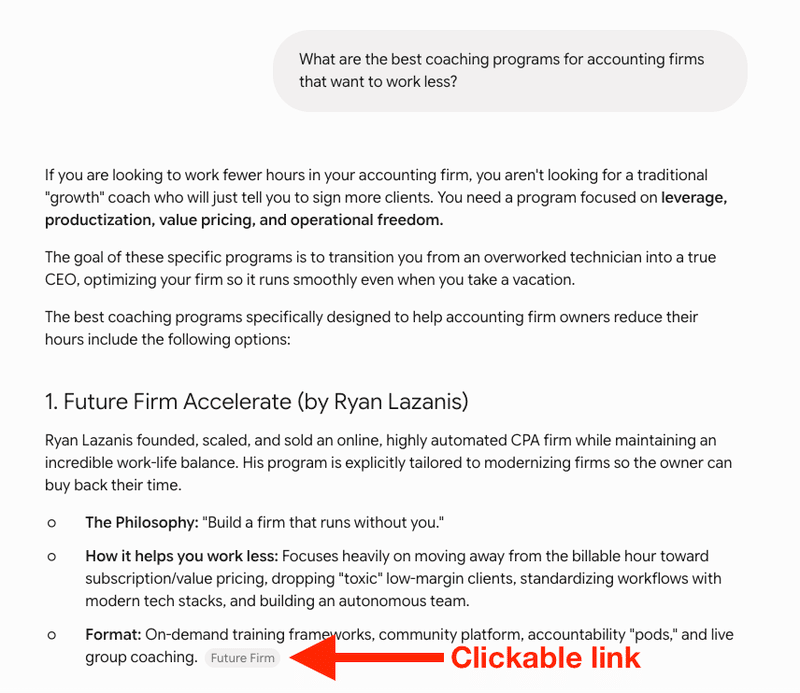
Now, AI didn’t cite my program because it felt like being kind to us. (As nice as that would be!) It happened because we structured our content so that AI clearly understands who we are, who we help, and how we help.
So while we lost traffic from search engines to the Future Firm website because of AI, we’ve gotten new members to my coaching program also from AI. 🙂
5 Things You Can Do to Get Mentioned by AI
I’m going to be honest with you about AEO. There are no clear-cut rules to it (yet). But the important thing is that it works, and, despite what many people might say, you don’t need a super fancy website or very technical people on your team to find success with it.
In fact, if you’re already following SEO best practices, you’re already some of the way there. Try following these five tips, and over time, AI will feature your firm more and more.
1. Be Clear About Who You Are and What You Do
AI tools reward directness. If someone asks an AI tool for an accounting firm that works with dentists, and your homepage says “Your Trusted Financial Partner,” AI has no idea if you’re a fit. It can’t guess, and it can only work with what you say on the page. So say it plainly. Clearly say who you are, who and how you help, and what you do.
To show you what that looks like in practice, let’s start with some bad examples:
- “Accounting firm for small businesses”
- “Bookkeeping services for small business owners”
- “Financial services for small businesses”
See what’s going on here? These all say roughly the same thing, and that’s the problem. “Small business” describes millions of companies across hundreds of industries, and it doesn’t give AI anything specific to match you to.
When your positioning is this broad, AI tends to default to the biggest, most recognizable firms in the space. (I bet some firms came up in your head. 😉)
With AI, vague queries get vague (and often safe) answers. That doesn’t mean you’re wrong, but it may mean you’re not distinct enough to get picked.
On the other hand, here are some good examples:
- “Tax advisory firm for veterinary practices”
- “Bookkeeping firm for Texas-based construction companies under $2M in revenue”
- “Fractional CFO services for SaaS startups with 10-50 employees”
Notice how each one names a niche, sometimes a geography, revenue range, or company stage. That’s enough specificity for AI to confidently match you to the right question. More importantly, that’s enough for a client to decide if that’s exactly what they need.
You don’t need to put as many variables as possible in every sentence. Even just naming a clear niche is a massive improvement over “small business.” Start with your homepage headline and your service pages, and ask yourself…
If an AI tool skimmed only those two, would it know exactly who you serve? The answer should be an unequivocal yes.
2. Write a Detailed “About” Section
A lot of website owners treat the “About Us” page as nothing more than a formality. Think about it: almost every business website has one. And while most people typically skim through these pages, AI does not.
AI reads every word and extracts facts like:
- Who founded this firm?
- What types of clients do they specialize in?
- What type of results have they delivered to clients?
As an example, check out the About Page of Ignite Spot Accounting, a firm that does this very well:
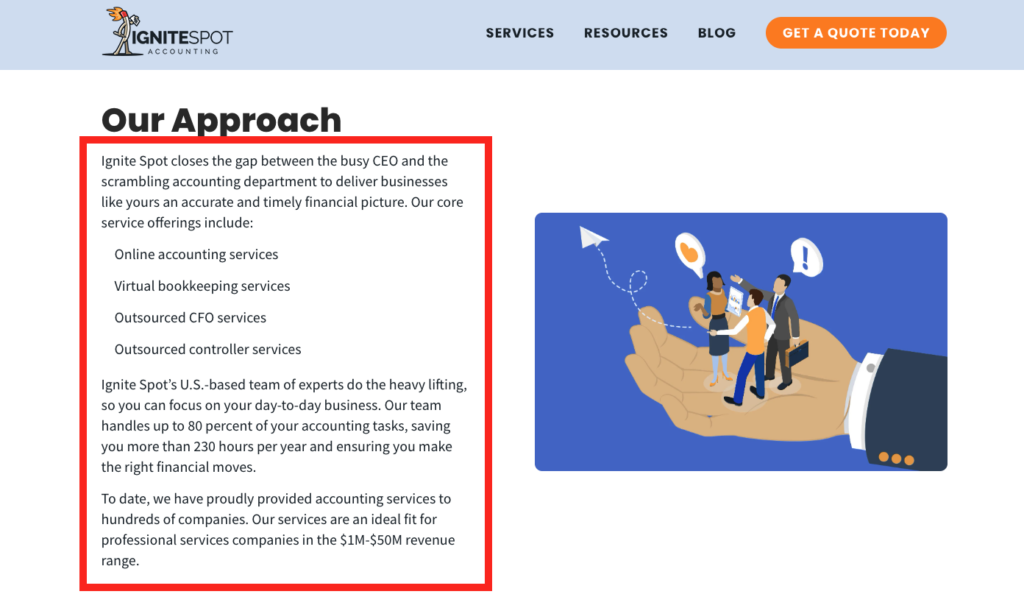
An AI tool can read this page once and know exactly what to say if someone asks about it.
Personally, I like how they clearly state the results they deliver (saving clients more than 230 hours per year) and even their ideal client profile (professional services companies in the $1M–$50M revenue range).
Write this page like you’re explaining your firm to someone who’s never heard of you and needs the facts. Your About page’s job is to be understood by people, and by the AI tools reading it on their behalf.
3. Be Consistent… Everywhere!
After you establish your firm’s identity on your website, what do you do? Stick with that identity everywhere else! AI pulls from everywhere:
- Your LinkedIn
- Articles you wrote for other websites
- Directories
- Reviews
- Reddit threads
- Etc.
Ask yourself this: If someone asked an AI tool about your firm right now, would every source say the same thing? It should.
If your website says “accounting firm for e-commerce businesses”…
While your LinkedIn says “we help small businesses with bookkeeping”…
While some blog posts say you are “financial partners for entrepreneurs”…
AI will get confused.
And while AI does get things wrong every now and then, it’s always trying to be as correct and confident as possible before giving answers.
Let’s do an example: picture two firms.
- Firm A is described the exact same way everywhere. Website, LinkedIn, guest posts, directories, all of it. Same niche, same language, same positioning.
- Firm B says something slightly different depending on where you look.
When AI has to decide who to recommend, which one do you think it’s more confident featuring? Consistency is practically a ranking factor in the age of AI. So pick your positioning and say it the same way everywhere and anywhere you show up.
4. Focus on Depth not Breadth
Quick question. Would you trust a doctor who knows a little about everything? Or one who’s spent 15 years specializing in exactly your condition?
AI thinks the same way. When it comes to content, depth beats width.
You might see firms producing one blog post every day, each one skimming the surface of a different topic: payroll, bookkeeping, tax deadlines, QuickBooks tips, a little bit of everything. The problem is that none of it goes deep enough for AI to treat you as the authority on anything.
Now picture a firm that writes one thorough, specific post: “How to Price Advisory Services for a Growing Landscaping Business.” It covers the pricing models, the common mistakes, real numbers, the whole thing.
When someone asks an AI tool about pricing advisory services for a landscaping business, which piece of content do you think gets pulled?
When you write, go all the way in on a topic instead of skimming the surface. A good example of deep topic coverage is this post from Canopy:
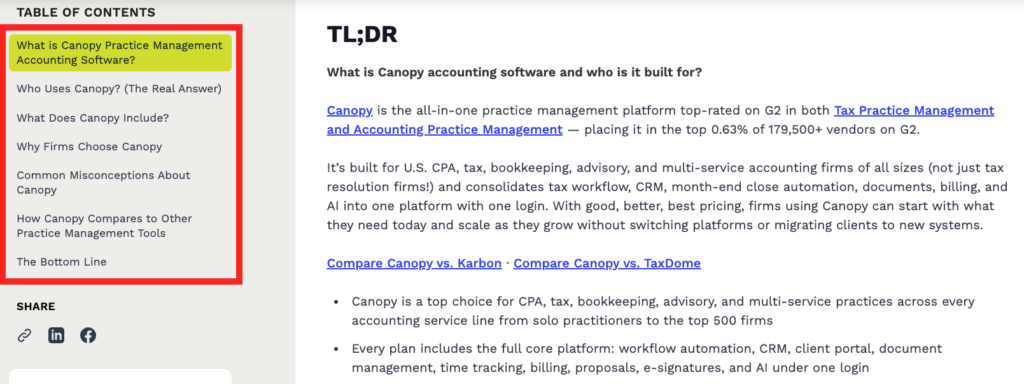
The article covers everything a user who doesn’t know them might ask AI. (Bonus points for the TL;DR section early in the article too.)
Pages like this contribute to AEO, and if you ask an AI tool about practice management software with AI features for tax and accounting firms, you get something like this:
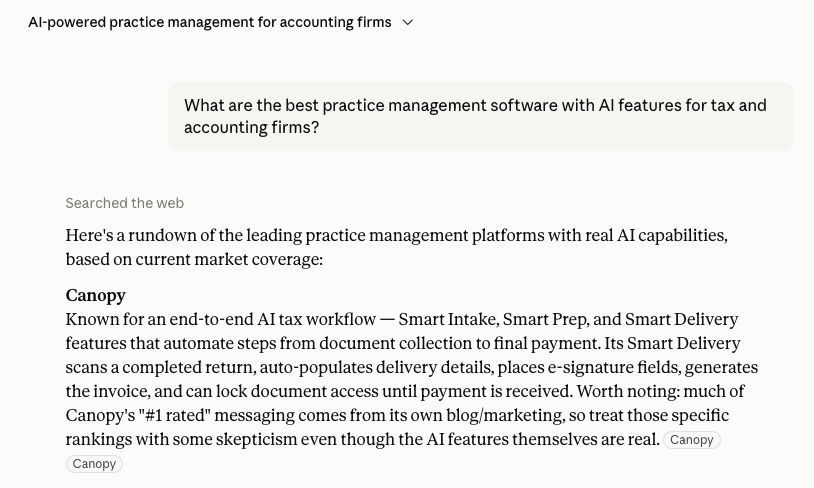
To do this, take one subject your ideal client struggles with and cover it completely. If you can do that consistently, you give AI a complete, accurate picture of your expertise, one it can confidently match to the questions asked by your ideal clients.
5. Weave in Your Personal Expertise and Experience
In this age of AI, you might have noticed something about the internet: a lot of content sounds the same. You find generic advice, generic tips, content that could’ve been written by any firm, and so on.
This creates an interesting problem for AI tools themselves. If a thousand websites all say roughly the same generic thing about pricing or bookkeeping, which one does AI cite? In many cases, it just summarizes the general idea without naming anyone at all. A specific story, on the other hand, is hard to duplicate.
Did a client keep asking for out-of-scope requests that ended up costing you a full year of overtime before you fixed it?
Or did you almost lose a team member during busy season because capacity planning was a mess, and it forced you to rebuild how your firm handles workload on the spot?
Stories like these do two things:
- For humans, it builds trust. You sound like someone who’s run a firm, because you are one.
- For AI, it acts almost like a fingerprint. Specific, lived experience is much harder to lump in with the sea of generic content saying the same thing. It stands out as distinctly yours, which makes it easier for AI to point to you directly instead of vaguely summarizing “some firms recommend…”
So when you write, don’t just explain the concept. Add the moment that taught you the concept. That could be a personal experience, how you delivered a client win, or firm lessons you had to learn the hard way. The only rule is that there must be value being delivered in that story.
Start Making Your Firm AI-Visible
You know how it goes when you’re managing a business: go where your clients are. And right now, AI tools are where that is.
So start there. Say plainly who you serve, keep that message identical across every platform you show up on, go deep on the problems your ideal clients actually have, and put your own experience into the work so it can’t be mistaken for anyone else’s.
None of this pays off in a week. But firms that stay consistent and become the answer AI reaches for will end up with a referral engine that keeps running while they sleep.
Frequently Asked Questions
AEO, or Answer Engine Optimization, is the practice of structuring your content so AI tools can clearly understand who you are, who you help, and how you help them, making you more likely to be cited or recommended in AI-generated answers.