
Here’s my prediction for 2026, and I’d go to Vegas on it: the firms that win the advisory conversation this year will be the ones whose month-end close is already automated. Period.
Advisory services, the high-margin, client-retaining, “we’re not just your bookkeeper, we’re your strategic partner” work, cannot happen while your team is still buried in spreadsheets on the 15th of every month, chasing down a mystery $412 charge from three weeks ago. You can’t have a forward-looking conversation with a client when you’re still doing forensic archaeology on last month’s transactions. Advisory requires time, and time requires that the close stops eating your calendar.
Canopy has stepped into Close Automation, its newest module built natively into the practice management platform accountants already live in. And as someone who spends most of her professional life helping firms figure out how AI actually fits into their day-to-day (not just their marketing slides), I think this release deserves a real look.
The Problem With “Month-End”
Traditional month-end close is reactive by design. Transactions pile up all month, nobody looks at them until the close window opens, and suddenly your staff is playing whack-a-mole with uncategorized expenses, missing receipts, and duplicate payments, all while trying to beat an ever-creeping deadline across numerous clients.
The reliance on spreadsheets, email chains, and specialized close tools makes it nearly impossible to catch issues early, pushing all cleanup and correction work into a compressed, high-stress close window. It’s not that firms don’t want to catch problems sooner; it’s that the tooling has never made “sooner” possible. Everything lived in disconnected systems, and disconnected systems don’t make task tracking and client communication easy.
Close Automation flips that model. Instead of a once-a-month scramble, it’s a continuous, always-on monitoring layer sitting directly on top of the general ledger.
What’s Actually Under the Hood
Let’s get technical for a second, because the “why should you care” only matters if you understand the mechanics.
Live Two-way GL connectivity, not a stale snapshot. Close Automation connects directly to QuickBooks Online (with additional general ledger integrations on the roadmap), pulling live transaction data into Canopy rather than requiring anyone to export, import, or reconcile spreadsheets by hand.
11+ purpose-built data monitors, running constantly. These aren’t generic anomaly flags. They’re specifically tuned to catch the recurring month-end villains: uncategorized transactions, duplicate expenses, missing vendors, unusually large transfers, and missing receipts. As soon as a monitor flags a record, it appears in Items to Review, where staff can resolve it directly, mark it reviewed, or send it as a client request. Nobody has to play detective to figure out what the flag is referring to. You can also build custom monitors with AI, which matters a lot if your firm serves a niche (construction, e-commerce, professional services) with its own patterns of “normal.”
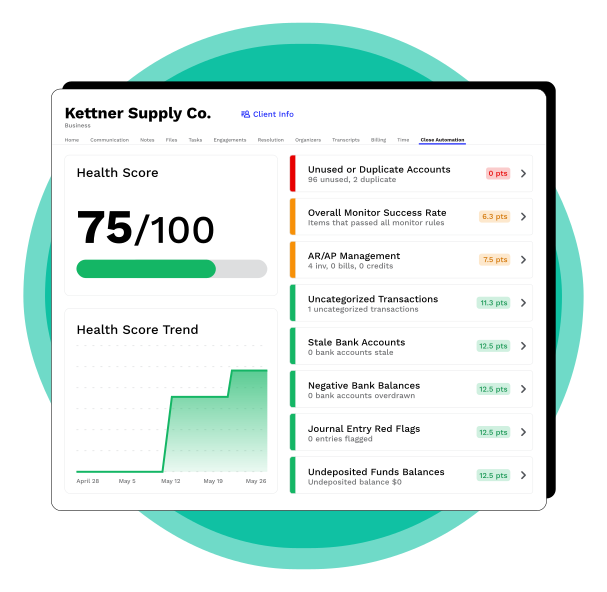
An explainable Books Health Score. This is the feature I’d bet gets the most attention from firm owners. Rather than a black-box AI score you must trust blindly, it’s a transparent, defensible metric showing exactly where a client’s books need attention and why. That’s not just a nice dashboard widget, it’s a pricing tool. It gives you objective data to justify a fee increase to a client whose books are a mess or just require a lot of hands-on work as well as the insights you need to evaluate a prospective client’s books before you quote them (so you stop underpricing chaos, which is an industry-wide bad habit).
A Close Health Dashboard is your command center. Close Automation also gives firms a broader portfolio view through the Client List, where teams can monitor connected clients’ accounting software, Health Score, and Items to Review without jumping between records. No more Slack-pinging three staff members to find out if Client A is on track.
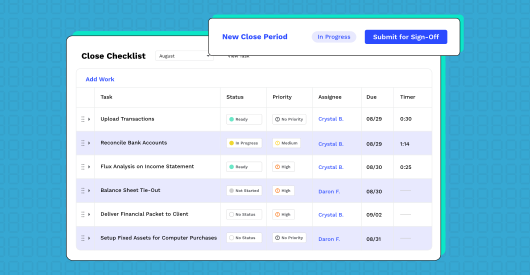
Defensible sign-off workflows. Once a close period is complete, teams can submit it for sign-off directly in Canopy. The platform records the signer’s name and sign-off date, giving firms a clear record of completion without relying on separate spreadsheets or email threads. If a client or manager has questions later, there’s a clear record of completion inside the close checklist.
Client requests are context-specific within the existing Client Portal. No more separate email threads for “Hey, what’s this $340 charge?” Teams can send one or more flagged items as client requests through the existing Client Portal, and each item is tracked individually.
AI-drafted, advisory-ready reporting. Once the close is complete, the Report tab provides a monthly financial report with profit and loss, receivables/outlook, and AI-generated analysis. The ‘so what does this mean for my business?’ commentary that used to consume a senior accountant’s Saturday afternoon can now be sent in PDF form with a single click.
Advisory Emerges Once Your Team Has Capacity
I want to push back gently on the idea that this is “just another bookkeeping tool.” It’s not. It’s a massive infrastructure shift, and infrastructure shifts are the ones worth paying attention to.
Here’s the thing about advisory services that nobody says out loud enough: advisory isn’t a service you add; it’s a service that emerges once the close stops consuming all your capacity. You cannot bolt strategic conversations onto a team that’s drowning in reconciliation. Firms have tried it, but it results in burned-out staff and advisory work that gets treated as an afterthought, which clients can absolutely tell.
Canopy explicitly positions Close Automation as freeing teams from time-consuming data entry so they can scale custom, high-margin advisory services across their entire client portfolio, and that framing is the whole point. This isn’t automation for automation’s sake. It’s automation as the precondition for the advisory pivot that firms have been talking about for years, but structurally couldn’t execute.
As Canopy Product Manager Joe Dwyer put it, the aim is to give firms cleaner books and a stronger foundation for Client Advisory Services. That last word, foundation, is doing a lot of work. You don’t build advisory on top of chaos. You build it on top of clean, continuously monitored, explainable data.
Where This Stands Today
A quick reality check, because I’d rather you have accurate expectations than hype: Close Automation entered open beta on June 9, 2026, available through Experimental Features for eligible customers. It evolved from what was previously referred to as “Canopy Bookkeeping” and was significantly expanded based on firm feedback before this broader release. During the beta/early access period, each account can connect up to 5 clients for free, with additional capacity available for purchase.
That timing matters for the 2026 prediction I opened with. If your firm starts adopting continuous close monitoring now, while it’s in open beta and the workflows are still being refined to your practice, you’re positioning yourself months ahead of firms that wait. In technology adoption, the early, deliberate movers are almost always the ones who shape the advisory offering before their competitors even have clean data to work from.
The Bottom Line
Month-end close automation isn’t a nice-to-have efficiency play anymore; it’s the on-ramp to the advisory services model your firm has probably been talking about in strategy meetings for the last two years. Canopy’s Close Automation module gives firms real-time ledger visibility, explainable health scoring, clear sign-off records, and AI-drafted reporting, all inside the practice management platform teams already use daily.
If 2026 really is the year the fully automated close becomes table stakes, the firms having the advisory conversation with clients in Q1 2027 will be the ones who spent this year building the foundation. Close Automation is one very real, very technical step toward that foundation, and it’s worth your attention now.