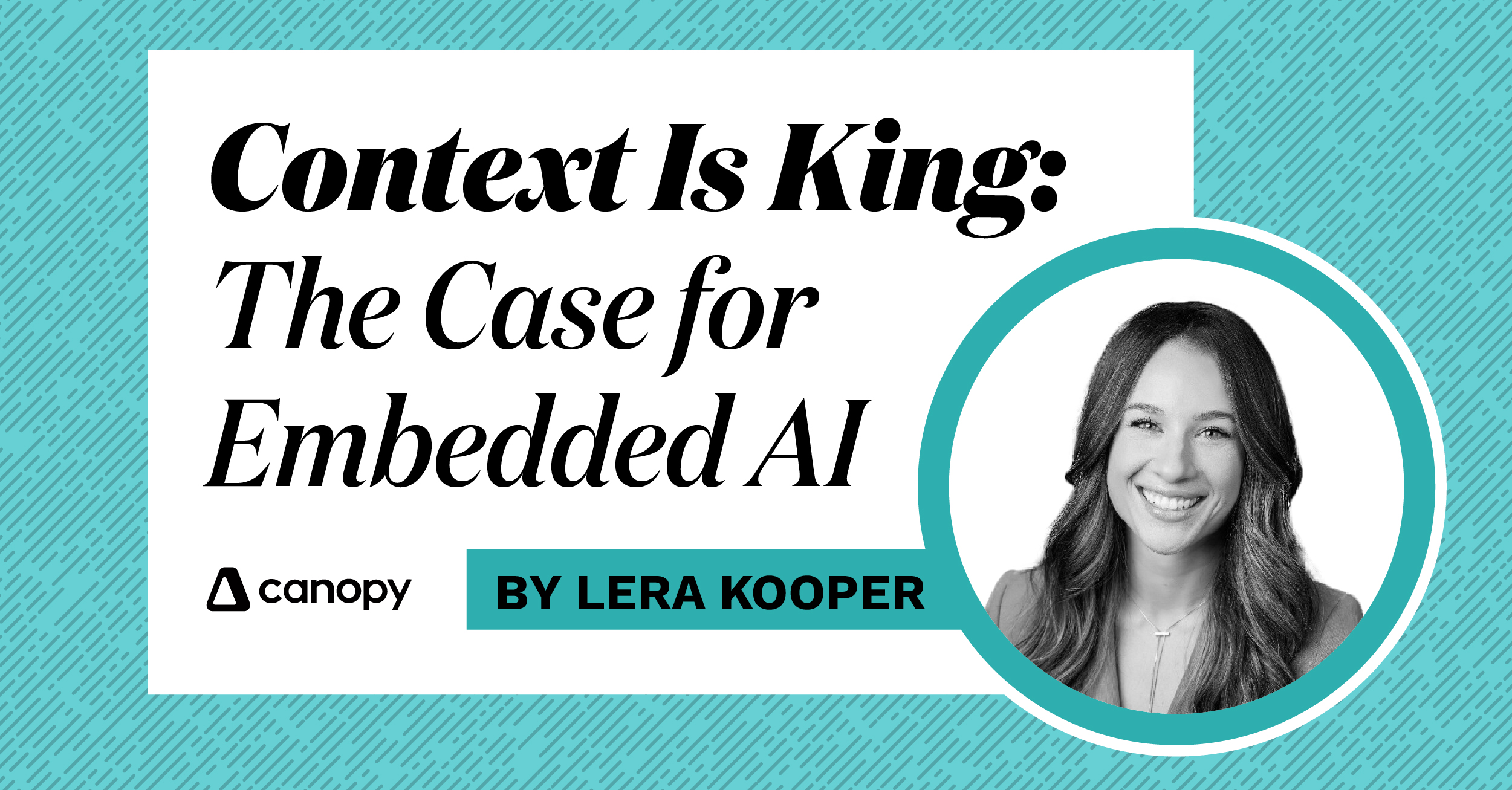

Remember when the conversation surrounding accounting and artificial intelligence centered around whether firms should use AI at all? Feels like a million years ago!
Now the only question accounting leaders are asking is, “How do we use AI effectively?”
The only thing that’s moved faster than the technology is how quickly our industry has implemented it. You’d be hard pressed to find any firm that’s not using at least one AI-powered tool.
But as I look at the next wave of innovation, I’m becoming increasingly convinced that the biggest shift isn’t AI itself. It’s where AI lives.
Context Is What Makes AI Valuable
The first generation of AI tools was impressive, but across the board they lacked one key ingredient that made it difficult to work them into your workflows: context.
Every time you opened an AI platform, you had to explain everything. Who is the client? What is the issue? Which engagement are you discussing? Which information matters?
Embedded AI changes that.
When AI lives inside the software your firm already uses, it can work from the client records, tasks, documents, billing data, and communications already stored there.
An AI tool that understands your ecosystem is ready to graduate from a mere companion to a trusted coworker.
That’s where Canopy’s natively integrated AI execution layer comes in, conveniently named…Coworker.
Like any employee, Canopy Coworker needs direction, context, quality information, guardrails, and oversight. Professional judgment and accountability still belongs to your team, but the practical applications accelerate output.
Meeting Preparation And Operational Lift
“Help me prepare for my meeting with Jane Smith.”
Instead of digging through emails and notes, Coworker cancan help surface recent communications, open tasks, prior meeting notes, and outstanding client requests in a matter of seconds. Imagine walking into every meeting fully informed, even when you’re slammed.
The same concept applies to operations. Most firms already possess the data needed to answer important business questions. The challenge is finding it quickly enough to act on it.
Questions like:
- Which clients have past due invoices?
- How many tasks are currently waiting on clients?
- Which clients have important dates or follow-ups approaching?
- Show me our Platinum clients.
- Which business owners may be due for a planning meeting?
- Which clients haven’t been contacted by our team in the previous 90 days?
None of this requires new information. The data already exists. Coworker shortens the distance between your questions and the right data to deliver answers.
AI Exposes Data Problems
One unexpected benefit of embedded AI is how quickly it highlights weaknesses in your systems.
Let’s say you want AI to help draft engagement anniversary messages for clients. Great idea. But does the anniversary date exist? Is it entered consistently? Is it stored in the correct field?
If not, the simple act of trying to use the tool will illuminate holes in your data.
AI acts like a mirror, reflecting the quality of the systems you’ve already built. If your data is organized and consistent, AI becomes remarkably powerful. If your data is messy, AI exposes the mess almost immediately.
Better Systems Create Better AI
This is why I view AI as an operational initiative as much as a technological one.
Every investment you’ve made in documentation, workflow management, process consistency, CRM data, and client records now directly impacts how effective your AI tools will be. AI amplifies what’s already there, whether your systems are weak or strong. There’s incredible value in having that kind of visibility.
The Best Is Yet To Come
It’s easy to imagine that in a couple years Coworker could help firms do more than identify planning opportunities, draft anniversary and birthday messages, surface client history before meetings, and recommend next-best actions for relationship management.
The direction we’re heading is incredibly exciting.
Relationships Become More Valuable
I know what some of you are thinking, “That sounds impersonal. I don’t want to hand off client relationships to AI.”
But the opposite is true.
I believe that as we offload more repetitive work, accountants will have more time to provide clients with strategic thinking, judgment, guidance, problem solving, and trust.
Clients don’t hire us for the nuts and bolts. They want a relationship with someone who can help them achieve their goals. AI enables more time for face-to-face interaction, and it doesn’t get any more personal than that.