Scaling an Accounting Firm Sustainably | Lera Kooper

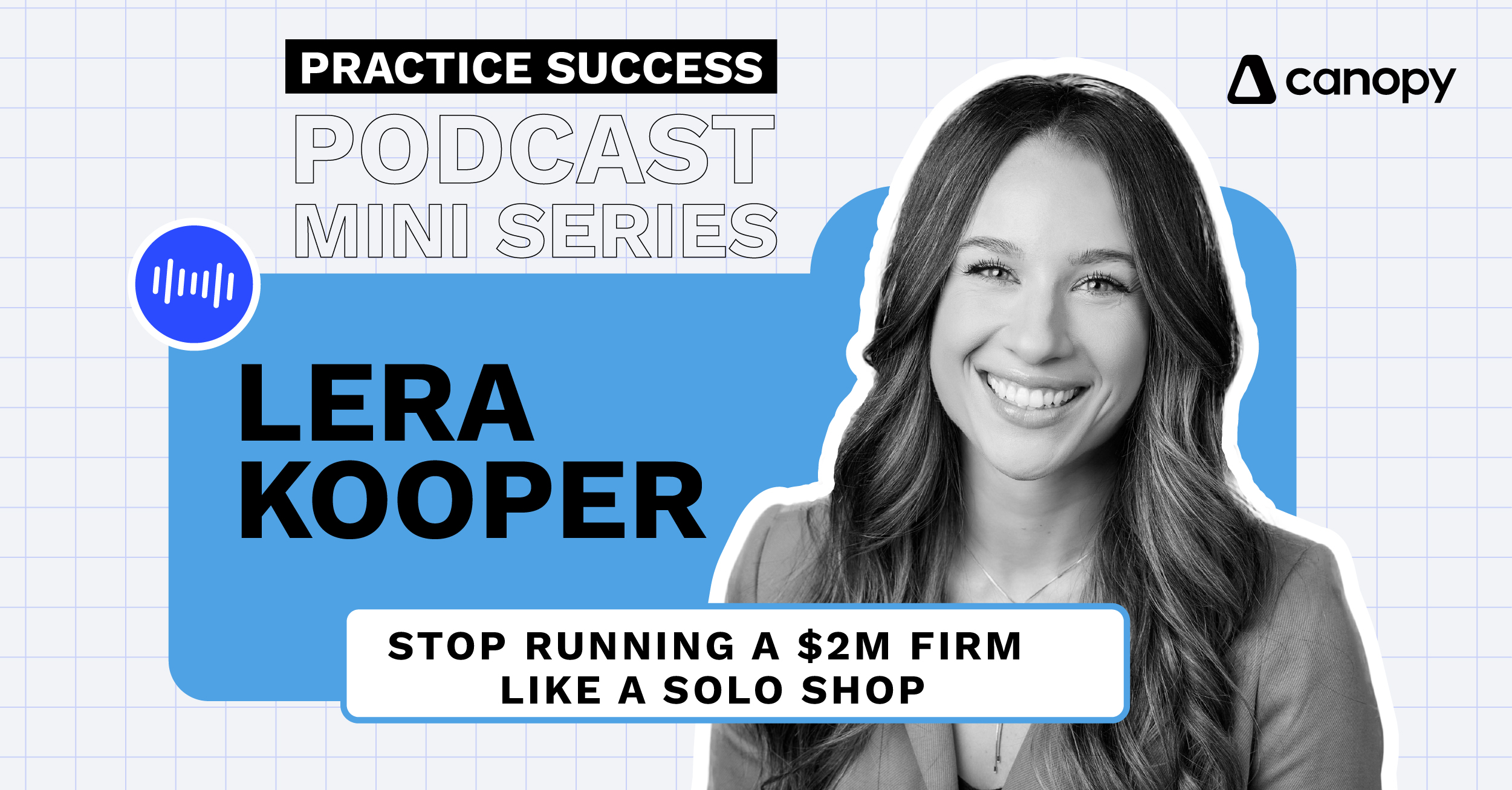



Stop Running a $2M Firm Like a Solo Shop
Luke Frye (00:01) Hey everyone, it’s Luke Frye, CPA and Accountant in Residence here, and your host of Canopy’s Practice Success podcast. We’re on episode four of our five-part series with Lera.
Lera, welcome back. We just got back from lunch, so we’re re-upping on our liquids here, and I’m excited to dig deeper into what sustainable scaling looks like.
Before we do, can you remind everyone who you are and why you’re talking with us?
Lera Kooper Yes. I’m Lera Kooper, COO and owner of Proactive Advisory Group. We’re growing and scaling quite aggressively, so I think that’s why Canopy is interested in this conversation.
Luke Frye Awesome. I’m excited to dig deeper into scaling with you, since you’ve been pretty aggressive with your growth. Now that we’ve had a chance to learn more about each other, I know you have a really big BHAG, and I’m excited that you’re working with us on accomplishing it.
One thing that’s really clear, having been in several different firms myself, is that scaling is really easy to do badly. You’ve lived through some versions that don’t work, whether that’s a firm you acquired or firms you’ve been on the inside of building. So I’m excited to learn more about the drag that puts on a firm’s culture, capacity, and quality.
We’ll do what we did before: a series of questions, then some predictions. Feel free to add anything as you see fit. Are you ready?
Lera Kooper Yes. Maybe.
Luke Frye All right. We talked about sustainability in one of the last episodes, but how do you define sustainable growth? What does it look like in practice inside your firm?
Lera Kooper Going into this project, it was always important to me that we could serve clients without underserving other clients or burning out the team or the owners.
The owners, I think, is just an occupational hazard if you have big goals. But if you have a clear purpose, the burnout doesn’t really feel like burnout. It just feels like hard work.
Repeat the question, because I started going this way and forgot where I was supposed to end up.
Luke Frye (02:24) We’re talking about sustainability and scaling. You have pretty ambitious growth plans, so how do you scale sustainably? You mentioned avoiding burnout and making sure clients are served. What are some ways you help your firm avoid burnout or make sure clients are taken care of?
Lera Kooper That’s where I was going with my original thought. The goal has always been to have a consistent experience, both on the client side and the team side.
Consistency means everyone defines everything the same way. That’s where standard operating procedures come in: defining good and training good, so everyone is speaking the same language internally about what a good result looks like.
Scaling well is never done. Any system we put in place is out of date in 18 months, so you’re constantly trying to keep up with the next need or the next constraint of the business.
But I think if we’re transparent about the constraints we’re going to focus on, and clear about what good looks like and where the attention should go, then we can scale sustainably, because our resources as a team are going to the right areas.
Luke Frye You mentioned things changing every 18 months. You have new firms, new clients, and new technology all at the same time. That’s a lot to juggle.
Lera Kooper Yes, very much so. Our goal is always the same: aggressive growth, but a consistent experience.
A consistent experience at scale means my team members have to deliver the experience that I did two years ago, or that a different owner did when it was a smaller firm. So we use tools like technology to create capacity, so we can train more and develop professional judgment in the context of our environment.
A lot of these things are new, but they also support each other, or give you the ability to accomplish the other thing.
Luke Frye Awesome. Next question: at what point did growth start feeling manageable rather than chaotic, and what changed?
Lera Kooper (04:46) In an earlier episode, we talked about how with growth, you’re always setting yourself up to be bad at the next thing, because a new level of growth requires new skills. So you get comfortable being uncomfortable.
I think “manageable” is a very relative term. As long as our team and clients have communication and transparency, and we do what we said we were going to do when we said we’d do it, and we’re hitting those metrics, it’s manageable.
It may feel chaotic because you’re going through a lot of change, but the output is manageable.
Luke Frye So part of that is tracking what needs to be done and having visibility into it. When things are changing, it’s easy to feel chaotic, but then you can look back at your numbers and say, “Actually, we’re making a lot of progress here.”
Lera Kooper Yeah, absolutely. Even for myself, anytime something new is required of me, it feels very overwhelming. Then I sleep on it. I think through it. I might write it out on some big sticky notes. I have them in my office.
The more you distill and oversimplify what actually needs to be done, the more you realize, “This is really manageable.” Usually what that oversimplification looks like is a KPI.
We have to close this much in new revenue. What do I need to do? I probably need to take 20 calls a week. That’s manageable. That I can track. That I can check off.
So it’s distilling these BHAGs into: what three things do I need to do a thousand times in the next few months? That makes it manageable.
Same thing for the team. As we provide clarity on the priorities and habits required to accomplish the goal, focusing on the habits more than the outcome is what makes it more manageable.
Luke Frye (06:54) That’s great. I think that ties in really well with the next question: how do you maintain quality and culture when you’re growing so fast?
Lera Kooper When you have a culture of people who genuinely care about their clients, care about each other, and care about the goal you’re looking to achieve, it’s a very positive environment.
I think it’s like an NPS score. You have promoters and detractors. The culture of an aggressively growing firm isn’t for everyone, and that’s okay. My goals aren’t someone else’s goals. It doesn’t mean one is right or wrong. It’s just the wrong seat.
So having the right people in the right seats, plus clear leadership, tends to create a better culture, because everyone knows why they’re there and what success looks like. That means clearly defining expectations and communicating what sort of rodeo someone is getting in on by joining up.
Luke Frye (07:58) What’s the growth mistake you see other firm owners make most often?
Lera Kooper (08:06) I don’t know so much about other owners. I know that I’m easily distracted. Every shiny object, every new idea, I want to pursue it. That leads to not being consistent in anything, and you end up failing at five things instead of succeeding at one.
That’s been a big mental struggle of mine: do the boring thing, focus in, hit the critical points, and be okay with saying no to interesting things.
I think that’s a trap that catches a lot of people. You start something, it’s exciting, you make a little progress, and then it gets hard. Then you get distracted by a new initiative or marketing idea, and you don’t make much progress on anything, even though you’re so busy.
I can’t speak for everyone, but it’s a trap I’ve fallen into.
Luke Frye Being able to focus on the most important priority, even when it’s boring or doesn’t seem to be producing results right away.
Lera Kooper Right. Like I said, it’s exciting at first, like a new marketing campaign or social media. Then you’re not getting the results you expected, and you have to decide: is this a long game, or is this truly not the best channel or use of my time?
Luke Frye Taking into account your experience acquiring other firms and folding them in, another way to look at that question: what are the first areas you look to optimize? What’s the low-hanging fruit in a firm that’s coming under your umbrella?
Lera Kooper (10:12) In that context, a lot of mistakes come from not updating systems with the growth you’ve experienced.
When you’re a solo or small firm, you may not need to be departmentalized. Your tax reviewer is also cleaning up the books. Then you start thinking, “If we had someone in accounting making sure the books were good before they even got to tax…” and now you start to see departmentalization. Obviously you need certain revenue thresholds to pay for that payroll.
But not shedding old habits through growth is a common trap. Billing after the fact. Not being departmentalized. Not having documented procedures is a big one, because then owners feel like, “I told them how to do this, and they didn’t do it.” In reality, you have to train someone for a long time before they get to even 80% of how you do something.
It’s like marketing needing seven touches, and I think that’s more now because people are inundated with more and more messaging.
People can get burnt out and stressed by their business if they’re using solo-owner tactics on a $2 million firm. You need to be more process-driven.
Luke Frye What got you here won’t get you there.
Lera Kooper Exactly. Thank you for summing it up.
Luke Frye For sure. Okay, last question before we dive into predictions. If you could only focus on one thing to position your firm for growth in the next two years, what would it be?
Lera Kooper Retention and client optimization.
Retention comes down to client experience. Deliverables, of course: providing value and being on time. But also, what was their experience throughout that process? I’ve talked about how a lot of clients work with CPAs to get a sense of financial security, to have someone who is thinking of them.
Lera Kooper (12:19) So client experience and retention all fall together. Then optimization is upselling your client base. Those are the two biggest focus areas for me right now. As soon as I’ve defined good, I can delegate some of that work to a growing team.
Luke Frye Okay, I lied, one more question. What would you say to an accountant listening who has a decent-size practice but doesn’t feel comfortable doing sales? You’re talking about optimization through upselling, and they may not feel comfortable selling at all.
Lera Kooper I think sales gets a bad rap. Yes, it’s a sale. You’re exchanging money for services or advice. But anytime you recommend anything to anyone, you’re technically doing sales.
“You’ll love this gym. It has the best equipment, it’s well laid out, and it’s never busy.” That’s sales. “You have to try this brunch spot. It’s so good, and the aesthetic is awesome.” That’s sales.
A good salesperson never looks like they’re selling, because they’re offering a product or service that provides that person value.
If you had a tax-only client who was always surprised by their tax bill, wouldn’t you naturally say, “We should probably meet in November, before the year ends, so you know it’s coming”? And if you can’t get a good gauge on their tax situation in November because their books are a mess, you’re going to say, “I should probably be reviewing your books quarterly.”
None of this is about taking more money from a client than the value you’re providing in return.
Luke Frye Right. It becomes more about helping people rather than treating them like a vending machine or an ATM. You’re really understanding their needs.
Lera Kooper Yeah. And you’re matching them with the outcomes you can help provide.
Luke Frye (14:40) All right, time for predictions.
Lera Kooper I might actually add one thing. It would be a disservice not to sell your clients what they need. If you’re nervous about it, remember that. If you’re not selling it, chances are they’ll find someone on Instagram doing the same thing you do.
Luke Frye Right. And then they come back and say, “They do tax planning.” And you’re thinking, “I’ve done tax planning this whole time. I just never told you.”
I like to use the analogy of a doctor. You go into the doctor’s office because you’re sick or something hurts. If the doctor has the remedy, it’s their responsibility to at least tell you: stop smoking, get more exercise, whatever you need. In this case, it’s reviewing the books or getting a better idea of what their estimates are.
And if you sell them something that doesn’t bring them value, it hurts your retention. So the two go hand in hand.
Lera Kooper I love that.
Luke Frye All right, on to predictions. If a firm owner is listening right now and hasn’t seriously invested in cloud or AI yet, what’s your honest prediction for where they’ll be in three years? Let’s think about it through the sustainability and scaling framework we’ve discussed in this episode.
Lera Kooper If they’re not using technology, I think they’ll say yes to an acquisition offer in three years.
It’s an uphill climb to bring in the same revenue without working more, so you’re more likely to get burnt out. You’re going to have a hard time attracting talent.
Again, there’s a place for everyone, and there’s a segment of businesses that will do just fine. But in broad strokes, I’m guessing they’ll be burnt out and have a hard time getting help. Then they’re more likely to say yes to an acquisition offer at a multiple that could have been much higher if they’d done some of those things in advance.
That’s exactly what we do with our business clients. If we know they want to sell in the next three to five years, we say, “Let’s start budgeting and cash flow planning, if you aren’t already. Let’s understand your drivers, assumptions, and KPIs, and focus on the levers that will increase the value of your business.”
Lera Kooper (17:01) So for a CPA firm, if they’re comfortable with technology, they’re on the cloud, and they have an actual structure to their billing, those are all things I’d look at and say, “Sweet, that’s work I don’t have to do,” at least not to the same extent.
Luke Frye We alluded to this previously, but I love how this question puts scaling a sustainable practice in a future-looking frame.
The billable hour has been dying a slow death for years. Does AI finally kill it? And if so, what replaces it?
Lera Kooper Billing by the hour is definitely becoming less common, or it should be, because you shouldn’t get penalized for getting better or more efficient at your job.
I do think tracking hours is still helpful for utilization. We talked about this in an earlier episode. So those are almost two separate conversations. We should keep tracking time, but we shouldn’t bill based on it, because then you’re penalized for doing your job better or faster.
Luke Frye Right. What does a truly modern accounting firm look like as a business? Not just in terms of tools, but how it’s structured, priced, and run, as it relates to sustainable scaling?
Lera Kooper Generally, I think it’s about being open to change. There are a lot of areas where I feel very behind, and AI is one of them. We’re open to exploring it and getting into it, but it’s changing faster than I’m able to keep up with, and I feel like we’re doing pretty well.
So the modern firm will be one that keeps putting its resources into whatever lets it do the job better and faster and provide value to the client.
Luke Frye I like that. Okay, we’re thinking 10 years out now. What’s your boldest prediction for the accounting profession in the next decade? The one that would make most people watching uncomfortable?
Lera Kooper (19:20) First question: can any prediction about the accounting industry be bold? It’s pretty consistent.
But I will say, with technology, a lot of the work we’re used to today will be nonexistent. The majority of the work will be client-facing relationships and advisory.
With technology moving at this pace, there will be a lot more automated DIY options. Those who are price shopping will DIY it and use technology. That means the people still looking to work with a professional team will expect the human element. That’s where we have to be prepared for our resources to go.
And we can only have resources to put there if we’ve used technology enough.
Luke Frye Well, that wraps episode four of our five-part series with Lera here on Canopy’s Practice Success podcast. I’m Luke Frye, and we’ll talk to you again soon.
Hosts & Guests

Lerra Kopper
Guest
About the Podcast
Share
Authors
By: Lera Kooper
Lera is the Chief Operating Officer and Co-Owner of Proactive Advisory Group, an award-winning firm intent on helping others get more out of their business. As a nationally recognized entrepreneur and innovator, her mission is to be a thought leader in the modernization of firms. She employs a combination of systems, processes, technologies, and philosophies to best prepare her firm, as well as others across the industry, to deliver personalized, forward-looking client care at scale. By championing best practices in client onboarding, communication, scope management, and strategic planning, she empowers tax, CAS, and advisory teams to help owners get more out of their business.
Read more by LeraDiscover more like this