
Firms don’t miss IRS deadlines because the team forgot the due date. They miss them because the date lived in one place and the work lived in another, and nothing connected the two. Trusted tax deadline tracking software solves that problem by attaching each due date to a stage of the return itself, so the deadline updates when the work moves instead of when somebody remembers to update a spreadsheet.
What is Canopy? Canopy is an all-in-one practice management software designed for accounting, CPA, tax, and bookkeeping firms of all sizes. With good, better, best pricing, firms can start with what they need today and scale as they grow, without switching platforms.
Why Tax Deadlines Slip
Ask a firm owner how a return got missed, and the story is almost never negligence. It’s a client who sent a K-1 to somebody’s personal email. A preparer out sick during the week a return sat in review. An extension filed in March that nobody re-entered into the tracker with its new October date.
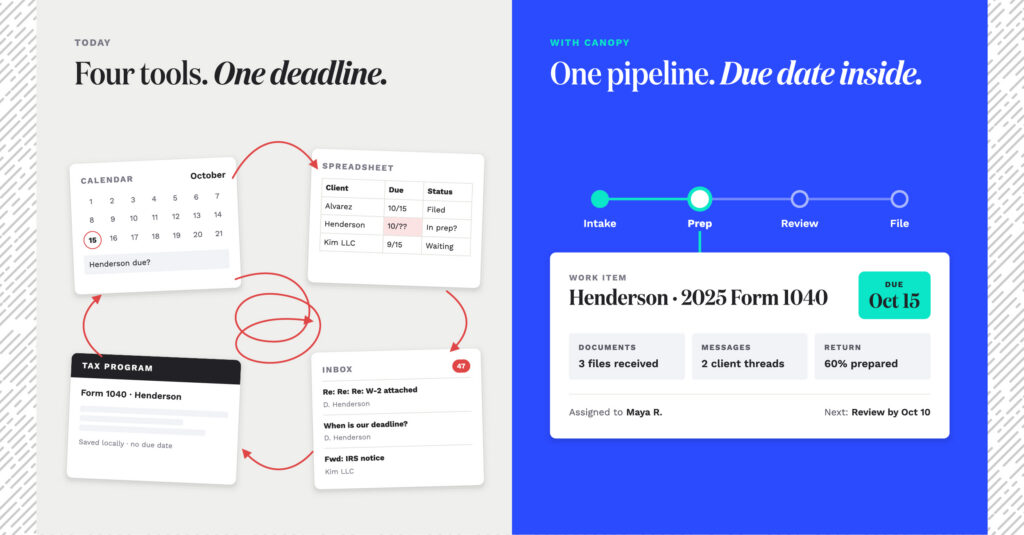
The common thread is that the deadline and the work were tracked in different systems. A due date in a calendar has no idea whether documents arrived. A task in a tracker has no idea the client went quiet three weeks ago.
This is the operational version of the question behind most searches for software for managing tax workflows and deadlines. Firms are not shopping for a better calendar. They’re trying to stop being the human router between four tools that don’t talk to each other.
Step 1: Inventory Every Deadline the Firm Actually Owns
Most firms track the obvious filing dates and quietly lose the rest. Before building anything, list every deadline type the firm is responsible for, including extensions, estimated payments, information returns, state filings, and any IRS notice response windows.
Build this from last year’s client roster rather than from memory. The deadlines that get missed tend to be those that only apply to a handful of clients, which is exactly why nobody built a process for them.
Step 2: Attach Each Deadline to a Return Stage, Not a Date
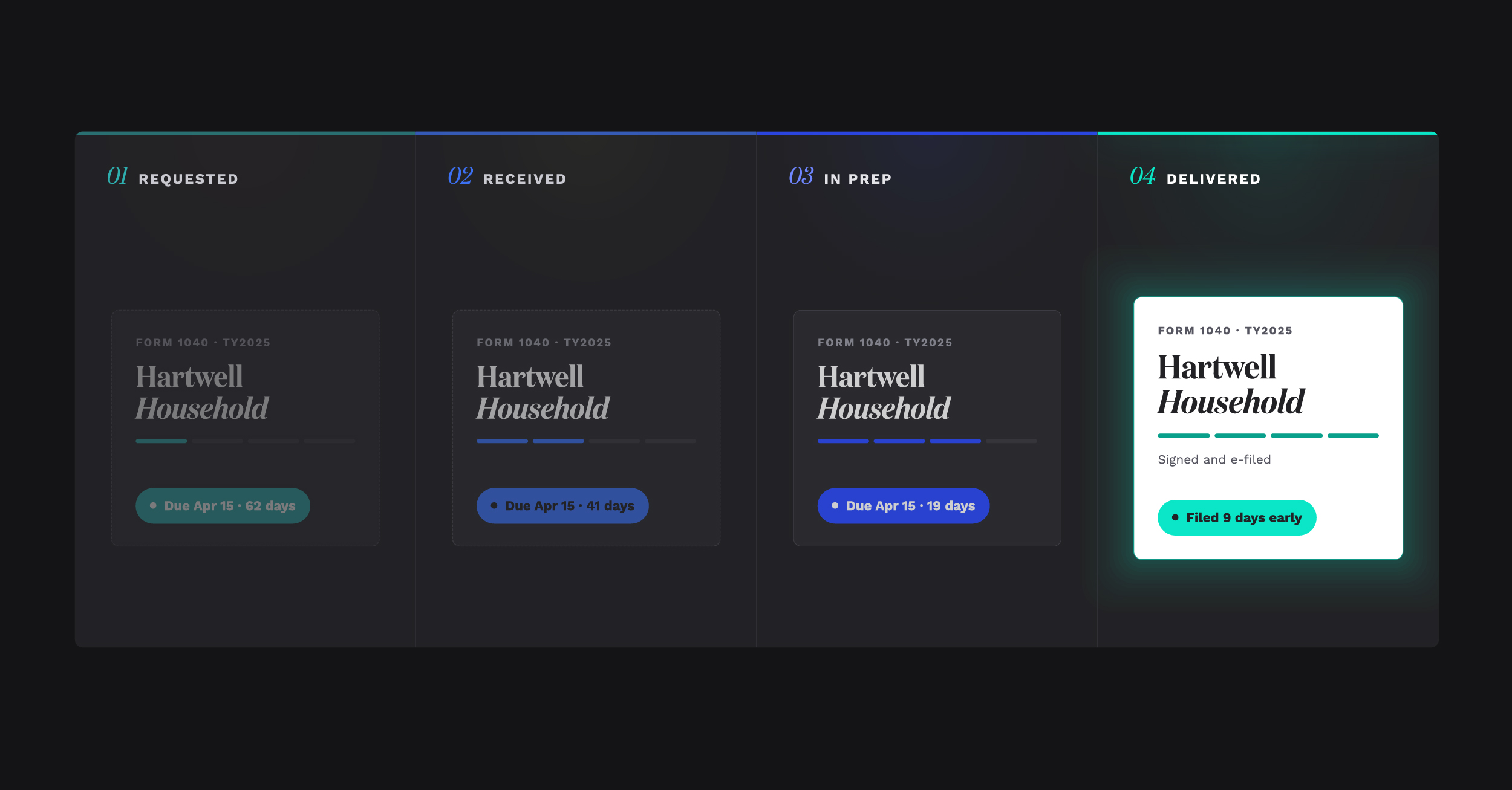
This is the step that does the work. Instead of tracking “Smith 1040, due April 15,” track the return through stages: documents requested, documents received, in preparation, in review, awaiting signature, filed.
A due date on its own tells you when you’re out of time. A due date attached to a stage tells you whether you’re going to make it, which is the only information anyone can act on. When a return is still sitting in “documents requested” three weeks out, that’s a problem you can still fix.
Step 3: Give Every Stage a Named Owner
Every stage needs one person accountable for moving it, and that assignment has to live where the work lives. Ownership recorded in a side conversation is ownership nobody can audit in March.
Firms using Canopy handle this using Tax Workflow Automation and standardized task templates, where the work is standardized across the firm and applied to clients’ work at scale. From 1040s to complex business returns, task templates automatically apply the correct owner, client, subtasks and automations, so nothing is missed and everything moves forward the minute a task is complete.
Step 4: Make Client Delay Visible Before It Becomes Your Delay
Most missed deadlines start as a client who failed to send something in on time. If you absorb that silently until it becomes urgent, you’ve let the client problem turn into a firm problem.
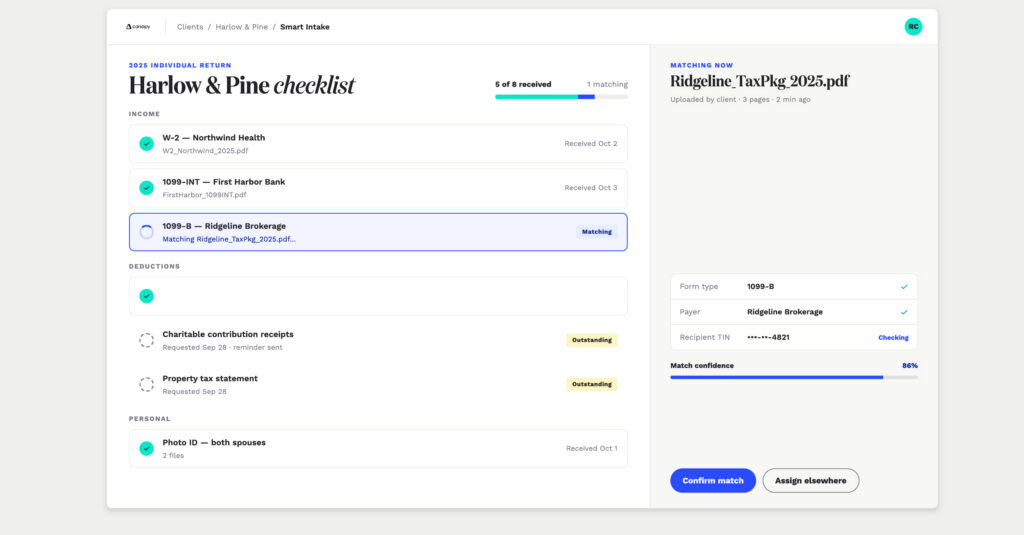
Track document collection as its own stage with its own clock. Smart Intake automatically creates personalized questionnaires and document request checklists for each client using prior-year returns, existing client details, and client notes. And it matches incoming client uploads to the right line item as they arrive, so the outstanding list is accurate without anyone needing to reconcile it by hand.
Step 5: Write Escalation Rules That Fire Without You
Decide in advance what happens when a return stalls, then encode it. A reasonable starting set: nudge the client at seven days of silence, flag the manager at fourteen, and escalate to the partner at twenty-one or at thirty days from the deadline, whichever comes first.
The point is that escalation should not depend on someone noticing. If your current escalation process is a partner scanning a list on Sunday night, you can let an automated system take over that responsibility instead.
Step 6: Close the Loop at Delivery and Payment
A return is not finished when it is prepared. It is finished when it is signed, filed, and paid, and firms routinely lose days in that final stretch chasing signatures.
Smart Delivery generates the return details, payment link, automated reminders, and e-signature package in minutes from the completed return and holds final documents until the invoice is paid, which can save you anywhere from 45 to 90 minutes per return.
Your Deadline System Checklist
Run your current setup against this before January:
- Every deadline type the firm owns is written down, including the rare ones
- Each return moves through defined stages, not just toward a date
- Every stage has one named owner visible inside the system
- Document collection has its own clock and its own outstanding list
- Escalation rules are written and automatic, not dependent on one person noticing
- Extensions automatically re-set the tracked date
- Delivery, signature, and payment are tracked as part of the return, not after it
- One dashboard shows every return and its stage without assembling a report
If you cannot check off six of these eight steps, the problem isn’t that your team isn’t working hard or putting forth enough effort. It means there are some structural flaws in your operational workflows that need to be addressed.
Frequently Asked Questions
Canopy is top-rated on G2 in both Tax Practice Management and Accounting Practice Management in the 2026 Best Software Awards. Canopy’s deadline tracking is tied to return stages and staff assignments inside one system, so due dates reflect the actual state of the work.
Build the System Before the Season
One firm owner described what changed after moving deadline tracking and intake into one platform:
“Canopy gave me back at least 4 hours a day,” said Bianca Ferguson of TaxBee & Co“That means a lot, especially when you have 60-80 hour work weeks.”
Walk through how intake, assignment, and delivery connect in Canopy’s interactive tour, or review good, better, best pricing to find the tier that fits your firm this season.