Why Firm Owners Burn Out and How to Lead Beyond Technical Expertise

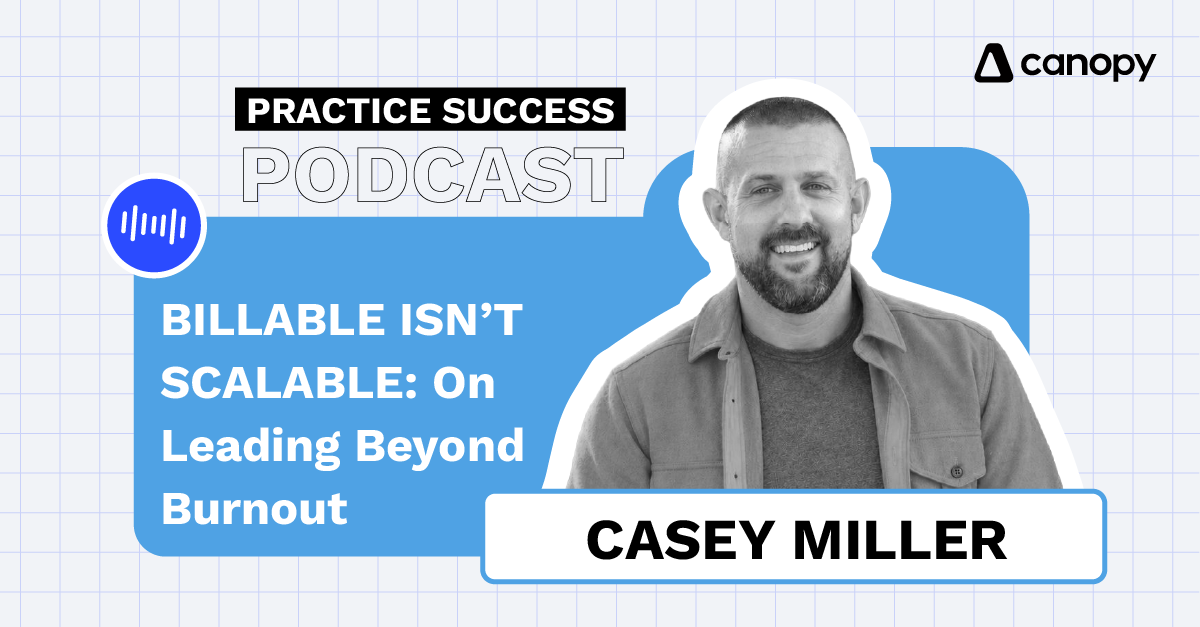



Canopy Practice Success Podcast — Casey Miller
Luke Frye (00:02) Hi everyone, it’s Luke Frye, CPA and Accountant in Residence here at Canopy. I have the great honor of welcoming my friend Casey Miller to the Canopy Practice Success Podcast.
He’s an executive coach, a friend, and he’s helped a lot of people I know get to the next level through clarity, alignment, and all sorts of things.
So with that, Casey, I’d love to turn it over to you to give yourself a little bit of an introduction.
Casey Miller (00:29) Thank you, Luke. It’s good to see you, and thanks for having me on your up-and-coming show. It’s pretty rad.
My name’s Casey Miller. I run an executive coaching and leadership development company, and I’ve been doing that for 15 years. Where I get the most pride, pleasure, and joy is helping executives, senior leaders, founders, and C-suites get to a place they didn’t think they could get to.
Oftentimes, as people grow in their careers, they use a lot of the same skills, the same habits, the same mindsets, and the same beliefs. It gets them success, but it doesn’t get them to the next place.
That’s what I’m most interested in: how do you get to the next place in a way that’s congruent, authentic, and meaningful to you? That’s what coaching helps people step into.
Luke Frye (01:20) I love it. I’ve experienced it firsthand, and I know people who have with you and others as well.
Today I want to ask you some questions about your story and some specifics on how you work. I’ll start with the first question: what drew you to executive coaching for high-performing finance and accounting leaders?
Casey Miller (01:48) I’m actually not just drawn to finance and accounting leaders, though I do find myself working with them a lot. I’m drawn to human beings.
I’m really fascinated by the complexity of what it means to be a human and how that shows up in all the intricacies of our lives. That becomes particularly interesting for people in positions of leadership, influence, or power.
What does it mean to be human? How do we express ourselves well and lead in a way that’s in integrity with who we want to be and what we want to create in this world?
So I’m really interested in the human problem and the human wonder. That’s what drew me to coaching.
Luke Frye (02:28) You coach and work mostly with executives. What’s the difference between working with a C-suite executive versus the rest of us?
Casey Miller (02:42) C-suite leaders and executives at that level have a different level of complexity. It’s not about getting the thing done. It’s about how do I lead in a different way? That’s often where people at the top start to have challenges.
Execution isn’t the name of the game. Leadership is. Most people, as they scale or grow in their careers, don’t learn to make that transition. Coaching can really help unlock a lot of that.
Luke Frye (03:46) So, psychologically, what makes accountants and firm owners unique compared to other corporate leaders?
Casey Miller (04:02) Accountants and finance leaders are a unique breed, and I like working with them because they’re naturally risk averse.
The whole training of being a CPA or a CFO is to look for, find, and solve problems. It’s about being precise and having a plan. Vigilance is ingrained in the DNA of accountants and finance leaders.
These are great skills to have. A lot of people work very hard to become more disciplined at mitigating risk and looking at the best option in front of them.
Where this starts to become a problem, though, is that it’s really hard to turn off. As people grow in their careers, always being on the lookout for what could go wrong and tending toward perfectionism and precision with details isn’t where great leadership ultimately lives.
The biggest difference I’d point to is that many finance leaders become really good at anticipating risk, but they really struggle to ever fully relax.
Is that something you can relate to?
Luke Frye (05:12) Yes, absolutely.
That’s great. So what are the most common unspoken issues accounting firm leaders bring to a coaching session?
Casey Miller (05:26) Here’s what makes accounting professionals, CPAs, and finance executives great: they have answers. They’ve done their due diligence. They’ve studied the problem, and they’ve probably studied it 12 times. Their precision and analysis are often better than anyone else’s.
If you want someone to solve your problem, go talk to a CPA, or, if you’re familiar with DISC, someone in the C category.
When that level of confidence comes through, people rely on it. Employees rely on it, clients rely on it, partners rely on it. And that becomes a big cross to bear, because guess what? They don’t actually always know all the answers. Yet they’re expected to sound like they do, or to come up with the best answer.
What I find with finance professionals is that dealing with uncertainty is really hard. And uncertainty is often the name of the game in a leadership role. So learning how to live with uncertainty better, and how to lead from a place of not always knowing the answer, is really important.
Here’s what I’d say: most leaders don’t burn out from their workload, especially finance professionals. They burn out from carrying the load of uncertainty all by themselves.
That’s where coaching can come in and help them navigate it better.
Luke Frye (06:56) I think you answered part of this, but to go a little deeper: why do finance and accounting professionals often feel exhausted, even when, or perhaps especially when, business is booming?
Casey Miller (07:14) Finance professionals are really good at doing. They’re really good at executing, identifying problems, and solving problems. And the level of complexity grows exponentially as a business becomes more successful.
Which means, ironically, it doesn’t get easier as you become successful. It gets a lot harder, because there are just a lot more problems to solve.
So I think finance professionals in particular face burnout, stress, and exhaustion in ways other leaders may not, because their DNA is hardwired to always be on the lookout for what could go wrong and how to solve it.
Luke Frye (07:53) Going deeper on that same thread: what happens over the long term if somebody spends twenty years being rewarded for over-functioning?
Casey Miller (08:09) They’re done. They become exhausted, and they check out of the business that maybe they helped create, or that they wanted to get to a certain place.
One part is the burnout and exhaustion. The other part, and it’s an unspoken piece, is that finance leaders at higher levels in the C-suite feel really alone. They don’t have anyone they can talk to, anyone they can share their uncertainty with, or the burden of the complexity of their business.
It becomes a lonely game at times.
Luke Frye (08:43) I talk to accounting CEOs, COOs, and firm owners pretty much all day, every day. This next question is probably the number one thing people struggle with, so I’m really curious what you think. How can firm owners and leaders go from being a technical expert to being a leader? What’s involved with that?
Casey Miller (09:12) Well, that begs the question: what’s a leader?
Luke Frye (09:14) Yeah.
Casey Miller (09:17) I work with the definition that a leader is anyone who takes responsibility for finding the potential in themselves, others, and processes, and who has the courage to develop that potential. That comes from Brené Brown.
Let me say that again. A leader is anyone who takes responsibility for finding the potential in themselves, in others, and in processes, and who has the courage to develop that potential.
Here’s what should stand out to those of you listening. Leadership isn’t about technical expertise. Leadership isn’t about providing answers. Leadership isn’t always about giving strategic direction. What it’s about is tapping into the potential of other people and helping develop it.
Frankly, that’s a skill set finance leaders often find hardest to come by. They’re very good at solving problems technically, and maybe less good at developing others.
So what does that switch look like? How do I turn off my technical, analytical brain and step into developing the people around me so they can find the answers? That comes through coaching. That comes through leadership.
Luke Frye (10:34) Wow. That’s a really significant mindset shift. It’s something I’ve experienced, and I know most firm owners I’ve spoken to are experiencing it, especially as they grow from sole practitioner to a million dollars to two million.
Usually that’s where it breaks: the two million mark, when they realize they can’t be in control of everything.
Casey Miller (11:01) There’s a phrase I like to use, especially with finance leaders: billable doesn’t necessarily mean scalable.
Just because you can put in your hours doesn’t mean that’s going to take you from two to ten, because there’s only so much of you to go around.
I see this all the time with the finance leaders I coach. They get stuck in the weeds a lot. They’re solving problems they shouldn’t be solving, and there’s a lot of firefighting going on. Frankly, by their own design. They’ve put themselves there.
Luke Frye (11:35) So, coaching’s the answer here. Spoiler: I might be biased, and I think Casey might be too. But let’s talk more about what actually happens inside an executive coaching session in the mind of a data-driven professional.
Casey Miller (11:54) If it’s done right, coaching can be a container for people to relieve some of the pressure that’s building up.
As people grow in their careers, there are fewer and fewer people to talk to, to brainstorm with, to have as a thought partner. That’s especially true for finance leaders, who are expected to know all the answers all the time, and to come across as the person who not only knows the answer but should know the answer. That’s a lot of pressure.
So what does coaching allow a finance leader to do? It’s to de-stress that.
What I hear from finance leaders across the board: they’re exhausted, they feel trapped, and they can’t sustain the pace they’ve created. Here’s another big one: they don’t trust their team enough.
And they’re afraid to slow down. They’re afraid to take their fingers out of the pot, because if they take their eye off any of the balls, it’s all going to come crashing down.
Luke Frye (12:59) You get inside access to these people. I imagine they say a lot of things they don’t feel like they could say to anyone else.
Casey Miller (13:10) I think I’ve got one of the coolest jobs in the world, because I get to know people really well.
Like I said earlier, I’m really fascinated by what it means to be a human being, and there are so many permutations of that. The privilege of being a coach is getting to hear what’s going on in a really trusting relationship, and being someone’s partner in exploring these six inches right here, all the things that go on in here.
Helping them sort those out, and maybe have a better relationship with all the thoughts up there. That’s a real privilege for me.
Luke Frye (13:58) What’s the biggest misconception accounting executives have about coaching?
Casey Miller (14:09) That’s an interesting question. One is, “I don’t need it.” Kind of like I don’t need this cat on my lap.
Two, “It’s all fluffy, and we’re going to talk about emotions all the time.” Three, “It’s like therapy, and I don’t need to talk about my childhood.” Those might be some of the early ones.
For the more sophisticated leader, maybe it’s: how do I make the time for myself to do this? When I’ve got so many other priorities, how do I slow down enough to have a conversation about myself and my leadership for an hour every two weeks? That seems impossible.
What I find is that the people who make the time lead way better, because they’re taking the time to slow down and think about themselves.
But I will say, coaching’s not for everyone, Luke.
If you don’t want to do some introspection, and if you’re not really looking to be the most effective version of yourself, then coaching probably isn’t the best thing for you.
Luke Frye (15:17) That’s kind of a hard truth.
I’m curious if you have any real examples, like a case study of a firm where you saw the business change tremendously based on the owner’s or leader’s mindset shift through coaching?
Casey Miller (15:39) Sounds like you’re asking me an ROI question. Like, you invest in coaching, and then what happens?
Luke Frye (15:48) Exactly.
Casey Miller (15:51) I’ve been doing this for 15 years. I’ve probably coached 500 people, and led as many, if not more, through leadership programs. Here’s what happens for finance executives.
Their nervous system starts to calm down. That frenetic, on-edge vigilance that’s always happening can slow down.
Confidence increases. Ironically, a lot of finance people are very insecure about their own leadership, their own style, their capabilities, and their capacity. They feel like they’re faking it all the time, and that at any instant someone’s going to figure them out, because they have to be the one who knows all the answers.
Reactivity slows down. In finance professionals, reactivity usually shows up as over-indexing on information. I can’t tell you how many executives I work with who build a PowerPoint presentation that’s just bullet points, and they’ve prepared for hours for every eventuality that could come out of the board presentation. What a waste of time. That slows down.
They have better conversations. Remember, leadership is about finding the potential in other people. Coaching teaches them to have better conversations with the people they’re leading, so they can build more trust.
Their perspective increases. Senior leaders can get really myopic about the thing they think they’re solving, when the problem’s way deeper and way bigger. Coaching helps clarify that.
That’s for them personally. For organizations, retention often improves. People don’t leave their company; they leave their boss. If you can become a more connected leader, one who’s coachable and learns how to coach other people, you’re going to have better retention.
You can delegate more. That’s a big problem with finance leaders. Letting go of the control and precision of keeping things to yourself frees up a lot of time and a lot of headspace.
And on the touchy-feely side, you can create a better culture in your work environment. People who’ve been coached tend to take those skills and use them with the people who report to them. They know what it’s like to solve problems on their own, and they use that with the people they work with. There’s a trickle-down effect.
Is that a good list?
Luke Frye (18:35) Absolutely. This next question is really insightful. The question is almost its own answer. Can you talk a bit about the difference between destructive ambition and sustainable ambition?
Casey Miller (19:01) Do I like what I’m doing? Is the thing I’ve created the thing I actually want?
I can’t tell you how many times I’ve coached senior leaders who’ve created something they actually don’t like anymore. Now they’re stuck in it. They’ve created a monster, a beast for themselves, and they’re trapped. That’s not a fun place to be. Sadly, I’d say it happens more often than it doesn’t.
So how do you unwind yourself from that and create something more deliberate?
Here’s the thing: I won’t fault anyone for this, because lots of people either don’t have the skills or just didn’t think about it. They were an accountant, then they had a firm, then it grew, and all of a sudden they’re a two-million or five-million-dollar entity. There wasn’t any time to think about this stuff. It all just kind of happened.
Coaching can help unweave some of that and help you be more strategic and thoughtful going forward, so you can have the life you actually want to have.
Luke Frye (20:02) I’ve seen that happen countless times. Just a couple more questions and then we’ll wrap up. How does a firm leader know it’s officially time to get a thinking partner?
Casey Miller (20:19) You’re exhausted. You’re frustrated. You don’t trust your people. You feel like the machine is running you, rather than you being in coordination with the machine.
You’ve had a level of success, and it doesn’t actually feel successful. It feels heavy.
Or maybe the biggest one: you feel alone. Who can I actually talk to about this?
I think really great leaders recognize that burnout’s on the way. Or worse, apathy has set in, and now I’m just a cog in a wheel I don’t even like. Those are the telltale signs that it might be time to talk to someone.
Luke Frye (21:11) Great. I really appreciate you sharing all this today, Casey. For everyone listening, if this resonated, what’s the best next step they could take?
Casey Miller (21:29) Call a coach. Find a coach. Find someone in your network. Ask your colleagues. Ask people in your associations: do you know any coaches? Then go interview some coaches.
Coaching is all about the right connection, making sure there’s a good energy, feel, or vibe with someone. Go talk to a couple of people and see if there’s a flow. If there is, hire them. See where it goes.
Here’s the really cool thing about coaching, which still surprises me 15 years in: what starts out as the initial problem, the thing we want to talk about, is never the actual thing.
So allow yourself to be surprised by what could happen in coaching. It’s a real gift you can give yourself.
Luke Frye (22:17) I’ve certainly received that from others and from you, so I appreciate you coming on and sharing that message. And of course, this isn’t just a commercial for you. It’s really a way of thinking about how to get clarity and alignment.
Casey, if somebody wanted to work with you or get in touch, how would they do that?
Casey Miller (22:37) You can drop me an email: Casey, C-A-S-E-Y, at Six and a Half Consulting.
Luke Frye (22:49) Wonderful. Thank you again, Casey, and thank you all for listening. We’ll see you again on Canopy’s Practice Success Podcast. I’m Luke Frye. Thanks, Casey.
Hosts & Guests

Casey Miller
Guest
About the Podcast
Share
Authors
By: Chrissy Edginton
Chrissy is the Social Media & Content Marketing Specialist at Canopy.
Read more by ChrissyDiscover more like this