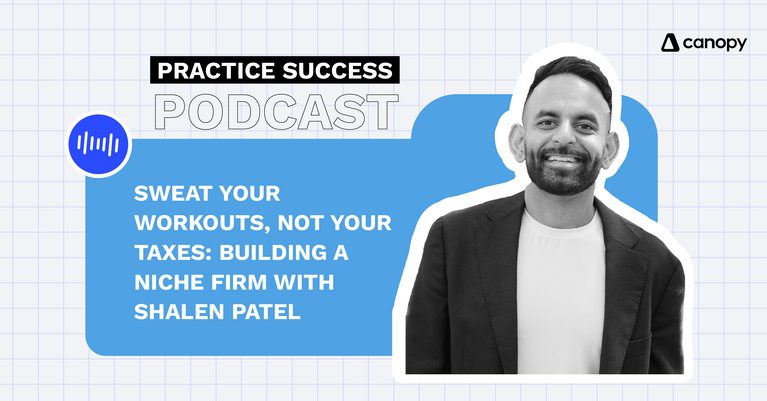
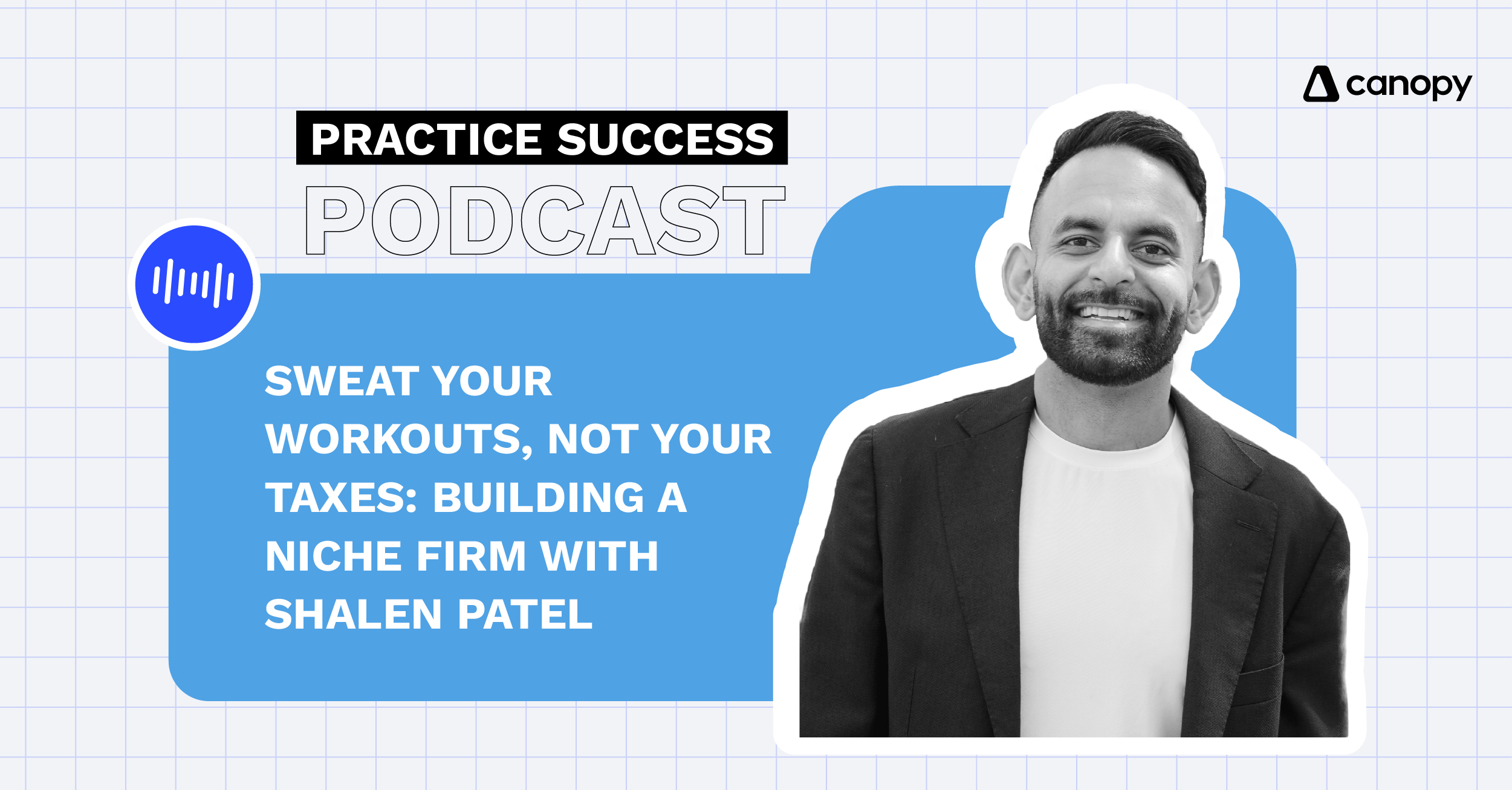
Sweat Your Workouts, Not Your Taxes: Building a Niche Firm with Shalen Patel




Luke Frye
Hi, everyone. This is Luke Frye, CPA and Accountant in Residence, your host of Canopy’s Practice Success podcast. Today, I have the distinct honor of having Shalen Patel join me.
Shalen, I’d love to hear a little bit more about you and your firm.
Shalen Patel
Thank you again, Luke, for that introduction. I’ve been a CPA since 2017, when I started my journey on the Big Four route. Along the way, I bounced around into financial reporting and somehow made my way into tax.
The funny thing is I started in audit, but I made my way all the way to tax because I saw that you’re generally helping people when you’re preparing tax returns. It’s a sensitive area, and not a lot of people have the right tools or people in place. I asked myself, “Where can I make the biggest difference for people on an individual basis?” And I chose tax.
I’ve been in the tax industry for around four to five years now. I first started off in crypto, believe it or not, because I saw a big need with all the people getting into Bitcoin and Ethereum. Eventually I lost interest in that, and I went into the health and wellness industry because I asked myself, “What can I do to never get fat again and also truly enjoy what I’m doing?”
So I created J&S, and now we’re a full-service accounting firm that caters to health and wellness entrepreneurs and product-facing founders in the CPG space.
Luke Frye
I love it. I see so many similarities in your career trajectory and mine that we haven’t gotten to talk about yet. I started a tax practice in 2016 and focused a lot on photographers, wedding photographers, and creators who have very particular needs. They want to write things off that we might otherwise not be comfortable writing off, but because those are ordinary and necessary expenses for them, we can see that and help them.
It also turned into something you’ve talked about before: when you choose a particular niche, you can tap into that referral network, or those people naturally refer their friends who happen to be in the same space.
Can you talk a little more about how being very specific about the type of client you work with has enabled you to drive more growth?
Shalen Patel
I love that. Believe it or not, we haven’t run $1 in ad spend, and we’ve hit some pretty big milestones in the firm. It’s all been referral based, and it’s because we’re making our name known in our niche.
It all started with me sending a random DM to a big health and wellness guy. I thought, “You know what? Let me just try.” Little did I know that by just trying, and thinking nothing of it, it would boost my firm onto a trajectory I never imagined. That one DM set off all the other referrals. “Hey, you need to meet my friend. I’m going to send you this person.” Ever since then, it’s been, “Whoa, this is great.”
In the beginning, we were taking all creators. “You’re a creator? Come on in.” Then we started getting bogged down with so many clients. It got to a point where we said, “Look, we say we’re a CPA firm for health and wellness entrepreneurs and product-facing founders. Are we doing that or not?”
When we did a whole audit of our client list, we weren’t. We needed to start being honest with ourselves. The more we say yes to the things we don’t want to do, the less we’re able to say yes to the things we do want to do. That’s a hard place to be, especially for a firm that’s just starting and really wants to be a success.
So we honed in. Now, when people want to refer someone to us, I ask, “Are they actually in the health and wellness industry? If they are, send them our way. If they’re not, my friend down the street is a great resource. He knows exactly what that person needs.”
It’s been great. And especially now, Luke, as I see AI starting to take over, a lot of people are going to say, “I can get all my bookkeeping done by AI,” or, “I can do all these things myself.” That’s fine. But people are still going to miss that honest referral from someone who’s actually experienced. They want that human personality. That’s what we’re able to offer by being primarily referral-based instead of spitting out ads on Meta all day.
Luke Frye
I think part of how that works is, like you said, you’re giving other people referrals. If somebody comes in who’s into Bitcoin, or is a creator you don’t serve, you have somewhere to send them. That instantly builds what I might call brand equity, or karmic energy, with those firm owners, who then send you referrals back.
Shalen Patel
Exactly. And for me, I just like being honest. Early on with J&S, I would overpromise and underdeliver. Someone would say, “I have four Dairy Queen franchises. Can you do this?” And I’d say, “Absolutely, we can do it.”
Little did I know, yes, we were getting money in, but I was doing that person a disservice because I wasn’t the best fit. I don’t have franchise tax experience. I was being dishonest, and I was bringing our brand down. We weren’t building brand equity and trust with our community.
So let’s just be honest. It pays back. Like you said, it comes back to you when you say, “So-and-so down the street is a really good person to go to. They know everything about franchise tax, restaurant tax, and real estate. You should really consider them over us.”
Clients love that. Potential clients love that, because they think, “Thank you for being honest with me and not just trying to pull me into the sales process.”
I really do believe honesty is a key attribute every firm should strive to have in its foundation. Even with the webinar we did, if you say yes to everyone, you’re going to serve so many people that you’ll hit a point where you’re asking, “How do we offload these people? We don’t really want to serve them.” Be intentional. Be honest.
Luke Frye
You alluded to something there I’m really curious for you to expand on: how you do sales. I know that’s a bit of a four-letter word in our industry. But by clearly qualifying someone, “You’re not in an industry I serve,” you’re starting the sales process right there.
What else would you say about doing sales and growing a firm, especially in the early days versus the more mature days?
Shalen Patel
When I first started, I was the main person doing all the sales. Now our director of client relations handles sales. I barely take any sales calls anymore.
But when I started, I’d give people the whole spiel about where I’ve been in my life and how fitness changed my life. It was authentic. I was 220 pounds. I was at a really low point in my life. I thought, “I’m a CPA. It’s not worth going back to school to do something else. There’s a need for me. But where am I actually going to enjoy getting up every day and serving the people I really want to serve?”
So I decided to get into the best shape of my life and write my own testimony while working with people, and be there on their journey. I’d say, “How about this? Let’s go for a five-mile run, or a two-mile run, and we can talk about why J&S might be a good fit.”
My lifestyle naturally fit into the sales process. When you connect with someone through something they’re already doing on a regular basis, the sale becomes a lot more natural than something forced on them.
Sales for us at J&S was natural because it fit our lifestyle. It wasn’t, “We’re health and wellness, we’re all healthy, now let’s go after some real estate people and try to figure out why we’re so great.” It was never forced.
Whenever people came to us, they’d already bought in. “Shalen works out. I see his Instagram page. I see what they’re doing. ‘Sweat your workouts, not your taxes.’ That’s my jam. I already know what I’m getting myself into.”
We barely did any follow-ups. No, “Hey, did you get my email? Just following up.” We’d say, “Look, if you want to shop around, that’s fine. But if you want someone who’s going to be there every step of the way, who’s on your team and won’t flake on you when times get rough, we take things to completion. We’re all about winning with you and being there for every point in your life. We don’t just want your money. We want to build a genuine relationship.”
When you do that, people really buy in and want to be part of it, instead of feeling sold to.
Luke Frye
It’s a way to be salesy that’s authentic, which makes it feel not salesy.
Shalen Patel
Exactly. I tell people all the time: a 1040’s a 1040. An 1120-S is an 1120-S. It’s the same form at every firm down the street. What really drives someone is your authenticity, how honest you are, and who they want to build a relationship with.
Taxes and accounting are already a sensitive topic. If you’re working with someone you don’t get along with, it’s just going to make it harder. That’s why I always tell people, “I understand if I’m not the right fit. I want you to have a genuine relationship with your CPA and your accountant, because it’s a journey.”
You’re going through different milestones in life. I work with individuals who were barely making $2,000 and are now making $25,000 to $30,000 a month. Their lives change. Through those milestones, you want someone you can trust, who won’t flake on you or try to take advantage of you.
A lot of people in a service business see that and think, “Let’s charge more.” We don’t work that way. We say, “That’s so cool to see you making moves in your life.” We really enjoy being there for every moment and celebrating your wins. We even send videos: “Hey Joe, congratulations on the new business. It’s great to see how far you’ve come.” And they love that.
Luke Frye
You mentioned you were in audit and landed in tax. I always found tax the most interesting because you can look at it as someone’s biography. You can see when they got married, when they had kids, when they moved, when they bought a house. It’s all in the tax return, and it’s so personal. You’ve been able to really be there for your clients.
As you built out your service offering, what does “advisory” mean for someone working with you, and how do you approach an advisory engagement?
Shalen Patel
Advisory engagements mean actually meeting on a quarterly basis. Here’s why. When people think about tax accountants, they think, “Year-end is coming. Let me get my tax documents ready.” Then they hand me their documents, I put them in my tax software, and they get a number. They don’t like it. “Why is it so high?” And I say, “Because you didn’t work with me back in January, and now here we are.”
A lot of my clients are athletes, so here’s how I pitch it. It’s like training for a marathon. If you don’t put any work in and you show up on race day, you’ll finish, but you probably won’t like your time. You’ll wonder, “How could I have been faster? How could I have finished more efficiently?” Well, you could have hired a coach to help you prepare every step of the way so you could run the best race of your ability.
When I put it that way, it clicks. “That makes sense.”
Meeting quarterly is me checking in on you, and you checking me, so we’re on the same page. When we get to year-end, there are no surprises. You can enjoy the process and not get hit with a huge tax liability.
It means sitting them down and helping them understand: “This is why we pay estimated tax payments. This is why we need to set you up as an S corporation, because self-employment taxes really hurt you last year, and we need to run a payroll cycle every month.”
It also means helping them understand what’s an ordinary and necessary expense. They see, “It’s a write-off, it’s a write-off, it’s a write-off.” I tell them, “Think about it. Is this really ordinary and necessary for your business to run?”
I get questions like, “I got a Louis bag. I’m going to put it in the video.” And I say, “Is that bag really ordinary and necessary for you to post on Instagram?” “Well, I’m getting views.” “But is it really necessary? You could use another bag.”
They start to understand. “I need to check in with Shalen quarterly so I know I’m writing off the right expenses, keeping my tax liability as low as possible, and getting my estimated payments in.”
When you work with someone from start to finish, it’s night and day. You can see their morale is a lot higher because they actually went through the whole process.
Luke Frye
How do you distinguish between the TikTok tax advice out there and yourself, so you’re keeping your client’s best interest in mind while also helping them understand things they’re seeing that may be misleading?
Shalen Patel
I tell them, “If it’s too good to be true, it’s probably too good to be true.”
People take a lot of these expenses out of context. You see it on TikTok: “You can write this off, you can write this off.” And I think, “Okay, here we go. This is going to blow up.”
So I try to be a realist with them. “Look, if you really want to write these things off, I’m letting you know there’s potential for an audit.” And if they want to push it through, I’ll tell them, “Then it’ll have to be self-prepared. I’m not going to put my name on it, because I know how tax law works, and the rules are in place.”
I’m all about finding a fair position. But if you’re abusing something to the point where it’s going to get flagged, I won’t put my name on it. At the end of the day, our brand image is out there, and so is the trust of our clients. They’re paying us hard-earned money to perform honest services. We’d be doing them a disservice by giving them false information or letting them continue the same habits over and over.
Luke Frye
I assume that means there have been some clients you’ve had to tell, “You know what? It’s not a good fit.”
Shalen Patel
Absolutely. “My tax liability was lower with this other firm.” I say, “Then you should go with them, because I’m not going to push it. I’m fine.”
I’d rather be honest. Honesty is the best thing you can do. Yes, they might get upset about it, but it’s the brand image we’re putting out there. We’re working with integrity, and we want to deliver services that help that person learn and understand.
I always tell them, “God forbid something happens to me. You need to educate yourself. There may come a time when you need to know these things, and if you keep doing things that aren’t aligned with the rules, you’re just going to shoot yourself in the foot.”
It’s about setting yourself up for success. There are so many legitimate strategies out there. Just follow them correctly. And it starts with planning from day one, not waiting until December 31 to figure out your tax strategy before the ball drops.
Luke Frye
You have a lot of clarity about who you serve, how you work with them, how you show up, and how you expect them to show up.
What advice would you give somebody who’s just starting a firm? Maybe they did the Big Four for two or three years and they’re just setting out on this adventure. Should they go right into a niche, or would you recommend staying general until they know?
Shalen Patel
That’s a good question. It’s really about seeing where your heart is, and what you’re getting a feel for.
A good way to do that is to see what clients you’re getting. Like you said, you were doing photography and the event space. If you’re really enjoying that clientele, you can say, “I really want to focus on this,” and talk to your current clients: “Can you be referrals for me? I really want to go into this niche.” Then keep branching out from there.
That’s how I started with J&S. I was going to be an accounting and tax firm for creators. Eventually I realized, “I’m not really liking this broad niche of creators, because now I’m taking in everybody.” Which clientele did I really like? Health and wellness, because I was getting in shape and I love working out. I have a real passion for it. So I honed in on that and targeted it.
I’d recommend anyone starting a firm first test the waters and see what you truly like. You just got done with the Big Four. You just came out of public accounting. Your brain is probably still recovering from the long hours and trying to figure out what you’re truly passionate about. So work with the general public first, then branch out into what you truly like.
You should enjoy what you do. A lot of people say, “Accounting is boring.” No. You can make accounting sexy again by honing in on a niche you truly love showing up for every day.
I’m not saying you’ll wake up every day super happy and joyful. You’re going to have lows. But in the long run, if you compound all the wins you’ve had in that niche, do they outweigh the losses? If so, you’re in a niche you’re going to truly love.
Luke Frye
You mentioned referrals. Do you have an official referral program for your clients? How have you seen that work, or not work, in growing your firm?
Shalen Patel
This year, our COO came up with something great. This is the beauty of working with health and wellness creators and entrepreneurs: a lot of brands, like Gymshark, give them codes. “Use code Fons to get 10% off.”
So we thought, why don’t we make a J&S code that they can post on their stories? Then we can track the links back to our website and see, “This person came from Fons. Let’s make sure we take care of them down the road for helping us out with this referral.” We’re creating custom referral links they can send out, and they get rewarded too.
We still get word of mouth. We’re also getting into different communities. There’s one called Founders Only, a group of founders from different health and wellness CPG brands. We’re one of the recommended service providers for accounting, and our COO is a representative in that group.
So we have different avenues for referrals. I’m active on LinkedIn, and now we’re about to target the NIL and athlete space. We’re having someone go in there and work with agents. We’re in a lot of spaces, but we have tools in place to keep track of it all.
Luke Frye
I’ve had a lot of fun getting to know you, your firm, and how you work. I’d love for you to share more about the role of a COO, and when, how, and why you chose to hire that kind of person.
Shalen Patel
I just posted about this on LinkedIn. I know most accounting firms, when they’re starting out, think, “How do I get more preparers? Another senior accountant? Another CPA?” I get it. That’s the conventional way to do it.
But I was at a point where success was coming in, and I realized I really didn’t know how to scale the right way. You can only take so many yeses without being organized. Without the right tools in place, like Canopy, things get lost in the inbox. I didn’t know about CRM management or any of those things.
It goes back to the fact that I love to make people happy and be a man of my word. I saw that I was falling short, overpromising and underdelivering. I knew I needed help.
By the grace of God, a good friend of mine, CJ Finley, who’s well known in the entrepreneur space and a serial entrepreneur with 10-plus years of experience, was there. I reached out and asked, “Can you come speak to my team? I’m trying to figure some things out.” He asked, “What are you building over here? Let’s talk. I think I can help you more than just speaking. I can come in and organize everything you’re looking for.” And I thought, “This is exactly what I was low-key hoping for.”
He came in on day one and started finding what was wrong. Nobody likes being told what they’re doing wrong. I don’t. “This is wrong. That’s wrong. We need a CRM. You’re going to miss this.” But he came in and executed.
In the beginning, it was a little hard on me, because I was the only CPA and I only had seasonal preparers. But by year two, it was night and day. He figured out what we needed to do. “We need to bring in an implementation partner for a full Canopy implementation. We need to create and record SOPs so that when we onboard someone, they’re not lost in the weeds. They have a system and a process. We need to really buy into Canopy so we stay organized and people aren’t getting lost in the inbox.”
That’s why I tell people starting a firm: set yourself up for the long run, not the short term. I get it. You’re trying to get money in the door. But long-term success comes from building for it, and you do that by hiring a key player: a COO.
Most firms wait until much later in their journey to hire a COO. I did something unconventional by hiring one in the first year. So my recommendation is to hire one in year one. Having systems and the right foundation in place will let you scale with ease. When you have 100-plus clients, bringing on 50 more won’t be a problem, because you have a CRM like Canopy, task management, and status updates in place. You did it from day one.
Luke Frye
I’ve seen this time and time again. Most everyone listening is some kind of accountant, bookkeeper, or tax preparer. When you’re just starting out in business, it’s so tempting to take whatever walks in the door. And you’ve proven that by niching down, you’ve actually generated more demand.
Do you think that’s going to become the dominant model in our industry, or will generalists always have a place?
Shalen Patel
Honestly, Luke, I think people are going to look for a story in the firm.
I look on LinkedIn and see a lot of people posting, “IRS this, write off that.” Everyone’s getting the same types of accounting videos. Sorry, we’re accountants. We’re not always super creative. I get it.
One example I like is BPN, Bare Performance Nutrition. That’s Nick Bare, out here in Austin. It’s a really good supplement company. I love the way he puts his personality and story into the brand, because people want that feeling and want to understand where it comes from. You can get creatine or protein powder from anyone. But you go to that one because there’s a story associated with it.
That’s the direction I think accounting firms should go, and it’s what we’re doing with J&S. We’re about to start a YouTube series called Sweat Your Workout, where some of my top creators put me through a brutal, Ironman-style workout. How many people can say they put their accountant through a tough workout? Then we talk about their business journey and what keeps them going.
It adds to the ethos of J&S and who we are. People see that we’re out there promoting a feeling of trust and community, and that they’re not just another number.
We should always have informational content out there. But have a story behind the brand, because that’s where people buy in. “These are normal people I can build a long-term relationship with. They’re right up my alley. They show me their resilience by doing hard workouts with people I know.”
The more you do things that are a little unconventional, the more people will seek you out, especially in a world where AI is dominating. We have to figure out where the human touch and personality come in, and it comes from doing things like that.
Luke Frye
What about the cliché introverted accountant who started their own firm and is just really good at tax or bookkeeping or whatever service they provide? Will they always have to get on camera and do what we’re doing, or how does that work for them?
Shalen Patel
I think they’re going to have to push themselves a bit. I’m not saying it’s not okay to be an introvert. Sometimes the best words are no words at all.
But in a world where AI is dominating and people are looking for human interaction, you’re going to have to build up your social skills. That doesn’t mean hour-long conversations with every client. It means some skill that makes you relatable.
Maybe you’re afraid of talking to every client individually. So record yourself and send a video to all your clients: “Hi, my name is so-and-so. Thank you again for using my services. Here are some key updates.” Small things like that mean you don’t have to be scared of talking to every client one by one.
That’s worked well for me, because I’m an introvert at times too. Trust me, we all are. Our social battery gets lower as we get older.
Some of our clients are paying taxes for the first time. Instead of talking to every single one, I made about five one-minute Loom videos. It took barely any of my time. Did I have to record them multiple times? Yes. But that’s okay. You get better over time.
Doing those small things as an introvert helps you build the social skills you need to adapt to today’s world.
Luke Frye
I love it. One more prediction, and then a couple of final questions. In 10 years, do you think the Big Four pipeline will still be the default path into public accounting?
Shalen Patel
No, I really don’t think so. So many people in Gen Z are starting their own businesses. They can see where they can innovate and use AI skills to become entrepreneurs, and work with brands and clients doing something different, instead of working on Hertz or bigger companies like Amazon or Apple.
Don’t get me wrong. It’s cool to put on your resume. It’s awesome. But people want something different and unconventional. They’re going to move toward smaller, regional firms, or firms like J&S that specialize in a niche.
I think that’s great, because it allows people to build a personal touch with the clients they serve, instead of being another number in a pipeline.
It also gives students less stress. When I was in college, everyone said, “You’ve got to go Big Four or you’re not going to make it.” That was the whole mindset, and looking back, that’s a scary way to think.
Now if you’re in college, you can say, “Big Four isn’t my end game. I don’t even want to start my journey there. I don’t want a bad taste of public accounting right out of school. I want to be passionate and have that drive. I want to work for a smaller firm I enjoy, or a niche firm that aligns with me.”
Luke Frye
I love it. I share that sentiment about the Big Four. I could never hack it, and I’m grateful for that in some ways, though I still feel a little inferior about it to this day.
Let’s wrap it up here. I’d love for you to share where people can find inspiration, like what you’ve been reading, researching, or finding through mentorship. And how can people get in touch with you?
Shalen Patel
I’m blessed to have so many entrepreneurs and mentors around me who’ve done it. One of my mentors is my former PwC manager. He runs a fractional CFO firm and owns a bunch of tax firms too. He’s now a part equity owner in my firm, because I told him, “I need you.”
He’s been there and done that. I’ll text him randomly: “What are you doing in this situation?” That’s allowed me to avoid costly mistakes early, and that’s the biggest thing.
I really recommend anyone starting their accounting or firm journey talk to people. If anybody wants to contact me, email me at shalen@jsas.co or add me on LinkedIn. I’m really active there, and I’m happy to give advice.
I believe CPAs are the last of a dying breed. Not a lot of people are going out there and going for it. So it’s about sticking together and building community. A strong community is super important, and learning from everyone’s skill set, and what they’ve done right and wrong in their careers, lets us keep adding value to the next generation of CPAs.
Luke Frye
That’s amazing. Thank you, Shalen, for the conversation, and thank you all for tuning in. This is Luke Frye with Canopy’s Practice Success podcast. That’s a wrap.
Hosts & Guests

Shalen Patel
Guest
About the Podcast
Share
Authors
By: Chrissy Edginton
Chrissy is the Social Media & Content Marketing Specialist at Canopy.
Read more by ChrissyDiscover more like this