
How many times has your firm had some version of the following conversation, during a lull between tax deadlines? “You know, we should really get into advisory services.” Everyone nods. Someone drafts a new service page. And then the conversation drops until the next slow period. Rinse. Repeat.
This story is more common than you think, and it doesn’t reflect a personal or professional failure on your part. This is simply what happens when a firm tries to bolt a fundamentally different business model onto a practice that was built around compliance.
If only there was a guide that could break down why that approach stalls, outlining a step-by-step process for creating profitable monthly revenue, deepening client relationships, and building scalable practices…
Oh, look, here’s one!
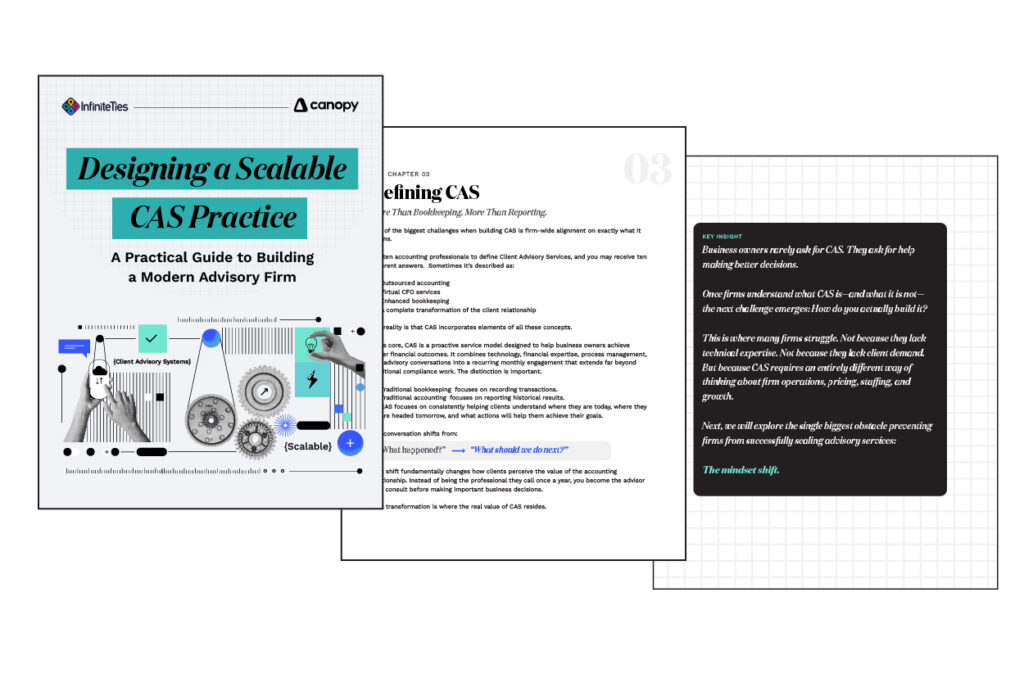
Designing a Scalable CAS Practice, a new ebook from Infinite Ties co-founders Christine Triantos, Michelle Welch, and Deneen Dias, is your step-by-step handbook for building CAS the right way.
Start with a Mindset Shift
For decades, accounting success meant returns completed, audits issued, and time billed. CAS flips that. The value isn’t in the hours logged anymore; it’s in the insights, interpretation, and strategic guidance you offer to help your clients make better decisions. That’s a genuinely different skill set—one you’ve spent your career honing.
But, if you treat CAS as an add-on instead of a redesign, you’ll end up squeezing advisory work into evenings and weekends until it quietly burns out. For CAS to truly scale, you need to shift your mindset from “we’re adding a new service” to “we’re building a new business model.”
Be Picky About Clients
Here’s an uncomfortable truth most firms learn the hard way: saying yes to every CAS-curious client often creates more problems than growth. Some clients eat hours of your time and generate almost no profit. Others fight every process you try to standardize. In this ebook, you’ll learn to differentiate a high-value CAS client from a time sink before you sign them, not after. You’ll also see why specialization, or going deep in a handful of industry niches rather than remaining an accounting generalist, compounds into referrals and pricing power faster than you might expect.
Stop Leaving Revenue on the Table
Most firms price CAS around one number: the monthly recurring fee. That approach undercharges for what you’re actually delivering, because onboarding, cleanup, custom reporting, and strategic planning all create value on their own. In addition, as automation continues to rise and you get faster and better at your job, hourly billing ends up turning your own efficiency against you, resulting in a literal pay cut. Fixed-fee, value-based pricing flips that incentive around, for you and for the client.
Think of Technology as Infrastructure, Not Just a Tool
As you grow, the technology you choose determines whether that growth creates capacity and opportunity or just adds to the chaos. Cloud-based platforms, like Canopy, connect financial data, automate workflows, and free up the hours that used to go toward gathering information, so your team can spend them advising, building relationships, and sharing your expertise instead. The goal with time-saving tools like practice management software is not to replace the human advisor; it’s to give them the time and space to actually be one.
Three Things You Can Do This Week
That’s just a small taste of what’s on offer in the full guide. Download it today for a 30-page introduction to building your own proactive advisory model, or try these three simple tips to start testing the waters:
- Pull your recurring client list and flag who’s already asking “what should I do next,” not just “what happened.” Those clients are your best early CAS candidates—no new business development required.
- Look for a pattern in your existing book. If you’ve got three or more clients in the same industry, you already have the beginnings of a niche. Note what’s similar about their financial questions.
- Separate one piece of CAS work from your monthly retainer and price it on its own. Onboarding is the easiest place to start testing value-based pricing without touching your core fee structure.
Get the Full Framework
Designing a Scalable CAS Practice goes deeper into all of this and more, helping you create your Ideal Client Profile, identify advisory opportunities in your current client list, refine your revenue streams, and ultimately start building the firm of the future.