Jason Staats on What Firms Get Wrong About AI Security

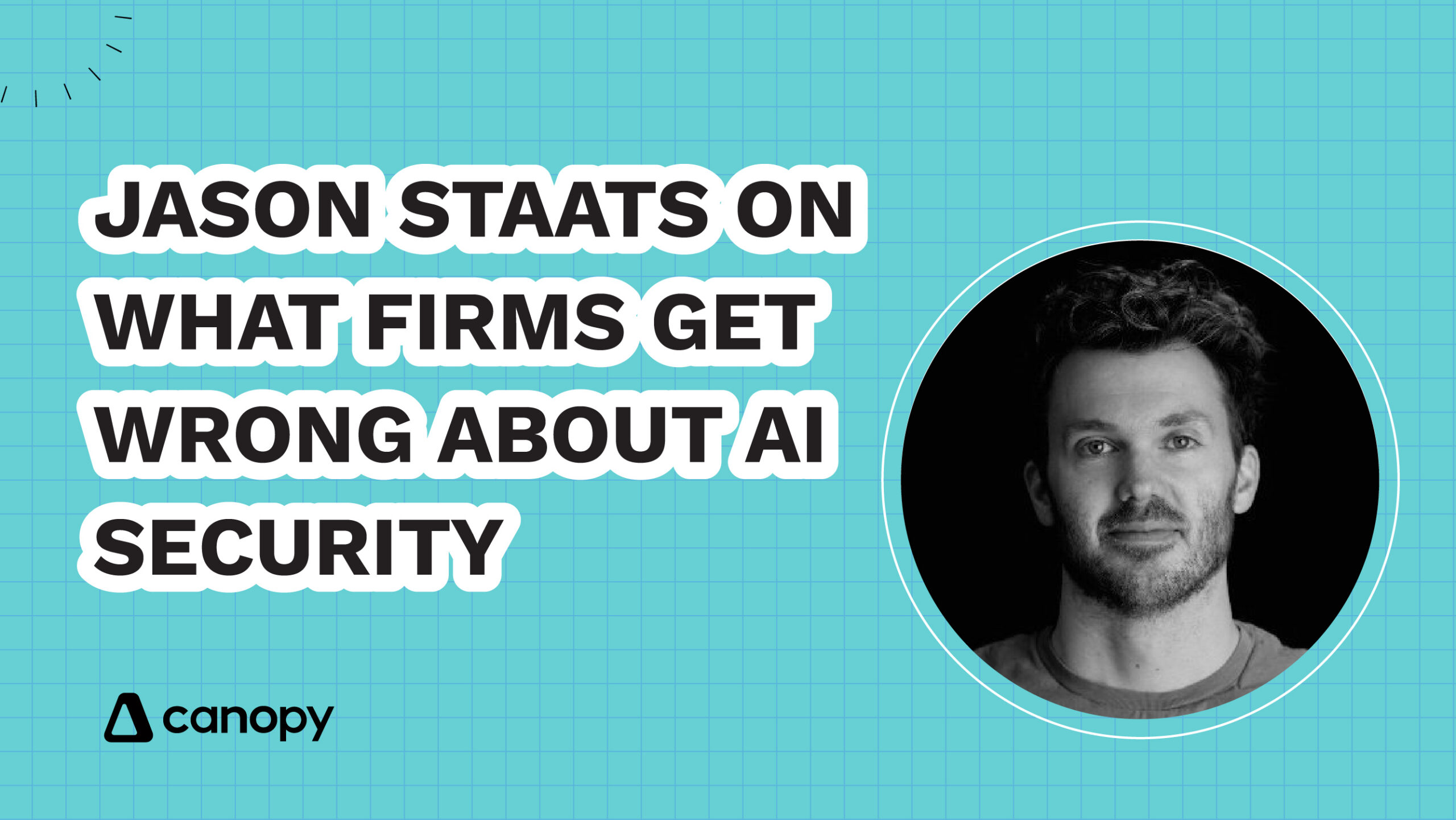


Jason Staats — Canopy Practice Success Podcast
Jason Staats — Practice Success Podcast Transcript
Luke Frye (00:00) Without further ado, a man who needs no introduction: Jason Staats. He last ran a $5 million accounting firm, then launched and sold a SaaS product. He’s worked on AI strategy with many of the coolest brands in our space and even helped put together the AICPA’s AI toolkit. These days, he spends 100% of his time talking with accounting firms and sharing what he learns.
I’m your host, Luke Frye, a Washington State CPA and the accountant in residence here at Canopy. I’ve scaled my own tax practice from zero, helped major platforms like Bench and Puzzle reach thousands of clients, and I now partner with firm owners to solve capacity, pricing, and technology issues through process improvement and best practices.
We’re going to walk through today’s agenda. We got so many great questions from everyone, so we’ll talk first about AI, then firm growth, then the future of accounting, and then we’ll take even more questions from you, because I know everyone will probably have additional ones.
So, how do you feel about using AI in your practice? All in and already testing it out. Cautiously curious and taking it slow. Interested but don’t know where to start. Skeptical and worried about the risks. Jason, welcome. I’m curious where you think this is going to land on our poll today.
Jason Staats (01:21) I think you’re missing “all of the above.” People are feeling all the emotions about AI simultaneously: skeptical, excited, nervous, and also a lot of “can somebody just tell me what to do? What’s okay, what’s inbounds, what are the rules right now?”
Luke Frye (01:38) Absolutely. Things are sort of all over the place right now, and we’re all kind of figuring it out together. I know you help a lot of us do that, and I appreciate it. That’s part of what we’re going to talk about today: where to get good resources and answer some very specific questions. I’ll give everyone another 30 seconds to get their answer in.
All right, it looks like 51% are all in and already testing it out. That’s probably unsurprising considering the audience you draw. Is anything surprising here to you?
Jason Staats (02:15) No. If anything, it skews positive, it skews to more progressive folks, which is great. Not everybody’s there, but regardless of where you fall, you’re welcome, and hopefully we can move you a bit down the comfort level spectrum.
Luke Frye (02:29) Well, with that, let’s jump into our first section on all things AI. First question: how do you use AI practically without falling for the hype? What should firms realistically expect in the near term?
Jason Staats (02:46) Okay, how to not fall for the hype. There’s a record number of companies, advisors, coaches, and software companies trying to capture the hype and ride the wave. I’d say it’s never been a harder time to know what products are real and what are not.
The big thing I’ve always pushed accounting firm leaders to do when making big decisions is to validate them with your peers as much as possible. There’s nothing new under the sun. That app you just saw on a landing page, where you’re like, “that’s exciting,” but is it real or not? There are users out there, people who’ve used it and left it. How do we gather information from our peers before making the wrong decision?
This is easy to think about with tech decisions, but it’s true even for hiring a coach for my firm. Where do I find a good coach? You find it through your peers. Where are your peers meeting with, who are they having success with? That’s the best way to get high-quality information. It’s not in coaches, it’s not even in people like me. It’s in your peers who are actually doing it. So as much as possible, lean on other people for what’s real and what makes sense for you.
Luke Frye (04:07) Absolutely. There are a handful of communities out there you could join, but you can also just participate online. That’s an easy way to do it, and it doesn’t cost anything.
Next question: what are the biggest concerns and most common mistakes firms make with AI, including when clients aren’t on board?
Jason Staats (04:30) The biggest mistake is people using consumer AI products that train your prompts into the model. With ChatGPT, with Claude, the consumer plans, often the ones pushed to you most, like the Pro plan or the Max plan, don’t come with any assurance that your prompts won’t be trained into the model. That’s very problematic. It’s probably technically a data breach if your prompts get trained into the model.
That’s not the case on business plans. With Claude, for example, a business plan comes with a commercial agreement that says your prompts are never trained into the model. But a lot of people don’t realize what plan they’re using, or they stumble into the wrong one. Or worse, a firm decides, “we’re going to wait, this feels too early, we’re going to pump the brakes.” Then you’ve got a 22-year-old on your staff who just ChatGPT’d their way through school. If that was you, don’t act like you wouldn’t have done the same thing. They’re AI wizards in a way we aren’t. Or it could be a 65-year-old, it could be anybody. They want to get their job done faster, and if we’re not giving them access to a tool, they take matters into their own hands even though they know they’re not supposed to.
So the biggest risk is simply using AI because it can help, but not using the right plan. The details matter.
Luke Frye (05:58) Along that line, you posted a video yesterday about redacting a tax return before uploading it. So the question is: is it safe to upload a tax return to Claude if you have a business plan?
Jason Staats (06:17) I’d always tell people, don’t take security advice from a YouTuber. But if it’s me running my accounting firm, yes, there are absolutely secure ways to use AI right now, even with client information. Get with your IT help and get a clear understanding of the basic framework: always be on business plans, and there are a few things in the organizational settings worth thinking about to de-risk it further.
Do that due diligence. It’s worth it, because there are completely secure ways to work with AI. A lot of people say things like, “we do this, but don’t worry, we take the company name off,” or “we give it the redacted tax return.” What Luke’s referring to is true: redacted information isn’t sensitive information under pretty much every rules body, from California’s rules to GDPR to HIPAA. If it’s redacted, it’s not sensitive.
But that’s not a strategy I’d roll out in my firm, putting a tool in my team’s hands and saying “you can use it, but you have to redact every single thing.” There’s going to be somebody who’s like, “I’ve got a cello recital at four, it’s three forty, I’ve got a seventy-page lease agreement, I think I scrubbed every reference,” and they chuck it in. That’s just not realistic. Even though it’s technically no longer sensitive if done perfectly, it’s not realistic to leave it up to your team to scrub sensitive things from a document before putting it in a tool. My take: only use the tool if it’s okay to use with sensitive stuff, and there are absolutely inbounds ways to do that.
Luke Frye (07:52) Next question: how do you remain human with AI? I think there’s a big opportunity to leverage this technology to be more human, to be a better relationship advisor with your client. But how can teams keep up with so much content out there without being overwhelmed, so they know where to invest time and resources?
Jason Staats (08:18) There’s an AI for anything now. Luke, have you seen the AIs that can make an AI of yourself that looks and acts just like you?
Luke Frye (08:25) Yes, it’s terrifying.
Jason Staats (08:26) It is terrifying. This stuff’s been around for a while. Two years ago, we ran a test. Some of you may have heard me share this story. We took the best AI video generator at the time, trained it on an episode of my podcast, and put out a 10-second AI clip alongside 10 seconds of the actual me. We ran a poll: which one is real? The votes were split. People couldn’t tell. I put it in front of my wife of ten years and asked, “honey, which one’s real?” She couldn’t tell. She’d had LASIK. There was no excuse for her not being able to tell. The genie’s out of the bottle. You can make AI that sounds and looks just like you.
But in our line of work, who wants that? Nobody. There are so many cool things AI can do in our firms, but what we need to be most protective of are the client touch points, the moments of interaction with clients. As soon as a client smells a whiff of AI in that, they’re going to think it’s lame. If anything, we ought to be reviving the client touch points that went by the wayside when we got overcapacity. We get busy, and responding to a client email becomes an annoyance. A client wants to talk, and we think, “can’t you just leave me alone, don’t you know you’re keeping me from getting the actual work done?” If anything, we should use AI for the doing of the work, to restore more of those touch points and double down on that humanity.
Luke Frye (10:03) On that note of being human: a lot of firm owners are struggling with whether to hire an intern or junior staff who may not have much experience, when they could just run a prompt to take care of the job. How do you think about hiring, recruiting, humanity, and AI in accounting?
Jason Staats (10:24) AI can tackle things across the entire skill spectrum, in my opinion. Definitely low-level things, but also very high-level things, like review. It’s not just capable of the menial tasks. I think some of this narrative carries over from older types of automation that started at the low level. The wild thing about generative AI is that it can help with both the low-level and the big-boss-level tasks.
It should be obvious what the problem becomes if you don’t have a human pipeline. If you stop hiring juniors and rely on AI to do everything, where’s the future talent inside your firm? There’s a real question of: if that person doesn’t have to learn the way I learned, how will they ever become me? We’ve always said this. Imagine, back when we first got software that could prepare and fill out tax forms, the old-timers in the office saying, “these whippersnappers are never going to learn, this is the end of society.” Somehow we’re all still here. The first guy I went to work for would literally, as an exercise, make you prepare a manual 1040. There are lots of examples of this in history, and somehow the world keeps spinning.
That said, there’s a real risk in deciding “we don’t even need juniors anymore” and fully cutting bait. That’s not the move, because you have to think about the talent profile in your company and how it continues to develop. A great argument for juniors: go back to that 22-year-old who ChatGPT’d their way through school. I’ve given so many keynotes to firm leaders who say, “yeah, AI is important, I totally get it, I’m bought in.” Then they go back to work and say, “I don’t have 20 minutes to spare this week.” Meanwhile, these kids coming out of school can’t have a conversation without using AI. That’s problematic in a different way. But don’t we need some of that energy and creativity around AI injected into us “fuddy-duddies” who are stuck sending emails, wondering when we’ll learn AI? It’s probably a combination of both that makes a good blend.
Luke Frye (12:41) Have you seen any good cultural best practices for getting elder millennials and people my age and older to adopt this, whether it’s a habit in Slack or a show-and-tell? How do we encourage this more in firms?
Jason Staats (12:57) First and foremost, it has to be on the calendar. It has to be part of the life cycle of the business, built in somewhere. If it’s just a “yeah, we should really be doing this” thing, that’s where initiatives go to die. At a minimum, there should be a standing weekly meeting where you’re actually having a conversation about it.
In enterprise, we’ve seen a lot of companies mandate daily AI usage and incentivize it: “we want you to use AI every single day.” That’s created weird incentives, in some cases people faking AI use. I don’t know that really makes sense.
What I’m doing in my own business is a weekly AI challenge: a fun but useful thing to build. Everybody builds their own version and delivers it at the end of the week with a short video explaining what they built and how they got there. A lot of it is totally half-baked, and people come at it from very different angles. But it’s turned an ambiguous, existential thing into “I’m actually using it every week now.” There’s a lot that just doesn’t work, but there are bits and pieces that turn out to be really interesting and useful. As much as possible, I’m not a fan of a regimented, hardcore method. I’d rather create a culture where people learn a little each week, without making it into a scary, ambiguous thing. It becomes something they’re using on their own.
Luke Frye (14:35) That’s fantastic. One more AI question before we move to the next poll. You probably saw the latest IRS guidance on AI use in preparing tax work. Has your thinking changed at all with that release?
Jason Staats (14:52) No, which makes me happy. I bought an eighty-year-old tax firm. I was preparing tax returns at nineteen years old, that’s kind of all I did. This might be the greatest thing to come out of the IRS. It was common sense and well thought out. By the second paragraph, they’re basically saying, “here’s the deal: you’re all using AI already, whether you realize it or not, so let’s talk about the responsible ways to do it.”
Beat by beat, it went down a list of things that make complete sense: you’re still responsible for the output, only use secure models for business, and so on. If it changed my thinking at all, it relieved some existential dread I had that they wouldn’t be aligned with common sense, because they aren’t always. It was great news, because they wrote this almost exactly the way I would have. Good validation that the folks trying to do this thoughtfully and responsibly are on the right track.
Luke Frye (16:03) Awesome. That brings us to our next poll question. Which generalist AI tool do you use most in your practice? ChatGPT, Microsoft Copilot, Google Gemini, Notion AI, Claude, Perplexity? I recently had Google Gemini help me with calendaring, I don’t know why I never thought of that before. So many obvious little use cases. What do you think is the most common one here, Jason?
Jason Staats (16:32) I’ll go with Claude, Copilot, ChatGPT, Gemini, and Perplexity last.
Luke Frye (16:38) Wow, a full ranking.
Jason Staats (16:40) What do you think? Agree or disagree?
Luke Frye (16:43) My first experience was ChatGPT, so I was stuck on that until this spring, when I started using Claude a lot more. Claude was a bit overwhelming and scary at first, but I think it’s actually doing the thing we all wanted AI to do. It’s not just a chatbot, it can actually do stuff, which is pretty awesome.
All right, we’re almost at 80% for the poll responses. Let’s see the answers and whether your ranking was right.
Jason Staats (17:16) No. Wow, ChatGPT over Claude, still.
Luke Frye (17:23) I imagine that’s because they were one of the first to market directly to consumers. You’re probably one of the biggest proponents of helping people understand the difference between enterprise AI software and consumer software, so it’s interesting that we’re still catching up. I imagine most people hear a lot of us talk about Claude.
Well, let’s jump into the next section. When it comes to firm growth, we can go so many different ways. We had hundreds of questions, so we distilled it down. First: what’s the single biggest operational bottleneck you wish you’d solved earlier in growing to forty people? How would you tackle it differently today with AI?
Jason Staats (18:14) Biggest bottleneck. In my progression, I started at this firm as a junior and ultimately bought out several of the partners, ending up owning it with a partner. By the end, I was the only non-client-facing person in the firm. I went from being the low man on the totem pole, to managing clients and booking business, to being totally out of client work.
The thing I waited too long to do, because it wasn’t culturally the norm in the firm, was give myself permission to spend time on things that weren’t client work. So many of us struggle with, “if I don’t do these things, what am I going to do with that time?” As if you’re ever going to find yourself running a business with nothing to do. You really think you’re going to get to 2 p.m. someday and look around thinking, “there’s nothing to do”? That’s not how running a business works, there’s always another thing. There’s also an identity element: “I’m this expert, if I stop doing this thing, then what am I?”
But what most accounting firms with more than six employees are dying for is someone spending time on things that aren’t client work: protecting the client list. Are all the clients on the list ones we should still be working with? What are we doing to make sure the next client who comes in the door pays us at a level that’s twice as profitable as the clients at the bottom of the list? How are we going to find our next hire? Very important questions someone has to be thinking about. Giving myself permission to get out from under the hamster wheel of production, living and dying by the billable hour, was the thing I waited too long to do. Does AI help with that? I don’t think it does. We want AI to solve these hard things that are really our own mental blocks, but I think it’s more of a “you” thing.
Luke Frye (20:15) I’m curious about your thoughts when a client comes to you with a bunch of AI answers they want you to respond to point by point, or says, “give me a cheaper rate, because I know you’re using AI and it’s not taking you as long.” Would those be contenders for getting rid of, or would you handle it differently?
Jason Staats (20:45) Not immediately, not necessarily. They’re a signal, and they could go further down that rabbit hole, or you could set them on a straighter path. If they come to you with AI answers, the obvious response is to run those through your own AI and see if it says the same thing. Kind of kidding.
There’s the real question of, “can’t AI do this? Are your prices going to go down?” But there have been versions of this before. The first time you could walk into a Costco and buy TurboTax to install on your computer and prepare your own return, my dad did that, and it was incredible. People asked, “why do I need a bookkeeper if I can just buy QuickBooks?” There are a hundred versions of this. I think it’s a signal that our firm hasn’t solved a specific, acute pain that goes beyond “I have to file a tax return every year.” If I’m the premier provider for taxidermists doing between one and two million dollars a year, and I know all the nuances of their work and how things specifically apply to them, and I’m the hub for people in that industry, there’s a lot more value to working with me than just completing a form. So it might be a signal we haven’t nailed a really painful problem for a specific type of person yet. You’ll get those questions for sure.
On a ten-year horizon, is there a world where AI suppresses the value of the doing of the work? Potentially. But there’s also an argument that it puts an even greater premium on a human having eyes on your work. AI has proliferated almost everything in our lives, to the point where people are saying, “can I just talk to a human?” So there’s an argument that the human side of this may get an even bigger premium: connecting with somebody who has the know-how. People will say prices should drop, but people have always said that.
Luke Frye (23:07) Same story, just new tech. Going back to building a culture and capturing institutional knowledge, and delegating workflow ownership, including training admins: what have you seen work really well for training and naturally sharing knowledge about how the firm works?
Jason Staats (23:38) We need to think about capturing as much context as possible about what’s happening in the firm. The biggest source of missing context historically has been not recording client meetings and calls. The tools we now have to capture client conversations would have been incredibly useful to us when we were coming up in an accounting firm, when we’d wonder, “has anybody in the firm ever had this conversation with a client before?” The answer is usually yes, hundreds of times. How amazing would it be to query past examples of that conversation? Or, coming into a monthly accounting client, being able to see the last six months of those conversations?
Here’s probably the biggest thing that makes people start capturing their meetings: say you’re going to buy an accounting firm, and all else is equal between two firms. One has documented every single meeting for the last three years, so you could step into running it and understand everything those clients have been told. Which firm are you going to buy? Capturing that context has gotten incredibly important, and as AI gets better at filtering through context and pulling out important details, the speed at which we can grow the junior track now looks completely different, because we have such better access to information.
Luke Frye (25:02) There are so many different apps for recording calls now, plus industry-specific ones for accounting. Thankfully, Canopy also built one directly inside the client portal, so you don’t even have to add another tool, and it has all that context. Either way, I’d recommend recording calls, there’s so much you can do once you have it recorded.
When you’re talking to an old-school partner about adopting something like a CRM, like Canopy, one of the biggest objections I hear is, “I’m not going to connect my email so everyone can see it.” What would you say to an old-school partner who feels like that’s an invasion of privacy?
Jason Staats (25:48) The details matter there. There are real things in your email you don’t want the team to see, but that’s something you can navigate through access controls. I find the biggest resistance to adopting something like Canopy comes from an entire generation of firms that have only ever bought software from the company that built their tax software. That’s the sales rep who has their ear, the only company they buy software from, whether it’s a practice management system, document storage, or anything else.
Taking that first step, telling your tax software rep, “I’m going to go a different direction, not for the tax software, but for literally everything else,” isn’t just about that first buying decision. It opens you up to an entire world of cool technology being built for accounting firms. If you’re like my firm was, and most firms still are, only talking to your tax software rep, you’re being shown a really small, old, out-of-date, and expensive bubble of what’s possible. As soon as you give yourself permission to ask, “are these other things real?” You realize there are hundreds of companies doing cool stuff in the accounting firm space that make us look smarter to clients and save time on how we do our work. Severing that total reliance on your tax software vendor is honestly what holds most people back.
Luke Frye (27:35) Tax software is definitely one of the final dinosaurs that will hopefully die off eventually. Until then, we’ll build around it. On scaling and capacity planning: what approaches work well without resorting to minute-by-minute time tracking?
Jason Staats (28:00) I’ve got a take on this that isn’t popular with everybody. Minute-by-minute tracking is a level of granularity that’s unnecessary. But I also see fellow “skinny jeans, avocado toast” accounting firm thinkers like myself saying, “doesn’t tracking time suck, let’s just never do that, it spoils the vibes.” You could reword the question to, “how do we plan our time without tracking our time?” We almost want to pretend time isn’t a thing.
I have no problem doing a very basic version of time tracking across my team. The problem with time tracking has always been the incentives. If it’s the stick you’re motivated by, and you post statistics every week like “look how much Tammy worked this week, she’s crushing it,” and realization rates and all that, it creates an awful incentive structure: no motivation to get more efficient, and it creates a toxic work environment.
I still believe the way to plan capacity in your accounting firm is with time. There are better ways to incentivize people, like production-based pay: when I make money, my team makes money, which aligns incentives in a helpful way. But going down that path alone is incomplete, because when I was running a remote team all over the world, I still wanted to know who was working sixteen hours and who was working six. Not to crack the whip, but to stay plugged in with the team. We actually put this to a vote on my team: do you want to stop tracking time? Some of my team members, in their first years managing their own teams, said no, they still wanted to track time for organizational planning purposes. It didn’t change how we bill, we still value-bill, but they chose to keep tracking time because it’s still an important metric. Go tell my kids, tell my wife, that the number of hours I work in a day doesn’t matter. I’m not pretending that’s not a thing, but there are definitely problematic ways to deploy it.
Luke Frye (30:26) Aligning incentives so we’re all moving in the same direction. Next poll question: what’s your biggest security concern about using AI at your firm? Client data leaving our environment, staff using tools we don’t know about, no clear firm policy on what’s allowed, or “I haven’t thought much about it yet.” Jason, what’s your guess here?
Jason Staats (30:52) B is the scariest thing to me by a mile. It’s easy to think inaction is safe, “we’re just going to wait and see,” when inaction might be the most dangerous thing you can do.
Luke Frye (31:05) Which doubles down on the IRS guidance: you need to know what your staff is using and how to apply and run it across your firm. That gives people extra incentive to learn this stuff.
All right, we’re at 81%. Let’s see the results. What’s your biggest security concern about using AI at your firm? Number one is client data leaving our environment. It’s easy for me to say that’s terrifying now, you’re signing up for all these apps, new ones funded all the time, is it secure to upload things there? Using a business plan is good, but I’d also recommend looking at SOC 2 compliance. And then, staff using tools we don’t know about, the term for that, which I only learned recently, is “shadow AI.”
We’re winding down into one of our last sections, keep asking questions in the Q&A. We’re talking about the future of accounting: succession planning, growing and scaling, what our work looks like over the next three months, six months, a year, next tax season.
I asked our producer Angie maybe not to include this one, but I recently learned people still use QuickBooks desktop to do annual write-ups. So the question is: are we moving off desktop apps toward the cloud? Is desktop really going away, and where are firms actually headed?
Jason Staats (33:35) Luke does not like this question. Is desktop going away? Let’s be real, QuickBooks Enterprise Desktop was the greatest accounting app ever made. It’s so complete, so good. But the reality is, not even the people who make it want to sell it to you anymore. Right or wrong, the financial model for selling software now is through an internet browser, and there’s no one standing behind the desktop software anymore. That’s a hard mountain to die on. Things are going to the cloud.
In the AI world, there are still people who, clear back to when ChatGPT first came out, said, “this is cool, but I’m going to wait until I can run a local AI model on my computer that’s actually secure.” People are still saying this three years later: “I’ll wait till the local models are good enough, I’ll run it all locally.” There’s a real argument that the server in your closet is less secure than hosted infrastructure, someone physically getting at a server. I don’t know that’s any more secure these days. Desktop software is amazing, I think the problem is the incentives: it’s much more lucrative for software companies to sell you a monthly subscription.
Luke Frye (34:57) And now we’re paying for usage and credits too, which is another thing to unpack: is it economical as currently priced? Based on firms you’ve talked to, what work do you believe entry-level accountants will actually be doing in five years, if AI handles much of the compliance and baseline work?
Jason Staats (35:20) They won’t be doing the same things you and I were doing, that should be obvious. The gut reaction is, “well, they can never be me if they didn’t go through the trials I did.” I did a lot of stupid stuff as a junior, spinning my wheels all afternoon, so much wasted time. I think we have to assume the production of the work gets compressed to almost nothing, and it becomes about the advising around the work.
One framing: we’re moving from the era of “how to do” to the era of “what to do.” The “how to do” has gotten very simple, we now have tools that can do just about anything you want. What’s left is deciding what’s worth doing. We could generate a 90-minute AI movie, Luke, and you and I could sit in a theater and watch it, but the fact that AI can make a 90-minute movie doesn’t mean either of us actually wants to watch it. So what we’re doing will evolve, and what juniors are doing will evolve too.
I know a lot of firms where the most capable AI people are the juniors. AI is the biggest lever we’ve ever had to be high output. You look at a junior with that much AI experience and capability and think, was that dangerous or irresponsible? There are limitations, but that’s where more seasoned people can speak into what they’re doing with a bit more experience.
Personally, the hardest thing about being a junior wasn’t the work, it was that our clients, successful business owners in their 40s, 50s, and 60s, looked at 23-year-old me and thought, “that’s cute, I have a grandchild about your age.” That was a bigger problem for me than what work I could do. Those human things will remain, but the work itself will evolve for all of us.
Luke Frye (37:27) Being able to grow facial hair by twenty-five helped me get a bit more respect. All right, before we go to more live questions: as you think about the future of the profession, my alma mater EY recently took some PE money, and PE continues to be supporting, helping, and, depending on your perspective, disrupting firms as we knew them. Then there’s AI, and staffing and offshoring. Three things creating tension and opportunity at the same time. Do you see any one of them as more of a threat, or more of a benefit?
Jason Staats (38:13) You’re really lifting the mood. Honestly, of those three, PE, staffing shortages, and AI, one is much more exciting to me than the other two. The notion of AI being the biggest lever you’ve ever had: somebody’s going to build the first single-person, ten-million-dollar-a-year accounting firm with AI, and that’s going to be super rad. AI is an amplifier of people with amazing capabilities, the same way tech in general is now.
If you went back to before computers existed and explained our accounting firms, you’d say, “we use these computers, and we pretty much all use the same software, QuickBooks, UltraTax,” and they’d ask, “so the computer does the work, and you’re all running the same firms?” And you’d say, “well, no.” What’s the difference between your firm and mine? It’s all the humans on top of the tech. In the future, the tech gets vastly more capable, so what will the difference between our firms be? Still the humans, and how they use the tech. To me, that’s exciting and enabling for all of us.
The fact that there aren’t enough humans wanting to do accounting is understandable, but I think AI will help with that by making us more productive than ever. As for PE, the world has more capital than it knows what to do with, so it’s trying all these different things. Honestly, for small, hundred-employee-and-under firms, the people I talk to, I think it’s all opportunity. If you want to sell your firm to a roll-up, sure, that’s never been easier. That’s not interesting to me, but every time these roll-ups happen, I get some great staff and clients out of it. There may be a version of this someone figures out someday that’s really cool, but I don’t think it exists yet. For the small firm practitioner, it’s all opportunity.
Luke Frye (40:28) So many people are ready to start their own firm or join one that’s still independent. All right, final polling question, and then we have a live question queued up. What’s on the horizon for your firm? Scale it up and grow revenue and expand your team? Optimize, keep it small but make it more efficient? Getting ready to exit, sell, merge, or roll up? Or survival mode, just trying to make it through the next tax season? If you’re in survival mode, I hope you find help, because you don’t have to be, there’s more demand than there are accountants. So maybe, Jason, you need to raise your prices.
Jason Staats (41:16) They don’t want to hear that from us, Luke. They just think, if we can find that next hire, everything will be fine.
Luke Frye (41:24) This is the last polling question. We’re at 73%, thirty more seconds. Did you make a guess here, Jason? What do you think is on everyone’s mind?
Jason Staats (42:03) I think A, B, and D are going to be close. If I had to pick, I’ll say optimize.
Luke Frye (42:10) That makes sense, A and B are so interrelated. We’re over 80% response now. Let’s look at the results: 43% scaling up, 49% optimize, only 3% in survival mode, that’s fantastic, and 5% exit strategy. Surprised by any of this?
Jason Staats (42:34) If you polled everyone’s spouses here, we’d probably see more than 3% survival mode. But that’s alright, we don’t need to think about that too much.
Luke Frye (42:46) Denial’s a river somewhere. Into the final Q&A: what’s your take on using generalist AI for tax research versus a dedicated AI tax research tool?
Jason Staats (43:10) Good question. Generalist AI has gotten very good at tax research, but it depends how you use it. By default, it’ll pull answers from places like NerdWallet and Investopedia, which aren’t exactly authoritative. You can point it to authoritative sources. Call me old-fashioned, but I still appreciate AI that’s backed by authoritative sources. So I still think there’s a place in the market for tools like Blue J, more purpose-built tools. I still see a place for dedicated tax research tools.
Luke Frye (43:43) That makes sense. Next: as firms grow, what operational process have you seen make the biggest impact on reducing interruption for the owner or management, while improving client experience?
Jason Staats (43:57) Reducing interruption for the owner: do you have your email open right now? You’ve got four monitors, is Outlook up on one of them? Close that. That’s probably the biggest problem, we’re monitoring email all day long. Closing it makes it easier to get into deep work. Team chat apps like Microsoft Teams or Slack create an expectation that we’ll get an immediate response from colleagues, which I think is actually a problematic expectation. The biggest thing is that we’re perpetually distracted by the things we let ourselves be distracted by.
Luke Frye (44:35) Who’s really distracting you? Next: where would you start if considering buying out an owner who wants to retire from a largely paper-based tax practice with limited staff?
Jason Staats (44:49) Paper-based practice, limited staff, a couple of big red flags. I’d say ask around more, because there are amazing firms for sale that are neither of those things. This is a cool time, the accounting world has never been smaller, never easier to connect with peers and other people doing this work, through conferences, local events, communities.
The best acquisitions right now aren’t happening on listing sites, they’re happening through peers: “hey, I use Canopy, how cool would it be to buy another firm that uses Canopy, with processes very similar to our own?” That’s a vastly better acquisition target than a firm you have to rebuild from scratch, bringing the staff along. That’s very hard.
Luke Frye (45:34) Jumping back to the tax research answer: there’s a question about whether Tax GPT is safe. I don’t see why it wouldn’t be, but what’s your answer?
Jason Staats (45:47) Tax GPT specifically is a research app, they’re doing some other agentic stuff too. Don’t take security advice from a YouTuber. Whatever your due diligence process is for onboarding new apps, go through that process with your IT support. People use Tax GPT, but that’s also not a reason to think, “my friend uses it, so it must be okay,” or “I saw them exhibiting at a conference, so it must be okay.” You have to have your own due diligence process for working through that.
Luke Frye (46:17) I keep hearing about how teams are implementing AI in their firms, but what if you’re a solo firm? How would you start using it without a culture of people competing on AI?
Jason Staats (46:34) It’s slower to learn in a vacuum by yourself. Bringing this back to the world getting smaller, there’s a whole bunch of other solo people asking the same questions. How could you get with some of those other solo people, maybe get on a call every week, share that journey with others to pick up what they’re learning too? The more of those connections you have, the faster you’ll learn. Don’t lock yourself in a room and try to figure it all out yourself.
Luke Frye (46:59) I recently got on Reddit and was shocked at how much is going on there. I know I’m late to the party, but there’s tons of free advice, good and bad, so you may need to filter through it, but tons of free communities. Finding other people in your situation makes a lot of sense.
Probably one of our last questions: as a non-partner operations manager, how can I convince our partners to do the things necessary to get out of survival mode, for example, moving to Canopy from a legacy practice management system?
Jason Staats (47:29) Bless you, you’re fighting the good fight, Angie. One thing that’s helpful when the world doesn’t see things your way is to reverse-engineer your own point of view. What brought you to this level of conviction? It’s usually a combination of things you’ve consumed, and the reality is we’re all very much programmed by what we consume, even if we pretend we aren’t.
So, how can you reverse-engineer that conviction? Maybe you’ve had conversations with a couple of firms that swear by this tool. When you go to someone in your business and say, “we’ve got to do this,” and they say no, ask yourself why they don’t see the world the way you do. It’s because they haven’t been exposed to the same things you have. A lot of people use my videos this way, to say, “this guy’s saying it too.” So share the videos, but also think about how you got convinced, how you got here, and whether there’s a way to expose them to the same context so they might come around to the same answer.
Luke Frye (48:40) Partnerships, can’t live with them, can’t live without them. Next: what are the most important characteristics you’d look for in hiring professional staff?
Jason Staats (48:50) Willingness and openness to change. There’s going to be a lot of change in the next few years. A lot of folks don’t like change, and you don’t want to carry that all on your own back. Are they energized by change, or terrified of it?
Luke Frye (49:03) The only constant. Well, Jason, thank you so much for being with us today. It was fun to have this conversation, and I hope everyone following along got a lot out of it too. This replay will be out, and we’ll be emailing you your CPE certificates within a couple of days. If you have any questions, don’t hesitate to reach out. Thanks again, Jason.
Jason Staats (49:24) Thanks, man. Thanks for having me.
Hosts & Guests

Jason Staats
Guest
About the Podcast
Share
Authors
By: Chrissy Rutledge
Chrissy is the Social Media & Content Marketing Specialist at Canopy.
Read more by ChrissyDiscover more like this