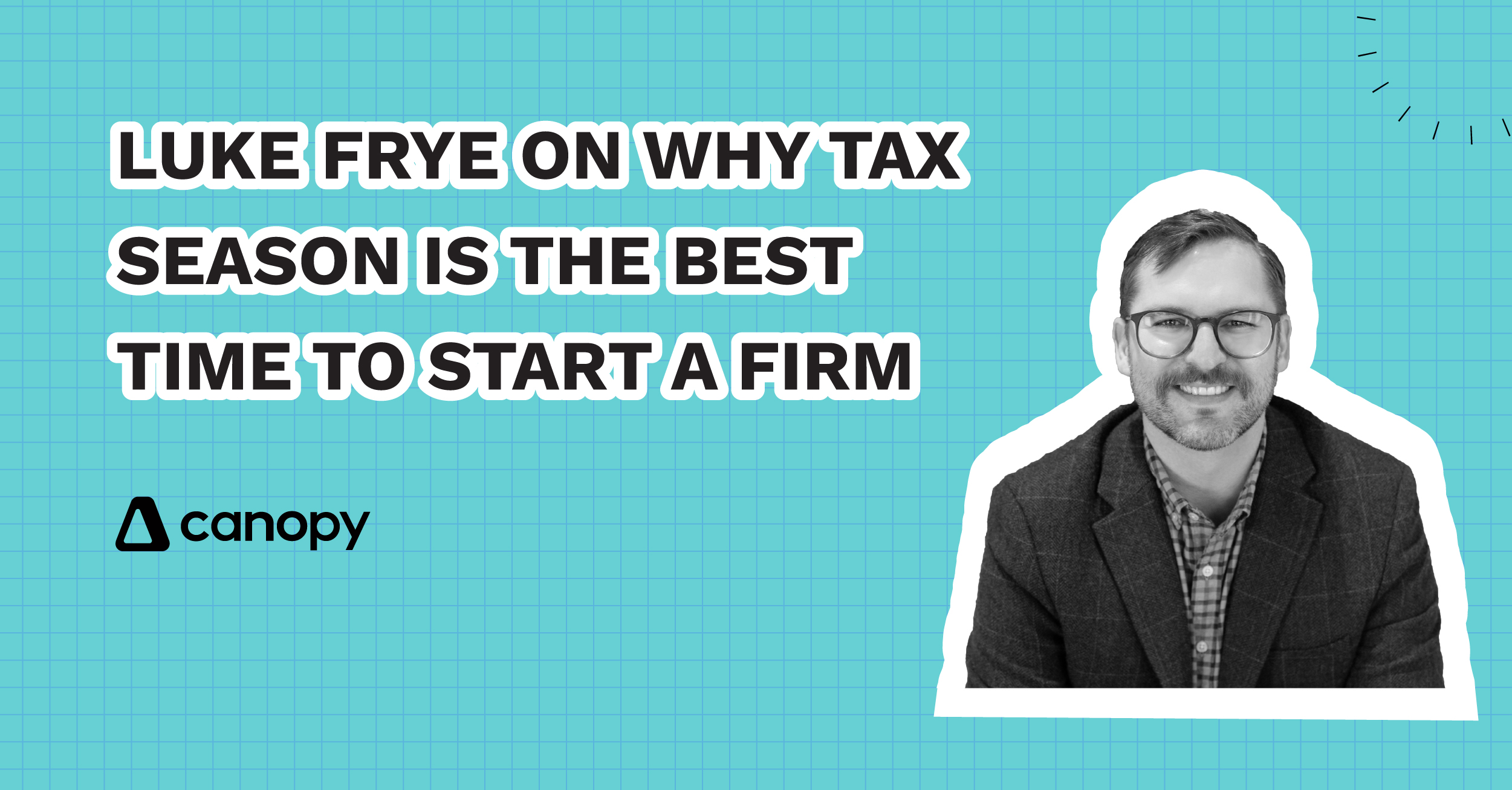
Luke Frye on Why Tax Season Is the Best Time to Start a Firm




Canopy Practice Success — Luke Frye
Canopy Practice Success — Jonathan Medows
Canopy Host (00:01) Welcome to another episode of Canopy Practice Success. I’m your host, and today on the podcast I’m excited to welcome Jonathan Medows, a New York based CPA widely known for his deep expertise in taxes for freelancers, creatives, clergy, and independent professionals.
Jonathan runs Medows CPA, a boutique firm that blends traditional accounting with modern financial planning, business guidance, and education-focused resources that help self-employed individuals thrive.
Thank you, Jonathan. Welcome.
Jonathan Medows (00:41) Thank you for having me today.
Canopy Host (00:42) I’m excited to dig in. I teased this a little bit before we hit record, but I love that you and your firm are focused on a very specific clientele. I’d love to hear your story there.
How did you identify that these are the people you wanted to work with? I know I threw in clergy at the end. It wasn’t in my script. It was something you mentioned as a fun clientele for you. Talk about how you got there, how you found these people, and whether there are others.
Jonathan Medows (01:15) I started my firm with one client. Like a lot of people, I advertised. Back in 2004 I used the internet to grow my practice. I used Craigslist, listed my credentials, and frankly, whoever emailed me, I responded.
After doing this for about two, three, four years, I started to notice which clients resonated with me. Clients who felt I added more value than not, and clients who, from an interpersonal perspective, I enjoyed working with.
I quickly noticed that I liked working with self-employed people. With self-employed people, you can always guide them to tweak the next year. Maybe I can help them find deductions for the past year, but I can certainly give them guidance for the following year. With people who work for someone else, essentially I’m just the umpire.
A lot of times they would owe money because they were wealthy people who didn’t have enough taken out for taxes, and they would shoot the messenger. I found with self-employed people, even when they owed, if I could find a way to reduce their liability a little bit, they were much more grateful. That resonated with me.
Perhaps because I was on the journey with them, developing my own business, their issues and their needs and their stresses resonated more with me. We’re on the same journey. I may be a few steps ahead, I may be a few steps behind, but we walk together.
Canopy Host (02:46) You’re able to relate because you were in the same position.
So you identified this attribute that you really liked. Talk to me about how that has impacted your business model, your operations, your pricing, even your marketing. I’m sure it has had a huge cascade.
Jonathan Medows (03:15) Absolutely. Most of my marketing material is targeted to the self-employed. Not everything, because there are certain tax changes that come out and I like to be timely. With the big, beautiful bill, there’s a new Trump account for children. That doesn’t necessarily target the self-employed, but self-employed people have kids. So I try to stay on target by writing to the self-employed.
For example, during COVID there was certain economic relief, and I wrote about it from the perspective of freelancers. I really tried to write from the lens of freelancers and small businesses. I morphed the practice into small businesses as well, which are essentially more successful freelancers if you think about it, because the owner still has the same issues.
Our writing and our marketing are geared toward them. Our pricing is geared toward them, because you have people at different levels of startup activity and you have to be price sensitive. Same with our offerings and services. I can tier up and tier down depending on what people need.
People who are price sensitive want a little more no-frills, and that’s okay. We can do that. People who are more successful or busier want more services, and we can add that as well. I’m not one size fits all. I try to be flexible with people and meet them where they are.
Canopy Host (04:33) Now you said a verb several times, and as a marketer my ear catches it. You said write. You’re writing.
I actually just pulled up your firm’s website. There are a lot of articles. You’re writing blogs a lot, yes?
Jonathan Medows (04:51) Blogs, tax articles, third party sites. Correct.
Canopy Host (04:55) This is so uncommon. It’s very rare that I come across an accountant who is writing content based on tax updates, or things that are just pertinent to your audience.
There are plenty of listeners who are thinking, “I don’t have time for that. What do you mean, write?” Where do you see the value in this? Because you obviously see a value.
Jonathan Medows (05:27) Part of what I do is education. I have a staff. Prior to speaking with you there was a bit of an issue, and I had to do some education. I spoke with my manager and said, please speak with our senior accountants. Of course you’re going to put it in our checklist. Of course you’re going to email them. But I want you to have the conversation, because we have to teach.
I’m constantly learning. My staff is constantly learning as well. I like to write because when I write and put these articles together, I learn the material better. So it’s a teaching exercise for myself.
Canopy Host (06:01) First and foremost, you see it that way. Have you also seen it positively impact you in terms of SEO and marketing, with the right people finding you because you’re becoming a voice on the internet on these topics?
Jonathan Medows (06:21) In our business there are two ways to get clients. Either you go to a marketing event and hand out cards, or you think about when people actually switch. Either they’re starting something new and they’re searching for people and they find me that way, or there’s an issue.
So I try to speak to people’s needs. I write for certain places, and some people just follow the articles. But a lot of times people are searching on exactly what I’m writing about, and it comes up for them.
I’m essentially a bit of a defensive person in the sense that I’m responding to a need they already have. That’s why they’re reading my article.
Canopy Host (06:58) You may be aware of this as well, but that’s also why AI responses in search will pull content like yours. The questions people are asking that you’re answering through your written content are rather specific.
A little background into marketing here, because I find this fascinating and I feel like not enough people understand the value of it. The more domain authority you create on your website by publishing content that’s helpful, that answers questions people actually ask, that Google or any other search engine pulls into an AI response, the more power your brand is given and the more likely people are to find you.
I wanted to highlight that because people are asking questions, especially as we’re seeing these AI responses happen, whether that’s in the search engine or directly within an LLM like ChatGPT or Gemini.
That builds a snowball effect. You’re putting out information that’s applicable, you’re deepening your expertise because you’ve niched to these specific people, and then people find you because of that expertise.
Jonathan Medows (08:42) There have been times when I search and I come across my own article.
Canopy Host (08:46) I love it. So you’re doing all of the right things, Jonathan.
Jonathan Medows (08:52) But it takes time, it takes effort, and it takes money. Most accountants can’t write to the degree that people will appreciate what you’re writing. So you need help. You need a copy editor. You have to invest in it. And it’s okay to get help. You don’t have to do everything yourself.
Canopy Host (09:04) Say that 10 times.
Jonathan Medows (09:11) I’m not a bad writer, but I need help. Writing an article that appeals to people, that’s readable, is very different from a technical argument sent to the IRS on a specific issue. It’s a different type of writing.
Canopy Host (09:13) I like that you call that out, because you have expertise that people want to understand. It’s not a bad thing that your expertise isn’t writing. Your expertise is accounting.
But you know that information, you have that passion for education, whether it’s for your clients or your staff, and you’re asking what the best way is to disseminate it. If you need help putting that in the form that’s most easily understood, you get that help. I love that.
So you found this commonality. You liked self-employed individuals. You talked about writing. Talk to me about your processes, the team you set up, and how finding that characteristic has impacted the way you’ve built your business.
Jonathan Medows (10:23) I’m looking for people who take responsibility for their work. I can teach, but I’m looking for people who will own their work and put the hours in. It’s not a nine to five job. If I find that and they have the technical background, that’s great.
What we try to do is take repetitive, similar work, because then I can identify patterns and teach people how to do things. For example, if I’m dealing with a lot of freelance workers in New York City, aside from where we report the freelance income, there are very specific New York City issues tied to these people. That lets me create checklists and teach people. The art of repetition brings expertise.
I encourage people to do a little research on their own. As I was telling someone earlier today, I need people to reach, not to jump. When you feel like you’re jumping, call me. But I’m not going to spoon feed it to you after a while. Initially I will, of course. After that, I need you to do some research and then come speak to me. I try to treat people like adults.
That said, we double check all the work. And if there’s higher risk, we assign it to more senior people. I do have to keep that in mind. We need self-starting people who take responsibility. Unfortunately that sometimes means weekends, sometimes it means nights. That’s just the nature of being responsible.
Canopy Host (11:38) Something you’re not explicitly saying that’s worth calling out is the word delegating. When you delegate, and I love that you mentioned checklists, you don’t need to delegate something to someone who’s equally as skilled as you.
Jonathan Medows (12:10) Absolutely not. With that in mind, I actually developed our own workflow where I can route different types of tax returns at various stages through our offices.
Preparation for certain types of tax returns automatically goes to team A. Other types go to team B based on risk. They’ll automatically go to the appropriate level of supervision. I’ll sort out the reviewing sometimes, because myself and my managers know who’s more risky and who’s less risky, and we’ll sort it out.
Canopy Host (12:45) Do you have a rubric of sorts, or is it pretty subjective, more gut feel?
Jonathan Medows (12:51) With certain types of tax issues, we know we have to delegate. With certain clients, we just know they’re more sophisticated. It’s also knowing your clients. You do have to know your clients after a while.
But I have a very structured workflow, meaning I have software that manages the workflow in my organization from beginning to end. I’m constantly tweaking this. In April I’m already writing down the issues I see for next year. Always reviewing, always tweaking, because you can always improve things.
Canopy Host (13:27) Is autophagy the word I’m looking for? When something is left alone, it automatically disintegrates into chaos. That’s the same thing with our workflows. You can’t set it up once and expect it to work well every single year.
You live in a world of change. Clients grow in their own regard, you gain new clients, your employees come in and out of the business, the technology around you changes and maybe you adopt something new. I love that you’ve highlighted that it’s something you’re already taking notes on.
Jonathan Medows (14:09) Absolutely. I’ll give an example. The IRS is going to eliminate the ability to send in checks for payments. I’m not sure exactly when. I got a notification from my insurance company about a webinar.
So first, I’m paying attention to education and watching other professionals speak. Second, I’m going to take that feedback. And third, we’re going to have to change our workflow and our communications to clients. Internal staff, then clients, and then our workflow, to make sure we meet this.
Canopy Host (14:39) Talk to me a little bit about the culture you’ve set up on your team to enable them to identify and surface similar things as well.
Jonathan Medows (14:51) For the most part, a lot of people have been with me for a while. We have two managers and four senior accountants. Essentially I manage the managers mostly, and the senior accountants.
People know if something is up, they should ask. I send them articles constantly, and they know to go up the chain of command and ask other people. Eventually it comes to me. I try to respect boundaries, but people have been working with me for five, six, seven, eight years. So I know their strengths and weaknesses.
Canopy Host (15:16) When you’re sending articles, what are some of your favorite sources and publications for your own personal education?
Jonathan Medows (15:30) CCH does a nice job. I have a subscription to that. I like CCH, and then Intuit sends out articles, and other publications send out emails. If I see something, I’ll forward it along. I go to CCH. I find they do it very, very thoroughly.
Canopy Host (15:35) As you look at a firm that might be looking to do what you have done, you said you identified these attributes of clients within the first couple of years.
Did you have to fire clients? Did you maintain those few who came on in your first few years as legacy clients? How did you make the transition?
Jonathan Medows (16:22) It’s a little bit of both. Sometimes clients fire themselves. I don’t like to fire people because it’s confrontational and frankly it’s draining. On occasion we have to, don’t get me wrong. But that’s the exception more than my rule. That’s just my personality.
People eventually will get rid of themselves. You can make people go away. Either raise your fees or delegate them to someone else. I always feel it’s best that clients leave you rather than you fire them.
Canopy Host (16:38) I like that.
Jonathan Medows (16:52) That’s just my style. Other people disagree. I’m a nice guy, so perhaps that’s it.
Canopy Host (16:58) I think that’s an important call, because I’ve been hearing the phrase “firing your clients” for several years now. The concept being, don’t be afraid to do some of the things you’re saying. Raise your price. Change the qualifications for the types of people you want to work with.
But I like that you’re calling this out, because I do think it’s a mental shift. No, I’m going to raise my price. I’m not fearful of a conversation I have to have with my client. They’re a human with the ability to make a choice. Whether they choose me or not is fine. But I know what I’m choosing and what’s going to be best for my business, and I’m going to move forward that way.
Jonathan Medows (17:45) You don’t have to be obnoxious when you do it. Try to do it in a professional way. If you’re charging someone $1,000 and raising them to $10,000, that’s obnoxious. If you’re charging them $1,000 and raising them to $1,500, or even $1,800 or $2,000, whatever it is, that’s fine. Try to be nice. It’s difficult. You’re dealing with people, you’re dealing with personalities.
The other thing I’d recommend is have other people do this for you. If this isn’t something you’re comfortable with, get help. I’ll give an example. AR. I don’t like it. It stresses me out. It’s money. I have someone helping me do it.
If you don’t like to do certain things, there’s nothing wrong with getting people to help you and you being Mr. or Ms. Nice Guy. That’s fine too. It has to get done.
Canopy Host (18:28) I came across a concept a while ago that applies here with you delegating something you don’t like, something that stresses you out. Many people in business think they need to strengthen their weaknesses. I heard ages ago the concept of, no, strengthen your strengths. Focus on your strengths and make sure you build a team that’s complementary to you.
That’s such a great example. Jonathan’s strength is not AR. It stresses you out. So have someone else on the team do that. Don’t worry about something being your weakness. Lean into your strengths and let everyone on your team do the same.
Jonathan Medows (19:20) A friend of mine years ago told me I need to be grandpa a little bit. You’ve got to be the nice guy. That’s okay. You’ve got to know the roles at times. It’s a team effort. As you said, people are complementary. And don’t be embarrassed to ask for help.
I think most professionals in the accounting arena feel they have to do everything themselves. Maybe some of it’s financial. I understand money. You don’t have the money to do things at certain times. I get it. Believe me, I literally cleaned the men’s room when I first started. I get it.
But as you grow, I’m a bigger fan of getting a junior accountant right away and administrative staff, good admins, to free you up. You’re new as a partner. You’re the rainmaker.
If you want a better client base, that means you have to be nicer and more sophisticated. So you have to work on that. If being bogged down in the minutiae of admin, booking appointments, AR, and all that is going to wear you down, you’re not going to be successful. You have to invest in your business. Most people make this mistake.
Canopy Host (20:18) I hear these mistakes being made all the time. I also beat the drum that this isn’t an accountant’s issue. It’s an entrepreneur’s issue. By nature of being an entrepreneur, though your expertise is in accounting, it’s not that you’re plagued with this because you’re in accounting. It’s a natural thing when becoming an entrepreneur.
The business you’re starting is your baby in a way. It’s scary to think, how can I delegate something to someone? Will they do as good of a job? I think that’s very human in general.
But when you have this mental shift, I think it’s easier to hire. To see, okay, what do I need to make up for? I know what I like to do. I know my strengths. What should I be looking for in someone else? It’s not about trying to find another you. Don’t ever try to find another you. Find a Mary, a John, a Philip, people who will round out the business.
Jonathan Medows (21:36) You have to invest time and money to make that successful. You can’t have someone come in and hit the ground knowing everything you do.
Canopy Host (21:41) Right. And you’ve hired, you started your firm in 2004 and you’re now at 15 people. So you’ve hired 14, maybe a few more in there, people have come and gone.
What are some of your biggest learnings in the hiring process as you’re evaluating someone? Do you have questions you really like to ask?
Jonathan Medows (22:10) The first thing I need to see is whether they have technical expertise, or whether they don’t have the expertise yet but they have a foundation. I’m looking for people who have a strong work ethic. That’s very important.
Canopy Host (22:22) How do you evaluate that?
Jonathan Medows (22:24) I’ll ask them about challenges they’ve faced. I’ll ask them about the hours they’ve put in at their job. And I sometimes get a sixth sense from people after a while.
Canopy Host (22:32) Anything else you’ve liked or found when looking for individuals?
Jonathan Medows (22:38) Certain headhunting firms after a while, certain channels, certain schools. I’ve had luck with certain schools. I know if I hire people from certain schools, they tend to do well. Not everyone, obviously.
I also like to hire siblings. In the past I’ve had siblings work for me, and I’m having it again. I like it because I find a culture of accountability.
Canopy Host (23:02) Just by nature of having someone there. Interesting.
Jonathan Medows (23:05) Yes. I know some firms don’t like it. I find it works very well.
Canopy Host (23:13) It’s funny you say that, because in my career I’ve had instances where I’ve tried to refer my husband to a position that opened at a company I’m at, and it’s never worked out. There’s always this worry of nepotism. Even in other job applications I’ve filled out, that’s a common question I come across, especially with a large company. Are you related to anybody?
Jonathan Medows (23:37) It doesn’t faze me. There’s a culture of accountability that I like.
Canopy Host (23:45) I’m thinking, I’m going to see this person at Sunday dinner. I better step up my game. Interesting.
Jonathan Medows (23:53) It works for me. Again, it may not work for other people. I just don’t want to be dismissive of it.
Canopy Host (23:56) I love it. As we round out our conversation, I have a couple of rapid fire questions for you.
Do you have a favorite tax deduction or tax hack that you feel like other firms miss?
Jonathan Medows (24:17) In New York, a lot of people work from home. A lot of firms are reticent to take a home office deduction, but in New York City it’s very common for people to work at home. So I like that.
As a corollary, I’ll tell people to tone down travel and meals, because I find they tend to be abused, and people with heavy travel and meals tend to be audited more likely than not. Again, I’m New York-centric, so there’s also the New York State Department of Taxation and Finance, so I’m sensitive to that.
Even if you win an audit, and we do win audits of course, the stress of going through it is rather unpleasant.
Canopy Host (24:52) It’s like, let’s just avoid it entirely if we can.
Jonathan Medows (24:55) If it’s possible. If it’s legit, it’s legit. But I’ll make sure. If I think something’s excessive, I’ll ask.
Canopy Host (25:00) What’s one piece of advice you’d give every first time self-employed person?
Jonathan Medows (25:07) You’re going to go backwards to go forward. I went backwards. You’re going to make less money initially. You have to be prepared for it. Transition into it.
I wasn’t able to do this because I was in graduate school. I started my CPA and I have other degrees, and I had very modest expectations in terms of money.
Canopy Host (25:09) Just giving yourself the room to ramp your business.
Jonathan Medows (25:34) I had three jobs at one point when I started, because I needed it. As we built the practice, I ditched the other part-time jobs.
Canopy Host (25:36) Last one. What’s one tool you think every freelancer should be using? Or if we want to broaden it, every self-employed individual.
Jonathan Medows (25:55) I think communicating with clients is the main thing. WhatsApp, email, text messages. But have a number separate from your personal one.
Be responsive, but you don’t have to be a slave to these devices. I’m guilty of it myself at times. I’m pretty responsive to people. The main thing in starting a business is communication. People like it. Be responsive, but if people are abusing it, slow it down.
Canopy Host (26:27) I love that you said have a separate number. And if you can put it in a secure channel, whether it’s WhatsApp or Slack or something.
Jonathan Medows (26:42) Whatever floats your boat. For me, I use WhatsApp now because I have a lot of international clients.
Canopy Host (00:01) Welcome to another episode of Canopy Practice Success. I am excited to welcome Luke Frye.
Luke is a CPA who’s had a unique career at the intersection of accounting, startups, and firm ownership. He was the very first accountant at Bench.co, where he helped scale the company from the ground up to thousands of customers. Subsequently, Luke built his own tax practice to $500,000 in revenue without taking on any outside funding.
Luke is also known for his people-first mindset, his ability to think in systems, and his deep relationships across the accounting and fintech ecosystem.
We’re excited to have you with us, Luke.
Luke Frye, CPA (00:41) Thank you so much. I’m excited to be here.
Canopy Host (00:43) I don’t even know where to start. People will have heard Bench and be like, “Whoa, tell us more.” But then also scaling your own thing from zero to $500,000.
Where do you want to start?
Luke Frye, CPA (00:59) I think it’s interesting because the industry, especially with AI and tech, has gone through a bit of a frenzy. And it’s not new in many ways. Just starting with QuickBooks Online was such a novel thing, to be in the cloud, remote software. So we’re kind of at the same inflection point.
Part of my origin story is I didn’t even know what a startup was when I joined Bench. They were doing something really novel, and before COVID, where we were fully remote. We were all in the cloud and it was something really ahead of its time. Unfortunately, not a great ending to the company, and there were certainly some problems, but it was really innovative.
But it was one side of the coin, where you’re taking on outside funding and you have less control over the company. One thing I really admire, having done it myself and worked with many business owners and accounting firm owners, is that I joke they’re real businesses, because they have to make a profit to pay their bills.
Canopy Host (02:12) I think about that all the time. My entire career has been in tech. I remember our first company, the founders coming up to the company meetings and talking about how we were profitable and we had cash in the bank, and how that was uncommon. And here I am, a freshly graduated undergrad, thinking, “Okay, cool. We’ve got money.” I didn’t realize how uncommon that was.
As I’ve shifted, and especially hosting this podcast and talking to accountants, that has become very top of mind for me. That’s one huge element my career has not shared with other accountants’ experience. I talk a lot about the things tech really can offer to accounting, and one thing we can’t often offer is profitability. It takes a while to get there when you’re backed with funding. Profitability is the goal in general, even for us at Canopy, and for any tech company.
So if you can figure that out early in your business model as an accounting firm and not have to take on funding, not have to be subject to someone else’s opinions, find a way.
Luke Frye, CPA (03:30) One hundred percent.
That’s why when I started my tax practice, our focus was entirely on single member LLCs and S corporations, because S corporations are what I call everyman’s entity. It’s the one that gives you a lot of the corporate benefits, like taxation at a lower level without FICA taxes on your distributions. And of course, you have to have a reasonable salary, as opposed to paying yourself a full salary and self-employment tax. That’s the challenge.
But it’s the way our economy is set up. Labor is taxed more than capital. Capital is the preferred method in the tax code. It’s treated easier and better. That’s why I loved S corporations, and still love S corporations.
Canopy Host (04:20) Talk to us about what you’ve done to be a profitable firm without taking on funding. Maybe even throw in some lessons you learned from Bench that was funded, things where you thought, “I’m going to start or stop doing some of those things when I start my own thing.”
Luke Frye, CPA (04:40) The biggest thing you have when you don’t have outside funding is control. You have full control. But then you’re at the mercy of your revenue.
I won’t sugarcoat the fact that I had some savings and I burned through that way faster than I thought I was going to. Then I used credit cards, and that came with other very big problems later down the line that thankfully are resolved now.
If you can start something on the side and then grow it to a point where you can take the leap, awesome. I’m single, no kids, so it’s really easy for me to take risks. If I had a family and kids, that’s a different story. I had the luxury of being able to do that.
The amazing thing about working in a venture-backed company like Bench, or even Pilot or Puzzle, is you can hire brand people, marketing people, sales people. All these people who help create something beautiful and cool that, when you’re starting from the ground up, you’re just hustling for. And that’s what I did.
Living in Vancouver, BC, my business partner is American and she had to go back to the US. So we both moved to Seattle together, a city we’d never lived in. We were like, “Hey, we just showed up, but we’re going to start a practice here.”
I did all the old-school networking tactics. If you compare and contrast with Bench in the golden days of Facebook ads, they were just dumping tens of millions of dollars into Facebook ads. It drove their growth, but I didn’t have that luxury.
So what did I do? I joined chambers of commerce. The GSBA was amazing. I joined every BNI group. I taught classes at camera stores to get my name in front of photographers, because that was one of our niches. I did all this old-school networking that didn’t cost me anything but my time to make connections.
I still ran everything pretty virtually as far as client meetings and that sort of thing, but getting a handshake and looking people in the eye goes a long way.
Canopy Host (06:54) It really does. Even in 2026, you can’t overstate how powerfully human connection influences decision-making.
I love that you said you just went boots on the ground and figured it out.
So you’re a few years in. It took you four years total to get there?
Luke Frye, CPA (07:23) It was a little over four years, and then I got it to half a million dollars of recurring revenue.
The first year, one month I was at $600. Then I’m actually blanking on some of them, but somewhere between $30,000 and $80,000. So not enough for two people to be living on. And then year three is when things really started to click.
Canopy Host (07:43) I was just going to ask, where was the tipping point? What do you feel like got you past the chasm?
Luke Frye, CPA (07:52) I love this question because I’m a huge Jim Collins fan, who wrote Good to Great. It’s a classic. If you haven’t read it, everyone should read it. It should be the first book everyone reads in business school.
I’m working on his Beyond Entrepreneurship 2.0 and he’s referencing flywheels again. The way the flywheel works is: was it me going to the networking event? Was it me following up on emails? Was it me having a pretty website? Was it me teaching courses or going to conferences? What is the one thing that got me there?
I don’t think there is a one thing. It’s all of those things together.
As a firm owner, especially starting out, we get overwhelmed by the amount of marketing tactics out there, whether it’s getting on a podcast, paying for ads, or cold calling. I personally hate cold calling. But I know people who love it.
So I’m a big fan of understanding your personality, both from a Myers-Briggs perspective, I’m an ENFP, and also your CliftonStrengths.
Canopy Host (09:05) I’m a CliftonStrengths girly. I love it so much.
Luke Frye, CPA (09:10) What does it say? It says depending on your strengths, different things are going to be easier and better for you. So focus on your strengths.
We were raised with a liberal education that I do admire. I’m so glad I had music. I’m so glad I had sports, all of it. But at the end of the day, we shouldn’t be perfect at everything. We should really embrace what we’re excellent at and just go for it.
Canopy Host (09:35) I’ll double click on that. My husband and I have read several of the Clifton books. We’ve read the marriage one, the parent one, leadership. I just love the concept of leaning into your strengths.
And then especially when it comes to hiring, and finding your co-founder, having someone who’s a complement. Knowing your strengths versus their strengths, and delegation.
I love that you’re reading Beyond Entrepreneurship 2.0. I talk about entrepreneur problems in general on this podcast a lot, because accountants have their expertise, but there’s still all of these other things.
Thank you for reminding me of Good to Great. It’s been too long since I’ve read that. I don’t know if you caught my reference to Crossing the Chasm, another good one.
So you talked about the flywheel, and it’s all of those little things that you feel like finally pushed you over the edge in year three.
Luke Frye, CPA (10:47) Exactly.
Canopy Host (10:50) What are the systems, the rhythms, where it’s muscle memory? Where you can just keep going and it’s not a slog to think, “I’ve got to go to this class, or I’ve got to go find a new thing.”
I’d love to hear more about your systems.
Luke Frye, CPA (11:11) Systems in the sense of automation, or just what?
Canopy Host (11:18) A little bit of that, or even just your rhythm. Do you have cadences? Do you have a weekly, monthly, or quarterly task that you do to make sure the business just moves forward smoothly?
Luke Frye, CPA (11:32) I wish I was that thoughtful. I think it was more survival mode at the beginning, and then a lot of catching up to do.
But we certainly had cycles and seasons. I think as an accountant who is extroverted, you have such a superpower for sales. And if you’re an accountant starting a firm, the number one thing you can do is be available March 1st to April 15th.
You will win so many clients by doing that. Most firms are full right now. They’re not taking new clients. So if you’re available and ready when people need you the most, that’s huge.
Canopy Host (12:16) So tax season is not a bad time to start your firm.
Luke Frye, CPA (12:19) It’s a perfect time to start a firm. If you’re going from zero. Hopefully you’re not also doing a tax season for someone else, though crazier things have been done.
As far as systems go, probably the number one thing I did was embrace a CRM, and I chose HubSpot. I just love HubSpot. That automated my sales pipeline, and I ran it as seriously as my business partner managed the client list of which returns are filed or not.
If you treat sales the same way you treat your actual client deliverables, you will instantly double your sales.
Then I went one step further, after failing to implement a practice management system I won’t mention. We set up HubSpot to manage our pipeline of tickets for client work. So if I sold four projections and a tax return, that was five tickets, and that became five jobs to be done.
I’m very much a Deming philosophy guy. Let’s have just-in-time. Let’s make sure we have things tracked in a Kanban board style, visualize it, and collaborate on it. Just using a CRM will infinitely expand your capacity, because it doesn’t totally depend on me having to document things in a certain way for somebody else to be able to collaborate with me.
Canopy Host (13:49) Anytime you can set forth a workflow and establish something that is wash, rinse, repeat, it saves you mental capacity, but it also gets you to a point where you can hire.
One of the entrepreneur books I love is The E-Myth.
Luke Frye, CPA (14:14) Me too.
Canopy Host (14:15) He talks about how you as an entrepreneur need to delegate, and you do not need to delegate at the same skill level as yourself. You need to delegate at entry level.
That makes it affordable for you as a business owner and provides an opportunity for someone else.
Small tangent, but I want to pivot back. I asked you about systems and rhythms, and part of the reason I did was because you were saying a buzzword for me that I feel like not many accountants know how to replicate or see the importance of. Or maybe it’s the pie in the sky and they’re saying, “Tell me how to get there.”
And that’s recurring revenue.
Luke Frye, CPA (15:04) Yes.
Canopy Host (15:06) We’ve also talked about recurring revenue at the same time we’ve talked about taxes, which is seasonal. Unpack that for me. How are you creating recurring revenue?
Luke Frye, CPA (15:16) This goes back to even the first question. As much as I love working in tech and doing sales in accounting tech and fintech, there are things I just don’t like about it. So I’m basically trying to bring all the best ways of thinking from there into traditional firms. One of them is recurring revenue.
It’s upsetting to me that in most tech firms, if I sold a recurring revenue project for three grand a month and then I sold a $100,000 catch-up, they don’t actually care about the $100,000 catch-up. When I’m a bootstrapped business, that’s amazing. I’m more excited about that than $3,000 a month.
So this idea that we can’t have revenue recur over and over in something we think happens once a year, I think that’s just wrong. Why? Because we pay subscriptions for everything. It’s just the way our economy is going, for better or worse. I understand there are downsides to it.
I think the biggest thing accountants do to undercut themselves is not valuing the quarterly projection.
People want so much assurance about whether they owe money. And I’m talking about people who are profitable, so usually a Schedule C or S-Corp, and then you have the reasonable comp on top of that. On an S-Corp, that’s six touchpoints: the personal tax return, the corporate tax return, and then the four projections. And the projections you could break out into a salary review as well as the projection.
What that means is they want to know, how much do I owe? As accountants, we’re overwhelmed with work and we undercharge. So what do we do? We just say, “Here’s the number from last year, give them the safe harbor. As long as you pay this, you should be fine.”
That’s kind of a CYA from an accountant’s point of view, in the sense that we’re not going to get in trouble for having the client owe penalties. The penalties certainly matter, and we should avoid them. But what the client actually wants to know is, how much do I really owe?
Real-time bookkeeping and real-time taxes are sort of fictional right now still. Maybe there’s going to be a change in that. But even if you just take the prior quarter and do a projection based off of that into what they really owe, and you work with them every quarter, now all of a sudden somebody paying you quarterly is not out of this world.
Then if you start doing bookkeeping with it monthly, you just lump it all in together.
The thing behind this that really was a huge part of my success was choosing a system that automated the proposal, the e-signature, the payments, and the invoices. There are a couple out there that are really great, and many practice management platforms also have that embedded.
If you’re still using a PDF into PandaDoc and a QuickBooks invoice, this will help you save 40 hours a week for two months if you just embrace one of those systems. It’s amazing. It’s life-changing.
Canopy Host (18:59) Seriously, the ROI. If there’s sticker shock at all for one of those systems, stop. The ROI is there.
There’s a principle I love from econ, I studied economics in my undergrad, called opportunity cost. It’s been the undercurrent throughout my adulthood. Is that worth the trade-off of my time?
I remember my professor giving the example of mowing the lawn on a Saturday. He said, “Yeah, I can do that. Or I can pay the ten-year-old down the street 20 bucks to do it.” My time is more valuable. What would I trade my time for instead of mowing the lawn? What would I trade my time for instead of doing this proposal manually?
The thing I love about the way the industry is moving is that I feel like it really is fully supporting an accountant to get into the parts of their job that they talk about the most and love the most. And that is their client relationships, and maybe even their work relationships. It’s the human connections. It’s enabling people to succeed in their lives.
People can be good with numbers and love that as well. But do you want to slog through it, or do you want to use tools that are really efficient for you so that you can get to these more meaningful interactions, and maybe even strategic things?
I’ll go back to CliftonStrengths here for a second. If you’re unfamiliar, there are four categories: executing, influencing, relationship building, and strategic thinking.
Funny thing, relative to what we talked about with complements. Four of my husband’s top five are strategic. And he has zero executing in his top five. I have lots of executing. I think I have three executing and two relationship building.
So whether you’re saving that time to lean into relationship building or strategic thinking, whatever your passion is. I know I want to be strategic. I so want to be, and I’m not. My husband is.
If I put myself in an accountant’s shoes and I’m able to free up my time, that opportunity cost, I know who I am and that I would love more time with those relationships. Whatever it is that you want more of, you can have it if you use the right systems and lean on technology.
Luke Frye, CPA (22:32) I think another way to say the same thing is, what’s your highest and best use? What’s the one thing only you can do? You should really outsource everything else.
Again, this goes back a little to being bootstrapped or having your own profit required versus being venture backed. But one thing I notice a lot is the penny-wise and pound-foolish people who are playing not to lose instead of playing to win.
Playing not to lose is this idea that I’m just going to save $20,000 by not using an automated system, and I’m going to do it all myself. But if I spent two weeks in the busiest time of the year, which is the best time to get clients, I could probably make more than double that.
Canopy Host (23:18) I love that point.
As we wrap up, I would love any hot takes you have on venture and PE right now.
Luke Frye, CPA (23:30) I like to joke that I have friends in both, and I do. So I certainly don’t think they’re evil. It certainly changes the whole landscape a lot.
There are a lot of accountants there. We’re in the middle of the baby boomers all retiring. So there’s this huge surplus of firms that are paper-full, with archaic systems, needing new ownership and leadership. So it makes sense. And it’s also a recurring revenue stream. Tax is recurring automatically. That’s music to investors’ ears.
I never went Big Four. I did audit for a summer in college for Eide Bailly in Denver. I really loved the people and enjoyed that, but I’m just not cut out for that kind of work.
It’s a pyramid scheme. You work your butt off and you either become partner at some point or you don’t. And then your reward for becoming partner is you work more. And now you may not even become an equity partner. And if you’re part of Moss Adams or Baker Tilly, you totally had your whole worldview change.
That’s why I’m so passionate about entrepreneurial accountants and building the firm that they envision. “Build the firm of your dreams” is a bit cliché to say now, but I believe it. What are you optimizing for?
The reality is, PE can help you acquire a firm, and PE can help you sell your firm. The neat thing I’ve been able to do with some of my current clients is, both of the CEOs are not near retirement, but the idea is they would be open to selling.
And regardless, at some point the business has to be transitioned. It’s just like having a good operating agreement with your business partner. Decide now how the partnership is going to end, because it is going to end, and it’s better to decide while you’re happy than when you’re not. Same thing for succession on your business. Are you going to hand it to a family member? Are you going to sell it to your employees? Are you going to sell it to PE?
For a lot of these baby boomer style firms, and even not, they are lacking systems and processes. The reality is, if you set up some of these process-first systems, and you’re not wanting to retire, maybe you’re just overwhelmed. Maybe you realize the business isn’t actually that overwhelming because you’ve set things up in a way that’s more scalable.
That doesn’t mean you have to sell. It doesn’t mean you have to scale. It just means you have a way of working the systems that run your business.
Canopy Host (26:22) I love it. Any parting words you’d like to share?
Luke Frye, CPA (26:30) My hottest take is I don’t think accounting firms should be building tech. There are so many great AI tools out there for building.
Canopy Host (26:40) Do you hear a lot of firms trying to build their own tech? I hear it occasionally, but I didn’t know it was that popular.
Luke Frye, CPA (26:43) It’s becoming more and more common, especially with cloud.
I think there are so many good reasons to partner with the innovators in the current industry. And the nice thing is, if they don’t work out, you just get a different one. Maybe there’s pain in the transition. And it is exciting to be able to build something yourself.
But what I’ve seen a lot of down the road is people forget that software has to be maintained. Even if you get it to a certain point, it then becomes an expense, a recurring expense. Recurring expense bad, recurring revenue good.
Canopy Host (27:26) It’s not like a desk, where you build it once and then you can use it.
Luke Frye, CPA (27:32) You maintain it as a living, breathing thing. So that’s my hot take. Use industry-leading software.
Canopy Host (27:38) I appreciate that. I just didn’t know it was a trend. I hear it every now and then, especially for something like a CRM, and I’m glad you listed off a CRM first as one of your tools.
We could go into that all day long. We use HubSpot at Canopy, and as a marketer, I know the value of that specific kind of tool. I lean on my colleagues in marketing operations and demand generation to understand and use things and positively impact our business.
But yeah, if you do not have a CRM, that’s pretty foundational.
Luke Frye, CPA (28:16) My joke is there’s a name at the top of most of the tallest buildings in every city, and it’s Salesforce, for a reason.
Canopy Host (28:28) There you go. Okay, Luke, this was a pleasure. Thank you so much.
Luke Frye, CPA (28:34) Thank you so much.
Hosts & Guests

Luke Frye
Guest
About the Podcast
Share
Authors
By: Chrissy Rutledge
Chrissy is the Social Media & Content Marketing Specialist at Canopy.
Read more by ChrissyDiscover more like this