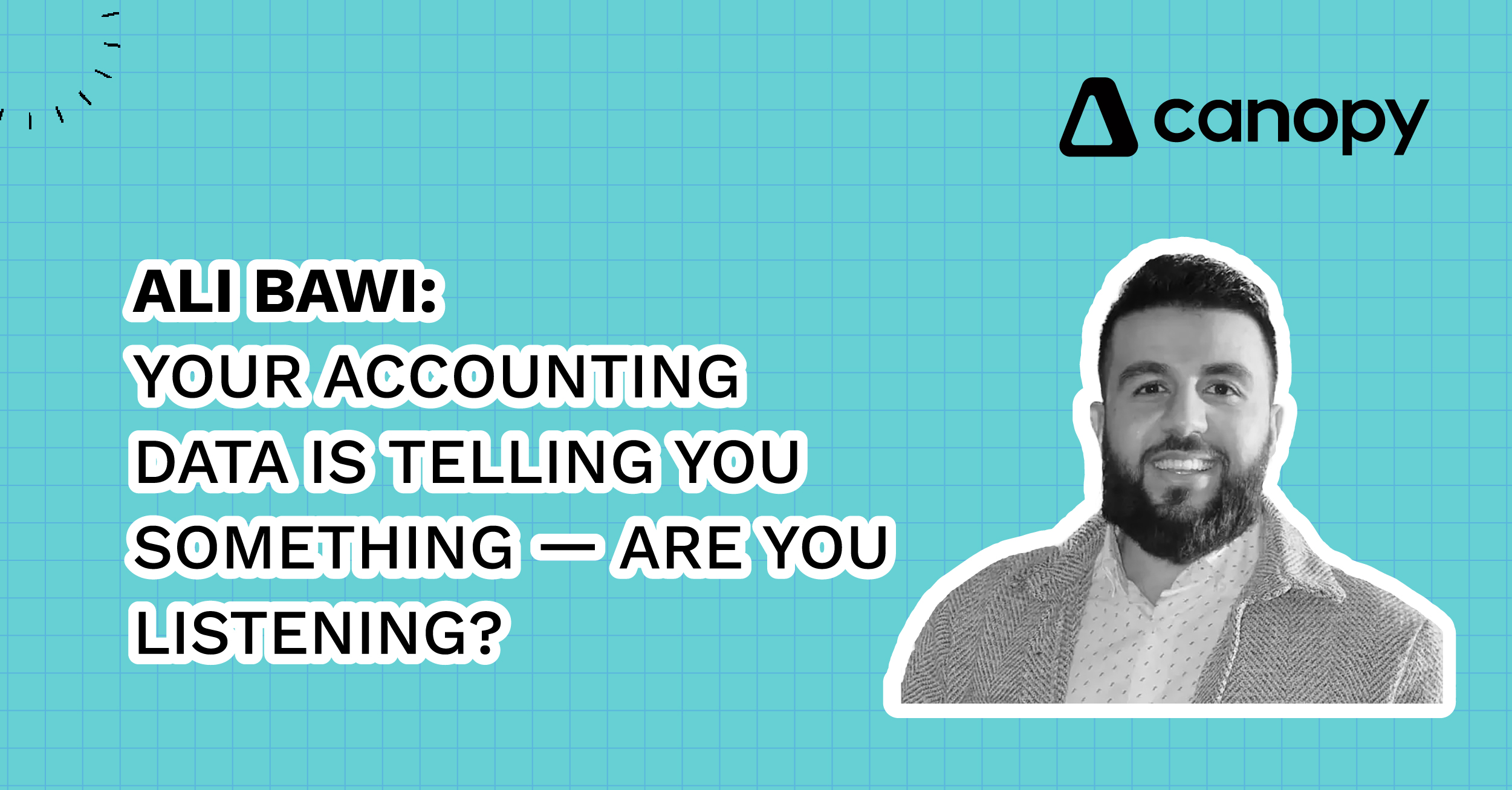
Ali Bawi: Your Accounting Data Is Telling You Something — Are You Listening?




Transcript:
Canopy Host (00:01) Welcome to another episode of Canopy Practice Success. Today’s guest is Ali Bawi, an entrepreneur at heart who became a CPA — not to crunch numbers, but to help businesses grow. He believes accounting is the language of business and he’s built his career translating that language into insight, strategy, and scale.
Ali has worked with Fortune 100 giants to small business founders. The biggest difference he’s seen: big companies use their numbers to drive growth. Smaller firms often treat them as just compliance.
We’re excited to have him on the podcast today. Welcome, Ali.
Ali Bawi (00:42) Thank you. So excited to be here.
I’m glad to hear you think this is a good fit, because I think my experience has been slightly different than a lot of other accountants in building and starting a firm.
Canopy Host (01:16) Yeah. Instead of going into accounting right away — like, “I’m going to have a career in accounting” — you came at it a little backwards. You got to it as a skill you needed to do what you wanted to do.
Ali Bawi (01:30) Exactly. It all goes back to my college professor. She explained accounting as the language of business and how everything is interconnected. I enjoyed that, but I went a more finance route — high finance, M&A work, corporate strategy, and then bookkeeping too. So I got to see everything.
And it really was: you need to know accounting to understand your business. But then use it. Not just to file taxes, not just to complete the compliance work you have to do — but use that data, structure your accounts and your financial statements in a way that helps you make decisions.
Canopy Host (02:07) Yes.
Ali Bawi (02:26) Make decisions.
Canopy Host (02:28) It’s so data rich that I feel like it’s often underutilized. It’s showing you your behaviors over time — your purchases, your spending, whether that’s as an individual or a business.
And when you layer on the expertise you gain from helping clients, you can spot trends. Now I’m talking about looking at this data as the accountant or the firm — and helping your clients. Which means, as you amass clients in a certain space, it uplevels your expertise not just in accounting, but accounting specifically in that industry.
But there’s also the flip side: you have your own firm, your one data point. You don’t have insight into how other firms are operating and how the data might shake out differently for them. I’d love any insight you have on how to educate or inspire firm owners to look at their own data.
Ali Bawi (04:00) For sure. In this episode, I’ll discuss my experience in accounting and how I use it. I really think anyone starting their own firm or looking to transform their firm can benefit from a different mindset and approach to how they run their business.
What is accounting, really? It’s tracking every dollar that comes into the business and how it goes out. Everything has to balance. And since that’s the heart of our profession, it is very, very data focused.
So you made a dollar. Track it. How did you get that dollar? From who? What did it cost you in terms of time, in terms of capital, working capital? Compare that to another dollar you got.
Since you’re already doing the accounting, set it up in a way where you can make decisions from it.
Canopy Host (05:23) As you were saying that, I’m reminded of the principle of opportunity cost. I studied economics in undergrad. I even remember a professor saying, I could mow my own lawn — or I could pay the 14-year-old down the street $10 to do it and do something else with that time that has a higher return. Not that I’m necessarily earning $11 to net a dollar, but my time is more valuable doing something else.
You’re talking about that: you bring in a dollar, and what are you doing with it?
Ali Bawi (06:02) Absolutely.
Canopy Host (06:19) I’m reminded of a finance training I participated in a few years ago. I wish I’d retained more of it. Finance is different from accounting — and maybe we can dig into that in a bit. But I learned things like liquid assets and fixed assets, and as a business, where you want a balance. It was just exposure to how companies think about money.
We mentioned in your intro that you’ve worked with small businesses and Fortune 100 companies. I’m sure there are wildly different mentalities, modes of execution, and ways of viewing data. I’d love any examples of either a small company that gained a Fortune 100 mindset, or what you saw in Fortune 100 companies that you then applied to other businesses.
Ali Bawi (07:31) For sure. It’s funny you mention return on investment for your time, because my friends hate me for this: I’m always telling them to focus on ROI. If you’re trying to make money and you have a degree and a job, invest more into it. Become an expert. That will get you the most in the long term — as opposed to going to learn drop shipping on the side.
And it’s really the same thing with any business, or any person. Being intentional about your time and your investment.
So I did corporate strategy at Starbucks. Starbucks makes great coffee, but what they’re really special at is the experience. And they understand the customer experience more than any company I’ve seen — because of how much they use their data.
The mobile app — I’ve read that around 50% of their orders come from the app. And the app tracks your behavior. If it’s Wednesday afternoon and you usually get your coffee but this week you haven’t, the app sends you 20% off. It didn’t ask you why you didn’t come in. It just incentivized you in a different way. That’s great business. It’s really understanding your ideal client.
Canopy Host (09:43) Okay, so how can accounting firms do that for their business or their clients?
Ali Bawi (09:48) Great question. I actually want to talk about a client first, and then I’ll tell you about an accounting firm I transformed.
So this client — a small business — had a day job but was creative. We work with creatives and tech companies. They had a mug shop. They’d draw on them and sell them. Very passionate, but they didn’t fully understand the business side. That’s an entrepreneur problem in general.
They had different sales funnels and revenue sources. One was trade shows. Another was a website. Here’s this person making very little money, working nights to ship and handle operations, but wanting to quit their day job.
So we looked at the numbers. They loved going to trade shows and it was bringing in the most revenue. I’ll change the numbers for simplicity: let’s say they were getting $50 from trade shows. The cost of a booth was $30. So in their mind, they’re making $20 of net profit.
But let’s break that down. How much did it cost to drive to the trade show? Gas, miles — that’s an expense. Let’s say $5. Now you’re at $15. How long were you there? Four hours. How good of an ROI is that?
Now let’s look at the website. It was generating $25. But what were the inputs? They were using Wix — simple, minimal expenses. Maybe $2. So the net profit was exponentially higher.
Canopy Host (13:37) The profit margin was exponentially higher. So — and I want to push on this — I’m not a small business owner. I’m a basic 1040 client. But I don’t see accounting firms calling out things like profit margins and assessing revenue streams. I feel like that’s supposed to be part of advisory. But how often are they having those conversations, and how often are they missing them?
This seems so obvious to me that once you get into the financials of that business, this is the first thing you’d bring up. Are accounting firms doing that?
Ali Bawi (14:51) Not my friends who are accountants, but I’ll say this: there is a lack of tools, and maybe even education on tools that can be used.
With accounting firms, you need to track your employees’ time — because that’s really your product. That’s your service. You need to understand how much time each client is taking, compare that to clients who take less time but have a higher monthly retainer. That’s how you track which client is most profitable.
I’m being hypothetical and keeping it simple, but it really is about being intentional. And everyone knows AI is getting better every day. Bookkeeping, tax filing — a lot of it is going to get close to automated. So our role is going to shift toward advisory. That’s how I see things shaping out in accounting.
A lot of firms are trying to get into that mindset of offering advisory. And they need to apply it to their own business too.
Canopy Host (16:50) You mentioned knowing your employees’ time and how it relates to the clients they’re working on. I want to push on that a little, because there’s a lot of chatter about abandoning time tracking entirely. Ron Baker has said hourly billing is dead — we just haven’t had the funeral yet.
I’ve seen people recommend not only moving away from hourly billing, but dropping time tracking entirely. I know this audience will find that extremely scary. I have colleagues who’ve billed in 15-minute increments at marketing agencies, the same as accounting firms do. They joke every few months about how they don’t miss it and how awful it would be to go back. What’s your take? Have you worked with someone who’s made the transition?
Ali Bawi (19:04) Absolutely. Not only the mental capacity it takes, but the inefficiency. You’re working across multiple clients, constantly switching. You could track every 50 minutes, but it’s going to be very inefficient. It takes time to track time.
So we completely abandoned time tracking in the traditional sense. The way we do it now: we have tasks for each client and we’ve allocated time for each task. That’s how we keep track — because I’m all about data, so I can’t just abandon the most important thing.
Canopy Host (19:51) Well, you’re talking to someone who blocks her time on her calendar. People always say, Casey, I can’t find time on your calendar. But it also lets me say no — I can see my own bandwidth. It lets me dive into tasks faster. The decision’s already made.
And I love my Google Calendar insights. I love being able to see how much time I spent in meetings this week versus think time or project time. Every month I go back through my calendar. What did I accomplish? I update my calendar invites retroactively — if something took less time, I shorten it; if it ran longer, I stretch it. I’m not time tracking exactly, but I understand my time.
And it lets me draw boundaries. In COVID, living at my in-laws while we were renovating, I remember my father-in-law trying to talk to me at 9:30 in the morning while I was working. I looked at him and said: I would love to talk to you about this at 5 o’clock. Right now I’m doing this.
Being able to say “this is what I’m doing from this hour to this hour” and then close the laptop and feel good about what I produced — that matters.
I do wonder to what extent time tracking gets in the way of your mental capacity. You don’t have anything in the back of your mind thinking “this is taking so long.” It takes as long as it takes. You’ll naturally find efficiencies: this is a menial task I hate, I’ll delegate it. This is something software can handle, I’ll find a way. And it frees you up to spend time thinking about how to make your business more efficient — instead of staying inside a billable/non-billable construct that doesn’t incentivize strategic thinking.
Ali Bawi (23:08) Right. There are so many reasons hourly billing is bad. And the client experience too — they start thinking, “I’m spending too much, maybe I shouldn’t call.” That really is bad for everyone.
Let me tell you about the accounting firm I worked on and helped transform. This was what I’d call a traditional tax office. They offered bookkeeping. They used local servers to share folders and files — off the bat, that’s outdated. People were downloading files to their laptops at home and uploading them the next morning in the office. They had EAs who were experienced but not very tech savvy. Clients would drop off paper bank statements and receipts, and we’d enter them into Excel one by one.
I’m sure people listening are thinking, wow. But I think people would be surprised at how common this still is.
So where do you start? On top of all this, they had some burnouts with previous consultants who hadn’t helped and had actually taken clients with them. So the first priority was gaining the owner’s trust — and to do that, we needed to give him full visibility on everything we were doing.
Canopy Host (25:21) Yeah.
Ali Bawi (25:33) They were actually behind on the bookkeeping.
Canopy Host (25:21) Yeah, yeah.
Ali Bawi (25:33) So the approach was: be intentional. That’s really what accounting firms should be. You have your April 15 deadline. Which clients don’t want to extend? Let’s prioritize completing their bookkeeping. We focused on those, got them clean, filed the taxes. Great. Now we have three to four months for the extensions.
Once that was done, we used the practice management system to give the owner visibility on where each client stood in terms of status and operations — documenting everything we do for each client.
Then the next question: how much are we getting from each client? Some were on monthly fixed fees. I kid you not, some were $250 a month. And how long did it take us? It was a full year of cleanup. It took us a lot more than $250 a month worth of work.
Canopy Host (26:58) And who’s doing the work — is it the senior person?
Ali Bawi (27:16) It was a senior.
Canopy Host (27:36) That’s not uncommon. And I want to highlight to our audience — this is an entrepreneur problem. Entrepreneurs are often plagued with difficulty delegating and knowing who to delegate to. You don’t need someone at the same skill level as you for every task. That would be its own inefficiency. You need someone with just the right amount of skill for that job — an entry-level bookkeeper. Then you create career paths, promotion opportunities, all of those things.
Ali Bawi (28:06) For sure. And in terms of internal operations, team morale — the more senior people get, the more they’ve paid their dues and the less they want to do mundane tasks. So going back to the time: how long did it take for each client?
Some of these clients were great people, great relationships with the owner. But in terms of business…
Canopy Host (28:46) A good person does not make a good client necessarily.
Ali Bawi (28:52) Exactly. So that’s the conversation accounting firms need to have with their team. These are the tasks we have for this client. This is how long it’s taking. Can we make it more efficient? Maybe we raise prices. Maybe we communicate to the client that we’re doing more than expected.
Canopy Host (29:32) As you’re talking, I realize it’s the same questions you’d ask about the mug business — the trade show, the Wix example — that you need to ask about your own firm. And you have to do it with your team. It’s probably hard because it’s vulnerable. You’re assessing your data, your behaviors, your profitability and making hard decisions.
It’s hard for that entrepreneur to say, “But I love trade shows. I love interacting with people.” And yes, I hear you. But what are you trying to do? Are you trying to keep the lights on, provide for your team, have a retirement, see your kids in the evening?
I have three little girls. That’s a big reason I try to be as effective as I can during the day. These little inefficient decisions really do add up. If you’re making those decisions over and over, you’re going to close your laptop at 7pm instead of 5pm. Or you’re going to get to a place where you’re stressed and burned out.
These principles — for the mug business, for the small accounting firm — it’s the same problem. Are you willing to sit down with your team and be honest about how the business is functioning so it can function better? You may have to trim some fat — whether that’s clients, old tech, or something else. But you can be a small business with a Fortune 100 mentality.
Ali Bawi (32:23) Absolutely. And this is music to my ears, because that’s what I preach. You can love the trade shows. You can love a client. I had a client — a film and media company — who loved traveling to client sites. But when we broke it down project by project, it really wasn’t profitable.
The CPA side of me comes back to: what is the main objective? A business is there to make money. We want fulfilling work, and I do serve clients I like and feel I can help. But we’re also trying to have a successful business. What does that look like for your accounting firm?
Canopy Host (33:24) And if you don’t make these decisions and have a successful business, you can’t help anyone in the future. You have to fill your cup first to fill someone else’s. In this case, the cup is revenue. You have to maintain a healthy business to keep helping others.
Ali Bawi (34:04) Exactly. Let me ask you — do you think that local tax office was making a lot of money and super happy?
Canopy Host (34:04) Absolutely not.
Ali Bawi (34:12) No. They were stressed. And that’s why they brought me on. So we transitioned them to a monthly retainer mindset — take the average time each client requires, identify your ideal profit margin, multiply it out, and figure out what to charge. It’s simple math. Accountants can do Excel.
And honestly, Excel is still the number one tool for CFO-level analysis. We use Tableau and Power BI for visuals, especially for larger clients. But for this kind of work? Go to Excel. This is my profit margin. This is how many hours this client costs me. Do the math and find out what you should be charging. Do it for each client.
It’s about having an intentional mindset about each of your revenue streams and your operations. That’s how businesses scale — by understanding your current operations, your current revenue streams, and asking: where can I improve the profit margin? Where can I cut costs? Where can I grow?
Canopy Host (36:01) Well, thank you so much, Ali. This was a delight and a great conversation.
Ali Bawi (36:07) Thank you for having me. I hope this was helpful.
Hosts & Guests

Ali Bawi
Guest
About the Podcast
Share
Authors
By: Chrissy Rutledge
Chrissy is the Social Media & Content Marketing Specialist at Canopy.
Read more by ChrissyDiscover more like this