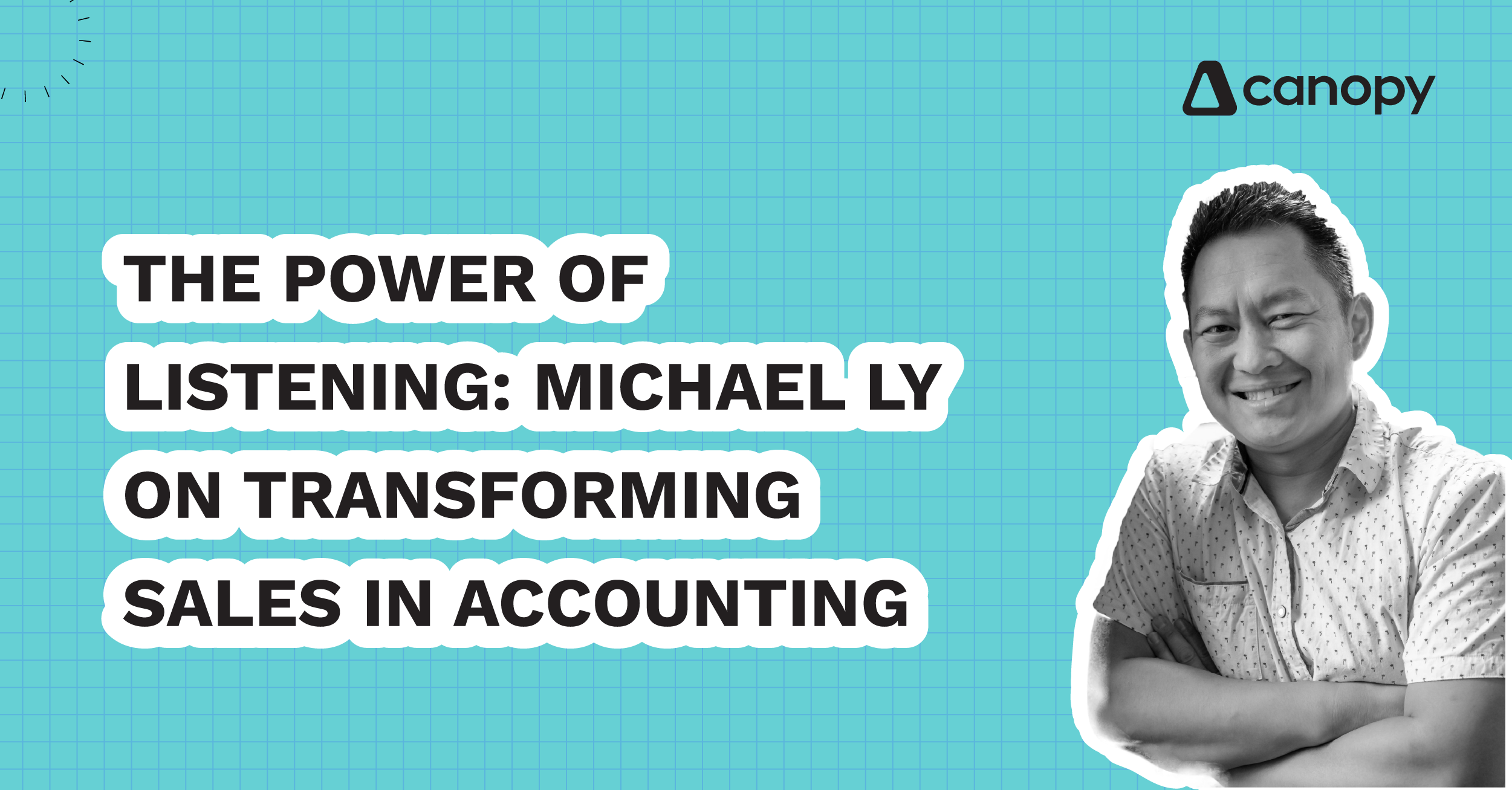
The Power of Listening: Michael Ly on Transforming Sales in Accounting




Transcript
(00:01) Canopy Host
Welcome back to Canopy Practice Success. I’m your host, Canopy Host, and I’m here with Michael Ly. Welcome!
(00:07) Michael Ly
Hey—how are you?
(00:08) Canopy Host
Good—how are you? I already asked that… it’s been one of those days. Back-to-back meetings—I’m sure our listeners can relate.
Michael, give us an introduction so I stop rambling.
(00:32) Michael Ly
I’m Michael Ly, CEO and founder of Reconciled. We’re an outsourced bookkeeping and accounting services firm I started in Burlington, Vermont, and we’ve grown into a national brand.
I’m not involved in the day-to-day much anymore. We’re about 40 people now, with a mix of U.S.-based employees and a nearshore team in Argentina.
I’ve also started a few other businesses and gotten into angel investing and venture capital—especially in the accounting space.
(01:45) Canopy Host
That’s a hot topic right now.
(01:47) Michael Ly
It really is—especially with AI and the influx of capital into accounting. That wasn’t the case before.
One thing I’ve always been passionate about is learning how to listen for opportunities.
(02:20) Canopy Host
What sparked that?
(02:23) Michael Ly
When I started Reconciled, I didn’t feel like I knew how to sell.
But I discovered something quickly: if I spent most of a sales call listening and asking questions, and very little time talking about myself, I almost always closed the deal.
Clients would leave knowing very little about me—but trusting me enough to sign and hand over access to their financials.
(03:48) Canopy Host
That’s fascinating.
(03:50) Michael Ly
It comes down to understanding the real problem the client wants solved.
And listening also reveals opportunities beyond bookkeeping—like advisory, HR, or other services.
(05:12) Canopy Host
Why do you think sales feels so intimidating—especially for accountants?
(05:12) Michael Ly
It’s the outreach and rejection.
Cold calls, emails, reaching out to strangers—that’s what people fear.
And rejection is part of it. Every successful entrepreneur or salesperson has been rejected thousands of times.
(07:17) Michael Ly
There’s another layer too—being okay with disappointing people.
Accountants want perfection. But in business, you won’t always deliver perfectly—and that’s something people have to accept.
(10:19) Canopy Host
So what does good listening actually look like?
(10:19) Michael Ly
It starts with asking the right questions—the same core questions every time.
We actually use a script. Anyone can sell for us using it—even non-accountants.
(10:49) Michael Ly
Most accountants ask the wrong questions—things that don’t matter to the buyer.
Instead, you need to:
- Identify the real pain point
- Understand future goals
- Listen for opportunities beyond accounting
(12:16) Michael Ly
For example, asking about growth plans:
If a client plans to grow, they may need:
- Cash flow support (CFO services)
- Hiring support (HR services)
But if you don’t ask, you’ll never uncover that.
(13:19) Canopy Host
And you’re not even talking about yourself in these calls.
(13:56) Michael Ly
Exactly.
If you sell yourself, clients expect you personally.
If you sell a process or system, you can delegate the work.
That’s how you scale.
(15:38) Michael Ly
We focus on selling:
- The brand
- The process
- The experience
Not the individual.
(16:19) Canopy Host
How did you figure that out?
(16:19) Michael Ly
I knew early on I didn’t want to be the bottleneck.
So I focused on:
- Hiring people better than me at delivery
- Getting great at sales
(17:43) Canopy Host
Do your questions change based on the client?
(17:43) Michael Ly
No—the core questions stay the same.
But we listen for different needs and layer services accordingly.
(20:08) Michael Ly
Some key questions we ask:
- What are your hiring plans?
- What are your growth goals?
- What challenges are you facing?
Those answers drive:
- 80% of pricing
- 80% of the proposal
(21:52) Michael Ly
Listening builds trust fast—which is critical when clients are sharing financial data.
It’s not about impressing them. It’s about understanding them.
(23:16) Canopy Host
Do you track conversion rates?
(23:16) Michael Ly
We aim for a 25–30% close rate.
That tells us:
- Pricing is strong
- Value is clear
If it’s too high, you’re underpricing.
If it’s too low, something’s off.
(24:54) Canopy Host
Do you bill hourly?
(24:54) Michael Ly
No—fixed monthly pricing from day one.
(26:34) Canopy Host
You also hire non-accountants for sales?
(26:34) Michael Ly
Yes—and even for delivery roles.
We prioritize:
- Attention to detail
- Communication skills
- Ability to learn
Not credentials.
(29:27) Canopy Host
How do you maintain a consistent client experience?
(29:27) Michael Ly
Through:
- Standardized services
- Clear engagement scopes
- Practice management systems
Everything is documented so anyone can step in.
(32:08) Michael Ly
At the end of the day, most accountants stay because:
- They feel valued
- They do meaningful work
Not because of titles or promotions.
(34:54) Canopy Host
Where can people learn more?
(34:54) Michael Ly
Search my name—there’s tons of content out there.
There’s no secret—it’s all about execution.
(36:34) Canopy Host
I love this conversation—especially in a world focused on AI.
Because what you’re talking about—listening, relationships—that’s something AI can’t replace.
(37:19) Michael Ly
Exactly.
(37:55) Canopy Host
Thank you so much, Michael.
Hosts & Guests

Michael Ly
Guest
About the Podcast
Share
Discover more like this