Renew Group: Breaking Free from the Broken Business Model




Transcript
Canopy Host (00:01)
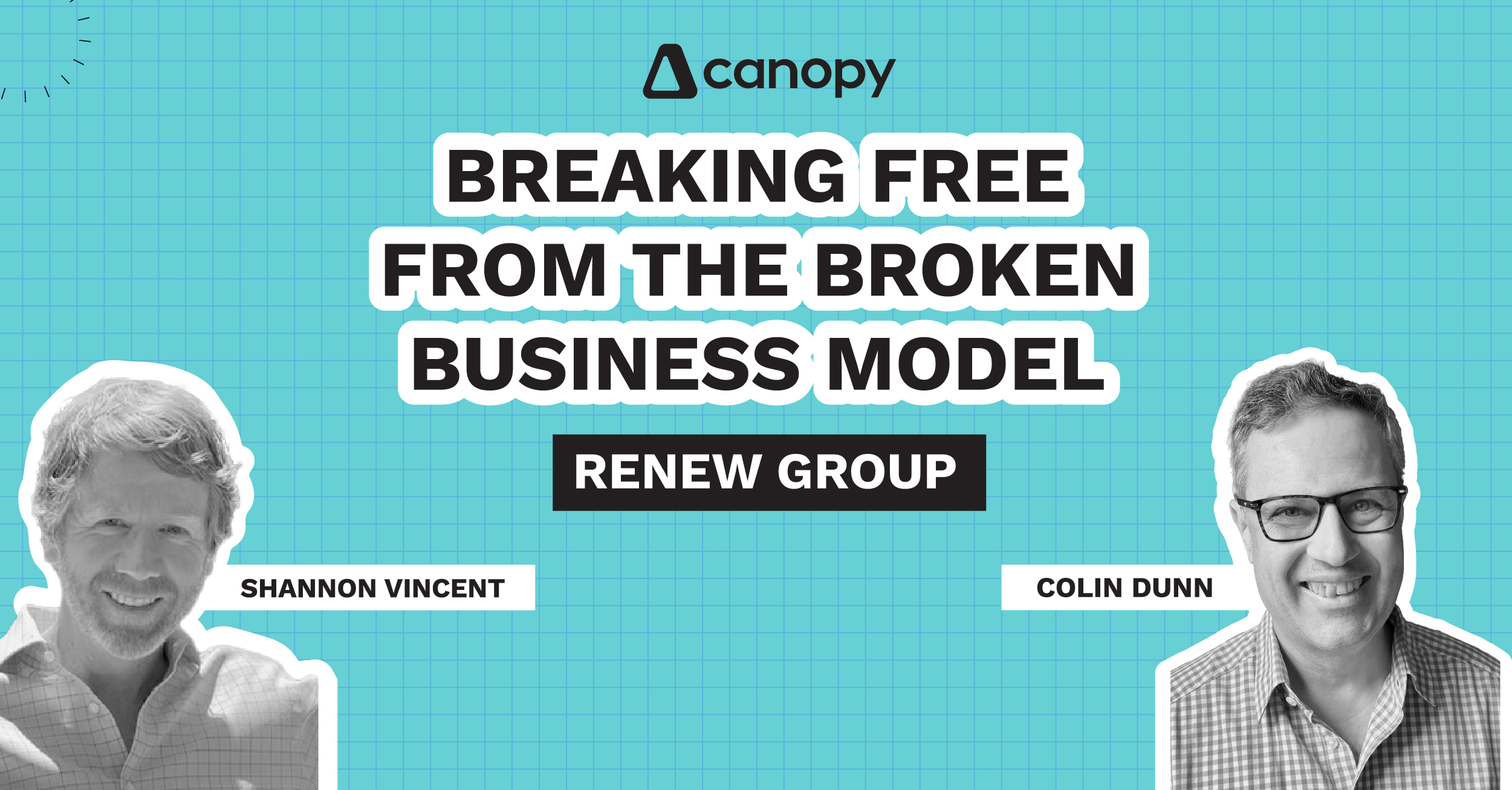
Welcome to another episode of Canopy Practice Success. I’m your host, Canopy Host, and I’m so excited to be here with Shannon and Colin, the founders of Renew Group.
Shannon, Colin—give us an introduction. Tell us a little about how you met. You’ve known each other for decades, and I’d love to hear about the origins of Renew Group.
Shannon (00:21)
That sounds great. My name is Shannon Vincent. I’m a CPA by trade, calling in from Northern California.
Colin and I met in 1996 after we both left public accounting, which is really part of the genesis of how we came together—to fix broken business models and create better lives for teams, while delivering more value for clients.
We loved public accounting, but we didn’t love the hours, the stress, and some of the firm cultures. So that’s what we’ve been working on for the last 30 years.
Colin Dunn (00:55)
Thanks for having us. It’s great to be here.
I’m Colin Dunn, co-founder at Renew. Like Shannon, I’m an accountant. I started in the UK and spent almost 10 years in a firm there. It was fast-growing and exciting—but we were both experiencing the same broken business model.
Long hours, constant pressure—it just wasn’t sustainable. So we built something better and now help other firms do the same.
Canopy Host (01:27)
I love it—glad to have you both.
Before we dive into the broken business model, I want to take a quick tangent. I talk to a lot of people in this space who are afraid—or unsure—how to change.
From what I know about you both, it feels almost like kismet. Shannon, you’re in Berkeley. Colin, you started in the UK and now you’re in Australia. Somehow, the stars aligned and you built something meaningful together.
It’s just a reminder that there is a path forward—even if the current status quo feels stuck.
So let’s use that as a bridge. Shannon, can you walk us through what defines this “broken business model”?
Shannon (02:48)
Absolutely.
At a high level, the broken business model comes down to:
- The wrong clients
- The wrong services
- At the wrong pricing
It’s the “all things to all people” approach.
That leads to a transactional model—where deadlines like 3/15, 4/15, 9/15, and 10/15 completely take over your life. You’re constantly reacting instead of being proactive.
The industry has historically tried to solve this by working more hours—but that’s not sustainable if we want the profession to thrive.
Canopy Host (03:49)
Yeah.
Colin Dunn (03:49)
It’s interesting—accounting may be the only profession that expects to work itself into the ground every year.
That’s because the model is broken. The only way to succeed in that model is to work more.
Canopy Host (04:12)
I’ve never heard it put quite like that—but it’s true.
There’s seasonality, sure. Tax deadlines are fixed—you can’t “creatively rethink” April 15th. But it’s hard to break out of that cycle.
Colin Dunn (04:56)
Exactly. And the shift starts when firms begin saying no.
No to:
- The wrong clients
- The wrong work
- The wrong team structures
When firms step back and design their model intentionally—defining who they serve and how—they can finally operate differently.
Canopy Host (05:25)
So how long does that transition take?
If someone decides today: “I’m going to start saying no,” how long are they in that uncomfortable, uncertain phase?
Shannon (06:31)
Great question.
We typically start with a Pareto analysis—breaking down the client base by revenue.
What we often find is a group of “insanity zone” clients—low-paying, high-demand, transactional work.
The goal is to shift toward year-round, value-based clients.
Realistically, transformation takes two to three tax seasons.
You can make big improvements in year one—but full transformation takes time. This didn’t happen in one season, and it won’t be fixed in one.
Canopy Host (08:05)
Fair—but does that mean a revenue hit for 2–3 years?
Colin Dunn (08:14)
Almost certainly not.
In fact, most firms become revenue neutral or better in year one.
They:
- Drop low-value clients
- Increase prices for the right clients
The key shift is mindset—moving away from scarcity and toward intentional design.
Canopy Host (08:44)
That makes sense—and I asked because I know people are thinking: “This sounds great, but it’s risky.”
So beyond pricing and client changes—what else improves early on?
Shannon (10:32)
One core principle: Make the firm your number one client.
When the firm is healthier:
- You create more value
- You work fewer hours
- You reduce stress
We’ve had firms say they feel anxious during tax season… because things are too calm.
Canopy Host (11:14)
That’s wild—but I get it. It’s like breaking muscle memory.
Shannon (11:26)
Exactly. People get addicted to the chaos.
But then suddenly:
- They’re home for dinner
- They have evenings back
That’s a huge shift.
Canopy Host (12:13)
And “less work” doesn’t mean less value—it means better work.
Colin Dunn (13:06)
Exactly—more impact, more value.
When you remove low-value noise, you can focus on your best clients and have better conversations.
That’s why people became partners in the first place.
Canopy Host (14:19)
You can’t be all things to all people—that applies everywhere.
Even in relationships. Trying to be everything dilutes your ability to be great at anything.
Shannon (15:30)
Exactly—and that’s why we shift how firms measure success.
Instead of total revenue or client count, we focus on:
- Average revenue per client
Do more meaningful work for fewer clients—and charge for it.
Canopy Host (16:05)
How easy is it for firms to actually access that data?
Colin Dunn (16:54)
They usually have the data—they just aren’t using it.
They’re too busy working in the business to work on it.
Canopy Host (18:16)
And it’s hard—especially when non-billable time feels like “lost revenue.”
Colin Dunn (18:16)
That’s why they need to prioritize working on the firm.
Otherwise, they stay stuck in the hamster wheel.
Shannon (19:04)
We recommend at least four hours per week working on the business.
And having accountability—whether that’s a partner, coach, or peer.
Colin Dunn (20:01)
And often, when firms consider dropping clients, their team says:
“You should’ve done that years ago.”
Canopy Host (20:58)
That’s telling.
Let’s talk metrics—what defines a “model firm”?
Colin Dunn (21:26)
Key metrics include:
- Average revenue per client:
Move from ~$1,500–$2,000 → $8,000+ - Revenue per full-time employee:
Target ~$250,000 - Labor cost:
Around 35% of revenue - Average charge rate:
~$200/hour equivalent
Canopy Host (23:43)
And you still recommend tracking time?
Colin Dunn (24:03)
Yes—but not for pricing.
Track time to understand cost, not to bill it.
Shannon (25:18)
Exactly—pricing is based on value and outcomes, not time.
Canopy Host (25:50)
What other metrics matter?
Shannon (25:59)
Two big ones:
- 40-hour workweeks year-round
- 75%+ subscription revenue
Subscription revenue stabilizes cash flow and eliminates reliance on lines of credit.
Canopy Host (27:41)
That alone reduces stress significantly.
Shannon (27:48)
Absolutely. Firms shouldn’t be borrowing to make payroll.
Canopy Host (27:57)
And firms aren’t banks—they shouldn’t be chasing payments.
Shannon (28:39)
Exactly. We move clients to monthly ACH billing.
You define the terms—not the client.
Colin Dunn (29:30)
That’s critical. Boundaries matter.
Clients came to you for expertise—not for the cheapest option.
Canopy Host (30:14)
I love that.
To wrap—this can feel intimidating. But there’s a better path.
Go stand in the mirror, do a power pose, and remind yourself—you can do this.
Colin Dunn (31:29)
Sometimes the first sale is to yourself.
Shannon (31:50)
And don’t price alone.
Bring in a partner, teammate, or advisor—the price always goes up.
Canopy Host (32:33)
Because others see your value more clearly than you do.
Or call Shannon and Colin.
Shannon (32:41)
We love increasing prices—it’s one of our core competencies.
Canopy Host (32:51)
Thank you both—this was a great conversation.
Shannon (32:55)
Thanks for having us.
Colin Dunn (32:57)
Absolutely—this was terrific.
Hosts & Guests

Colin Dunn
Guest

Shannon
Vincent
About the Podcast
Share
Discover more like this