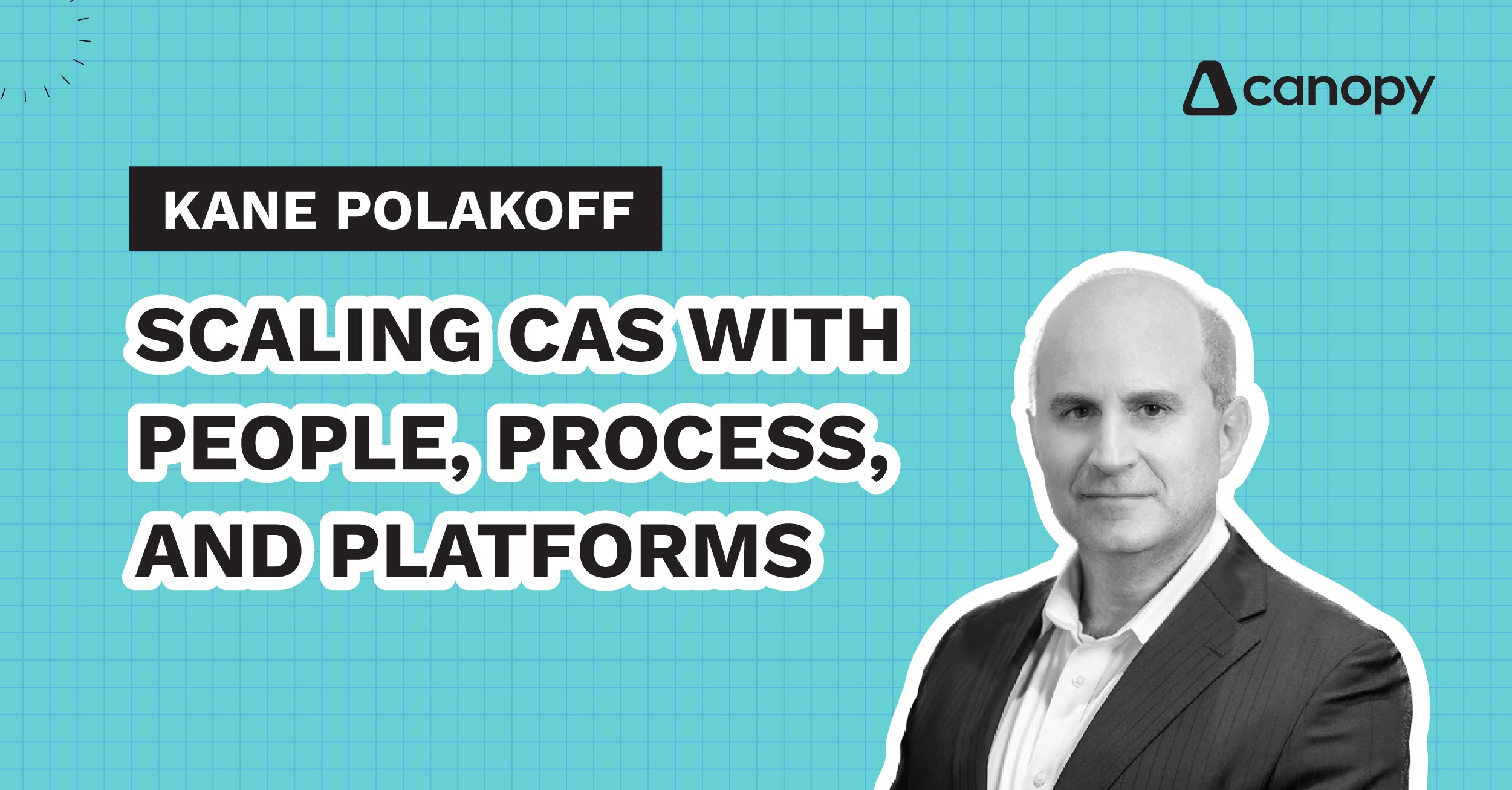
Kane Polakoff: Scaling CAS with People, Process, and Platforms




Transcript
Canopy Host (00:01) Welcome to another episode of Canopy Practice Success. I am your host, and I am here with Kane Polakoff. Kane has 30 years of experience developing and implementing strategic services and solutions to help businesses drive operational growth and value. He was in CAS (Client Advisory Services) before it was even called CAS.
Kane D. Polakoff (00:12) And counting!
Canopy Host (00:27) We are excited to dive in. Welcome, Kane.
Kane D. Polakoff (00:31) Thank you. It’s a pleasure to be here. I appreciate it.
Canopy Host (00:34) I’d love for you to walk the listeners through your resume—strategically speaking. You’ve had such an interesting path, especially being at such a large organization. You hold values and worldviews that differ significantly from what people typically attribute to large firms. Could you give us a history of your journey and perhaps tease why I said you’ve been in CAS since before it had a name?
Kane D. Polakoff (01:14) It’s funny; I remember being in Chicago early in my career—the same city where my daughter is now starting her own career at a large public accounting firm. I started in consulting in the late 90s during the big push for Y2K and globalization. Everyone was worried the world would end when the year 2000 hit, so we were looking for global operations to support clients and ensure banking systems stayed functional.
Early on, I worked with individuals in China, India, and the Philippines, which was relatively new at the time. After meeting my wife in Chicago, we moved to Michigan, where I found an opportunity in what we then called Business Process Outsourcing (BPO). One of the organizations I worked for was actually a carve-out from RSM McGladrey. That carve-out was essentially CAS, though nobody knew the term then. We provided accounting services and technology to support clients, mainly in the hospitality space, delivering financial statements and advising them.
Fast forward to today, and I’m back in public accounting for my “second tour of duty.” I’ve had the success of building one practice from scratch, and for the last two and a half years, I’ve been fortunate to be at CohnReznick.
Canopy Host (03:36) It sounds like it’s been a fantastic journey.
Kane D. Polakoff (03:36) It hasn’t always been easy, but it’s been a lot of fun. We’ve found a great group of people working hard together to drive results. We’ve done some pretty amazing things in a short period.
Canopy Host (03:53) Where do you feel BPO (Business Process Outsourcing) failed? What is the big “delta” between traditional BPO and modern-day CAS?
Kane D. Polakoff (04:12) BPO and CAS are similar in some ways, but the difference lies in the focus. BPO was focused almost entirely on the transactional level—low-end data entry. In the early 2000s, we had huge rooms of operators typing and scanning documents because OCR (Optical Character Recognition) technology was just beginning to emerge. It was purely a labor arbitrage play. At one point, I had 5,000 folks in Chennai, 2,000 in China, and a couple thousand in the Philippines just doing manual entry.
CAS today is a combination of people, process, and technology. Technology has evolved so much that what used to cost big companies millions of dollars in ERP systems can now be done for a fraction of that. We have incredible general ledger systems, AP automation, and CRM tools. That technology is the backbone.
Where BPO was just about cost savings, CAS is about telling stories with information. It’s about making recommendations and helping clients determine the future of their organizations. We call this “CAS 2.0.”
Canopy Host (06:54) I feel like when people first get into CAS, they might still fall into those BPO-type behaviors or outputs. I hear a lot about “imposter syndrome” regarding advisory work—people wondering how to get comfortable offering advice. What would you say to help them cross that chasm?
Kane D. Polakoff (07:48) It’s an interesting point. People used to think of this as “write-up work” or bookkeeping—a necessity just to get a tax return done. It was after-the-fact work where you weren’t really partnering with the client. Often, poor performers in a firm were moved into those roles.
Now, CAS is sexy. It involves new technology, analytics, and AI. You’re partnering with CFOs and CEOs. We are seeing some of the most intelligent, extroverted, and analytical people joining the field. We are even starting internship programs to show college students that there is a third path beyond just Audit or Tax. According to the AICPA, CAS is the fastest-growing line of business. We saw 60% top-line growth last year. To succeed, you have to bring in top talent and build the right infrastructure.
Canopy Host (10:33) I’m a visual learner, and while we can’t do visuals here, a story might help. Do you have a client story that illustrates the ideal “CAS journey”?
Kane D. Polakoff (11:16) Sure. Take a restaurant client of ours. Before they came to us, they were using an outdated general ledger. They had no AP automation, their financial statements were never on time, and their Point of Sale (POS) data had to be entered manually. They couldn’t accurately track food costs, labor, or paper goods.
We had to determine which systems would work for them and how to integrate their existing ecosystem to get real-time information. This client actually had three different POS systems across various locations due to acquisitions. We spent a few months cleaning up the data, setting up an AP automation tool, and building a new general ledger that provided the franchisor with a clear view of profitability.
Canopy Host (13:47) The client came to you with a problem, but did they realize the full scope of what you could do? How do you sell them on that higher-level CAS offering?
Kane D. Polakoff (14:24) That’s part of the “dating process.” You have to demonstrate your knowledge of their business and show them what could be done through business cases and specific use cases.
Building a solution like that is dynamic. You’re putting a new engine in the car and a new coat of paint on the outside. You’re building a foundation that drives financial health. As a non-accountant, you might think, “That doesn’t sound like accounting.” And you’re right—it’s a mix. My team includes accountants, but also engineers, tech specialists, and project managers. You need a cross-functional team to move the ball 100 yards down the field.
Canopy Host (17:18) So, you’ve analyzed the systems, integrated the data, and ensured data integrity. Where do you go from there?
Kane D. Polakoff (17:35) Once the foundation is set, you execute. We bring in experience from specific verticals—whether it’s restaurants, non-profits, or real estate. Knowing the nomenclature of the industry is vital. We look at KPIs (Key Performance Indicators) and determine the definition of success.
The vision is to pull data from payroll, operations, and finance and put it together in a simple way so an executive can make better decisions—whether they want to grow, optimize their bottom line, or make an acquisition.
Canopy Host (19:33) That is the top tier of CAS. It’s about becoming that “trusted advisor.”
Kane D. Polakoff (21:17) Exactly. You become an extension of their team. I always say I want to be in a position where our clients invite us to Thanksgiving dinner. That’s how integrated we want to be.
Canopy Host (21:17) That makes sense, especially for entrepreneurs whose business is their “baby.” You’ve helped that baby grow.
Kane D. Polakoff (22:02) It’s the best part. When we get a “thank you” or even a hug from a client, it reminds us why we’re in the service business. It’s not just about accounting; it’s about solving challenges together.
Canopy Host (22:35) I love that. Arthur C. Brooks, a Harvard professor, defines happiness as enjoyment, satisfaction, and meaning. You’ve hit on all three. CAS is pulling the industry away from the 80-hour-a-week “grind” mentality of the 80s and 90s and toward finding meaning in our work.
Kane D. Polakoff (23:58) In my book, three words are most important: People, Culture, and People. I love what I do, but I want our team to have a good work-life balance. If we don’t have people with great attitudes, the technology doesn’t matter.
I don’t want my team working 80 or 100 hours a week. That’s why we have a global operation. Our US team takes off the entire week of July 4th and Thanksgiving while our global team steps in, and then we return the favor for their holidays. Everyone should be challenged and successful, but also happy and balanced.
Canopy Host (25:37) Kane, you are a breath of fresh air for this industry. Everyone, look up Kane Polakoff on LinkedIn—he was recently named one of the Top 100 Most Influential People by Accounting Today. Thank you so much for joining us.
Kane D. Polakoff (25:44) Thank you for the opportunity to talk today!
Hosts & Guests

Kane Polakoff
Guest
About the Podcast
Share
Discover more like this