
CONTENT HUB > Featured >
Nov 21, 2025 60 min watch

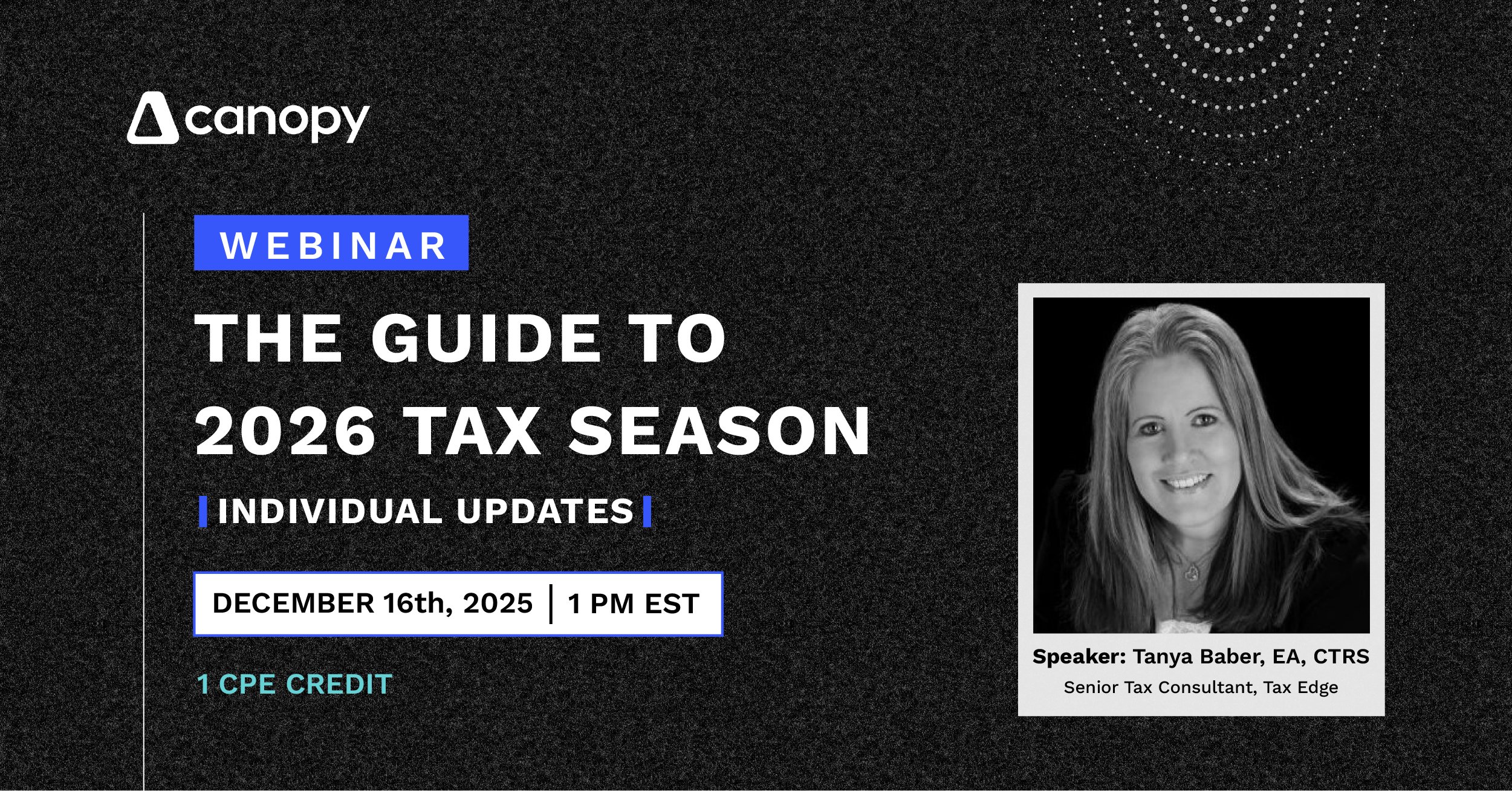
The Guide to 2026 Tax Season: Individual Updates
on demand
The Guide to 2026 Tax Season: Individual Updates

Speaker:

Tanya

Tax laws change every year, and keeping up can be challenging...even for the most experienced professionals.

With the 2026 tax season right around the corner, now is the time to make sure you have the insights you'll need to guide your clients with confidence.

In this session, you'll:

  • Get a clear overview of the most important individual tax changes for the 2026 season
  • Understand how new IRS updates may impact your clients
  • Know what to prepare now so you’re ready when filing season begins


2026 Tax Update for Individuals Q&A

Estimated Taxes and Filing Mechanics (MFJ vs MFS)

Estimated tax reporting, if both spouses make estimated payments, do you file two Schedule 1s since an SSN is required?

On the newly re-designed 1040 form (page 2) line 26 allows for a spot now to acknowledge if you made an estimated tax (ES) payment with a former spouse by allowing you to enter their SSN. This would not be needed if both spouses made estimated payments and are filing MFJ.

The purpose of this box is to assist the IRS in applying ES payments when made with a former spouse, and then they can find the payment and apply properly. (Only one of the spouses claiming that particular ES payment however).


For MFJ returns, if estimated payments are made as one lump sum, how should they be allocated between spouses?

Similarly, if estimated tax (ES) payments are made as one lump sum and the spouses are filing MFJ, there is no worry about allocating the payment in any fashion. You would not use box 26 on the Page 2 of the 1040 at all unless you were needing to apply ES payments that were made along with a former spouse.


What happens if an estimated payment is accidentally made under the spouse’s SSN and the IRS doesn’t match it, resulting in a notice or adjustment?

The purpose of the newly re-designed 1040 Page 2 (line 26) is to hopefully assist in better matching in the future. However, as is true with any notice or adjustment, if it is in error, it will require contact with the IRS in order to fix the error.


Line 36b of Part V adds the $6,000 for the spouse, is this how both spouses are handled on one schedule?

Yes, precisely. That would mean both spouses can be included properly on the same Schedule 1-A to take advantage of the deduction (Up to $6,000) per person enhanced senior deduction for when both spouses qualify.


Line 36, can the $6,000 senior additional amount be entered twice when filing jointly?

It would be entered on line 36a for one spouse, then again on line 36b for the other spouse if they also qualify, making it possible to take advantage of the deduction for each spouse.


On Line 32, it references $75,000 single and $150,000 MFJ, if there are two forms for a married couple, why is $150,000 used, especially since Schedule 1-A only asks for one SSN?

As is common with many IRS Schedules, the one SSN is simply used to tie it back to the main taxpayer on the return (the SSN that is listed first is considered the main taxpayer) and it would be correct that this form would be used only once, but would account for both spouses within lines 35 & 36 under Part V of the New Schedule 1-A.


Why isn't the senior deduction total phaseout limit $300,000?

In this case it is because it was decided that phaseout would begin at $75,000 ($150,000 MFJ) and then would be fully phased out after $175,000 ($250,000 MFJ). This is calculated in Part V by using lines 32 and 33, which will start to force the phase out of the 6% for income over $75,000 ($150,000 MFJ) based on the rules set with the OBBBA. 


Tips, Overtime, and Wage Classification

MFS status, tip exclusion and overtime exclusions do not apply, must file jointly to qualify?

Yes, that is correct, MFS filing status does not qualify for this deduction. In order to claim this, a married individual must file a joint return. Non-married individuals will still also qualify, but basically only the Married Filing Separately (MFS) status will specifically not qualify.


For the tip deduction, if a manicurist files Schedule C, do tips need to be separated from income to qualify, or are they excluded entirely?

In the IRS guidance, it listed a self-employed guide that operates as a sole proprietor. In that example, since the self-employed worker kept a log of each of the dates, customers, and tips received, the daily tip log substantiated the tip amount, so it was able to be used. Keep in mind that this deduction cannot be greater than the amount of net profit from the trade or business (basically cannot turn it into a loss).


Should a W-2 be accompanied by an employer statement detailing tips or overtime?

Yes, a W-2 (or 1099) is supposed to be accompanied by a statement detailing tips and occupation codes or separate accounting for overtime compensation, but there is penalty relief provided in Notice 2025-62 that will not make it a requirement for 2025. Many employers and payors do not have the information or systems readily available, and the IRS is not able to update the W-2 or 1099 forms either. For the 2025 year it will be encouraged to have the information supplied, but won’t be required or penalized for lack of supplying the information.


Would gratuities qualify for the tip deduction?

Tips are based on eight categories, the worker must work in a category on the list which is identified as “customarily and regularly receiving tips”and receive qualified tips, and paid for voluntarily by the customer. If the gratuities are within the rules for qualified tips, they would also count.

The eight Treasury Tipped Occupation Codes are a three-digit code and have descriptions within the proposed regulations found here: 

Definition of Qualified Tips


The $25,000 tip deduction is the total maximum even if MFJ and both spouses earn tip income, while the overtime deduction is per taxpayer?

Yes, the $25,000 tip deduction is the total maximum amount, no matter the filing status (except MFS, which would not qualify at all). The Overtime Deduction is $12,500 per taxpayer, so it would be $25,000 maximum, but only for MFJ filing status, since it is based on a $12,500 maximum per taxpayer limit instead.


Sounds like if overtime pay is 1.5x the regular rate, only the excess 0.5x qualifies for the OT exclusion? 

Yes, that is correct. In the example in the IRS guidance provided, it lists where if the amount provided includes both the regular and the half time addition, that the total would be divided by 3 in order to determine just the portion  that qualifies for the OT exclusion. In this example the full amount of overtime including the regular rate was $15,000, thereby making the qualified overtime amount used $5,000 ($15,000 divided by 3).


Will the W-2 be changed to show how much income is attributable specifically to overtime?

Yes, that is correct - there is already a draft form for the 2026 W2 which includes Box 12 codes of TP - for total amount of cash tips reported to the employer and TT - for Total amount of qualified overtime compensation. Additionally, there is Box 14b descriptions which include to use this box to report up to two Treasury Tipped Occupation Code(s) for your tipped occupation.

See page 9 of draft form here.


Would a final paystub be sufficient documentation to substantiate overtime income?

For 2025, there is not a requirement (yet) for employers or payors to report overtime income to their employees / payees. In the guidance issued, it states that individuals who are not furnished a separate accounting of qualified overtime compensation in box 14 (for W-2) or on a separate statement, must make a reasonable effort to determine whether they are considered FLSA-eligible employees, which may include asking their employers or other service recipients about their status under the FLSA (Fair Labor Standards Act). It does further state that other documentation such as earnings or pay statements, invoices, or similar statements that support the determination can be used, and then further describes the methods for purposes of determining the amount of qualified overtime

See the guidance in Notice 2025-69. 


I thought I read that tax-free tips are not available if filing MFS.

It is correct that the tips deduction is not available if filing MFS, that is one filing status that is not eligible for the deduction.


For 2025, is the tip reporting threshold still $600?

As an employee who receives tips, they have the requirement to do three things:

  1. Keep a daily tip record (The IRS recommends using Form 4070A, Employee’s Daily Record of Tips, which is included in Publication 1244)
  2. Report tips to their employer, unless the total is less than $20 per month per employer and 
  3. Report all tips on an individual income tax return.

For more information click here. 


What about Davis-Bacon wages versus normal hourly wages, which category do they fall under?

There is further guidance found in Notice 2025-69 that will help with calculation of qualified overtime (also guidance on qualified tips in here as well). This is found here:

Guidance for Individual Taxpayers who received Qualified Tips or Qualified Overtime Compensation in 2025 

Since the rules under FLSA have overtime requirements that are different for different classes of employers and employees (as defined in the FLSA) that would be one of the resources for guidance. Basically the main idea is that while the additional one-half times portion required by the FLSA may be qualified overtime, payments in excess of the FLSA-required premium are not.


Is the maximum overtime rate limited to time-and-a-half, and how are the double-time payments treated?

Only the portion that would be the extra half time would be counted, in the case of a double-time payment the extra isn’t allowed. In the example the IRS provides, it shows to take the amount and divide by 4 ($20,000 of double pay would result in just a $5,000 amount to be allowed for this overtime deduction).

This is because it would be the portion that would be the “half” extra only in a time-and-a-half calculation - determined by taking the $20,000 and dividing by 4).


1099-K Reporting Rules

There has been recent guidance issued on October 23, 2025 from the OBBBA which effectively retroactively reinstated the reporting threshold in effect prior to the passage of the American Rescue Plan Act of 2021 (ARPA) so that third party settlement organizations are not required to file Forms 1099-K unless the gross amount of reportable payment transactions to a payee exceeds $20,000 and the number of transactions exceeds 200.  

For more information:

IRS issues FAQs on Form 1099-K threshold under the One, Big, Beautiful Bill; dollar limit reverts to $20,000

Additional information: 

IRS revises and updates Form 1099-K frequently asked questions


Does OBBBA's change in reporting threshold mean I won’t get a Form 1099-K if I receive gross payments totaling $20,000 or less, or have 200 or fewer transactions?

Not necessarily. A TPSO (Third Party Settlement Organization) may still send a 1099-K for payments lower than these thresholds, or from other payment settlement entities (such as merchant acquiring entities) because they do not have a minimum threshold.

Also, if any reporting party withheld any backup withholding, no matter how small the amount, it would still require 1099-K reporting in order to show this withholding amount.


For tax year 2024, what is the dollar amount at which a 1099-K is issued?

Since the OBBBA effectively retroactively reinstated the reporting threshold in effect prior to the passage of ARPA, then the threshold was retroactively reinstated to include even 2024 reporting, which would be now if the gross amount of reportable payment transactions to a payee exceeds $20,000 and the number of transactions exceeds 200.


Credits, Deductions, and Income Limits

Do we need to report these credits to the IRS directly, or does the software handle that?

Most tax preparation software is good about calculating credits to assist in the preparation of tax returns. The proper calculation of credits is essential in being able to claim them for a taxpayer, but it is always up to us as tax professionals to double check and look over everything that our tax software produces to ensure we agree with the outcome prior to submission.


Will individuals with ITINs qualify for the Child Tax Credit or the Additional Child Tax Credit?

No, you may not claim the child tax credit for a child with an ITIN. The child must have a SSN to be a qualifying child eligible for the Child Tax Credit (CTC) and/or additional child tax credit (ACTC).

To be a qualifying child, they must be a U.S. citizen, U.S. national, or U.S. resident alien, have a valid SSN, and must not have attained age 17 by the end of the tax year.

See: Child Tax Credit 4

While the requirement to have a SSN was a temporary requirement set in place with the Tax Cut and Jobs Act and was set to expire at 12/31/25, the OBBBA made this now a permanent requirement, and has also set a requirement that the person claiming the credit (Or at least one spouse, if filing jointly) also must have a work-eligible SSN.


Is the above-the-line charitable deduction available if you itemize, but not enough to claim charitable contributions on Schedule A?

No, the two are mutually exclusive. This means that starting in 2026, you can only take the new above-the-line charitable deduction if you take the standard deduction. If you itemize, any amount of charitable contributions would be included in the itemized deduction amount instead.


Can you repeat the rules for capital gains taxation for 2025?

While the OBBBA has introduced several changes that affect many provisions in our tax laws, the core long-term capital gains tax rates have not changed. Capital Gains rates are adjusted by inflation each year and the new rates are illustrated in the slide materials.

This basically means that once you determine the total taxable income, this then will set what rate your capital gains will be taxed at. For example, in 2025, if you are filing a Married Filing Jointly (MFJ) return and your total taxable income is under $96,700, then any of your capital gains would be calculated at the 0% capital gains rate.


Can you repeat the rules for taxation of student loan forgiveness?

Cancellation of Debt (COD) income that is attributed to student loan discharge was previously excludable from income through the end of 2025. This includes certain types of programs like the IDR (Income Driven Repayment) forgiveness plans after 20 or 25 years and discharges due to death and permanent disability, Public Service Loan Forgiveness (PSLF) and employer-provided assistance (up to $5,250 per year).

The OBBBA modified this slightly, since it extends the COD exclusion permanently for the Death and Disability, Public Service Loan Forgiveness and also the Employer-Provided Assistance programs. The only change is that starting in 2026, the Income-Driven Repayment (IDR) plan forgiveness will now be considered taxable.


Which inflation factor is used for these provisions, and how does it differ from the Social Security COLA?

Both tax inflation adjustments and Cost-Of-Living Adjustments (COLA) use CPI data, but they use them for different things. COLA ties benefit increases directly to specific CPI versions (like CPI-W) to maintain purchasing power, but tax inflation adjustments use broader CPI (like CPI-U) to prevent “bracket creep” to ensure the real income isn’t taxed at higher rates just because of general inflation. In general, although both are basing adjustments off CPI and inflation, their methodology is different.

Each year, the IRS will issue their inflation adjustments (as referenced in the slides) and this will set all new rates and deductions and adjustments that are indexed and tied to inflation.


Health Insurance and Premium Tax Credit (PTC)

Regarding the PTC enhancements under ARPA and extended by the IRA, currently scheduled to expire December 31, 2025, what is the current legislative outlook?

Without clear legislative action and proposals, this is unfortunately not something we can begin to guess at. We are seeing it is at least a topic of conversation with lawmakers, but until there is something concrete, it is impossible to guess.


Are any short-term or permanent extensions expected to pass before year-end?

Again, unfortunately without clear legislative action, it is difficult to know which way this will go, and if there is anything actually set to happen by year end.


What planning advice should be given to a middle-income client above 400 percent of FPL who may face the subsidy cliff starting January 1, 2026 if no extension passes?

In general, it is always better to help any taxpayer plan based on what current law is, even if it is that it is unfortunately not forgiving, since we cannot base our advice or assistance in planning on the possibility of future legislation and extensions.

Only current law is set, and future provisions are not set until they become law. So in this example, even if it is unforgiving, if the current law is that a provision is expired, that is what we are going to want to help our taxpayers in planning for, and then if it changes in their favor, that will be a good thing, but not one that we can plan on or guarantee.


Educator, and Occupation-Specific Questions

Would an occupational therapist employed by a public school qualify as an educator in 2026?

Generally the requirements for this are to work as a teacher, instructor, counselor, principal, or interscholastic sports coach or admin for grades K-12 and to work a minimum of 900 hours during the school year. If a school-based occupational therapist meets all these criteria they would generally be considered an eligible educator.

(Note, the American Occupational Therapy Association (AOTA) as noted that self-employed contractors may not qualify in this case)


Can a coach who is not an educator, but coaches grade school children, claim the $350 educator deduction for tax year 2025?

Eligible instructor was expanded starting in 2026 to now include interscholastic sports coaches and administrators, and to also include athletic supplies for health & physical education and instructional activity in this expanded definition.

However, since that applies starting in 2026, it would not apply in your example in 2025 (additionally, the limit is only $300 for 2025, and will increase to $350 for 2026). 


Vehicle and Loan Interest

If a car loan is refinanced, can the car loan interest still be deducted?

Yes, you can generally still claim the car loan interest deduction provided the original loan and vehicle meet all eligibility requirements. This means the original loan was taken out after 12.31.24 for a new personal-use vehicle that met all initial requirements (U.S. Final assembly, weight limits, secured by lien on the same vehicle, etc.)

But you can only deduct the interest paid on the remaining principal balance of the original loan amount at the time of refinancing. If you borrow any extra amount above the outstanding balance, the interest on the additional amount does not qualify. 


Is the vehicle interest deduction limited to U.S.-manufactured vehicles?

A vehicle that qualifies is described as one that has a gross vehicle weight rating of less than 14,000 pounds and that underwent final assembly in the United States.

The way to check to see if the vehicle qualifies is to check the vehicle label at the dealership, and to check the vehicle identification number (VIN) with the National Highway Traffic Safety Administration VIN Decoder (to verify vehicle assembly location). 


Trump Accounts and New Programs

How is the Trump $1,000 deposited, does it require an application?

According to the recent updates on trumpaccounts.gov, you elect to open Trump Accounts for eligible children when you file your 2025 taxes or through an online portal that will be available by summer of 2026. It instructs to check trumpaccounts.gov for latest updates.

How this is accomplished: Form 4547 will be used, and the draft of this form released in December is here:

2025 Form 4547

Instructions for Form 4537:

2025 Form 4547 Instructions


Are there interest rates associated with Trump accounts, and if not, what is the purpose of the account?

It isn't based on interest but is instead an investment, so earnings would be based on the investment performance.

In the illustrations on the website trumpaccounts.gov the illustrations are derived from historical S&P 500 averages and calculated on an account opening at birth with $1,000 opening deposit. 


Does the second increase for participants ages 60 to 63 continue into 2026, and why was that age range chosen?

Yes, the second increase for participants ages 60-63 continues into 2026, but keep in mind that these particular catch-up contributions become subject to ROTH (after-tax) rules for that contribution starting in 2026, so that may limit some higher-income earners from participating in the additional catch up provisions due to the ROTH rules. As to why this age range? Some of our tax laws don’t necessarily explain the ‘why’ but this one is specific for just those age ranges for the additional ‘second’ increase to the catch-up contributions.


IRS Administration and Payments

Is there any IRS guidance on accepting paper check payments or issuing paper refund checks?

The IRS is going to deposit refunds by direct deposit or by other secure electronic methods, and has issued a few news releases to this effect:

What is the IRS phaseout of paper checks means for you

Modernizing payments to and from America's bank account

However, even though they have indicated that more guidance would be issued ahead of the filing season regarding payment options for taxpayers making payments to the IRS, that guidance has not been issued yet as of this publication.

For now, the IRS is indicating the payment options for taxpayers can be found here:  

IRS Make a Payment 

Speaker:

Tanya

Tax laws change every year, and keeping up can be challenging...even for the most experienced professionals.

With the 2026 tax season right around the corner, now is the time to make sure you have the insights you'll need to guide your clients with confidence.

In this session, you'll:

  • Get a clear overview of the most important individual tax changes for the 2026 season
  • Understand how new IRS updates may impact your clients
  • Know what to prepare now so you’re ready when filing season begins


2026 Tax Update for Individuals Q&A

Estimated Taxes and Filing Mechanics (MFJ vs MFS)

Estimated tax reporting, if both spouses make estimated payments, do you file two Schedule 1s since an SSN is required?

On the newly re-designed 1040 form (page 2) line 26 allows for a spot now to acknowledge if you made an estimated tax (ES) payment with a former spouse by allowing you to enter their SSN. This would not be needed if both spouses made estimated payments and are filing MFJ.

The purpose of this box is to assist the IRS in applying ES payments when made with a former spouse, and then they can find the payment and apply properly. (Only one of the spouses claiming that particular ES payment however).


For MFJ returns, if estimated payments are made as one lump sum, how should they be allocated between spouses?

Similarly, if estimated tax (ES) payments are made as one lump sum and the spouses are filing MFJ, there is no worry about allocating the payment in any fashion. You would not use box 26 on the Page 2 of the 1040 at all unless you were needing to apply ES payments that were made along with a former spouse.


What happens if an estimated payment is accidentally made under the spouse’s SSN and the IRS doesn’t match it, resulting in a notice or adjustment?

The purpose of the newly re-designed 1040 Page 2 (line 26) is to hopefully assist in better matching in the future. However, as is true with any notice or adjustment, if it is in error, it will require contact with the IRS in order to fix the error.


Line 36b of Part V adds the $6,000 for the spouse, is this how both spouses are handled on one schedule?

Yes, precisely. That would mean both spouses can be included properly on the same Schedule 1-A to take advantage of the deduction (Up to $6,000) per person enhanced senior deduction for when both spouses qualify.


Line 36, can the $6,000 senior additional amount be entered twice when filing jointly?

It would be entered on line 36a for one spouse, then again on line 36b for the other spouse if they also qualify, making it possible to take advantage of the deduction for each spouse.


On Line 32, it references $75,000 single and $150,000 MFJ, if there are two forms for a married couple, why is $150,000 used, especially since Schedule 1-A only asks for one SSN?

As is common with many IRS Schedules, the one SSN is simply used to tie it back to the main taxpayer on the return (the SSN that is listed first is considered the main taxpayer) and it would be correct that this form would be used only once, but would account for both spouses within lines 35 & 36 under Part V of the New Schedule 1-A.


Why isn't the senior deduction total phaseout limit $300,000?

In this case it is because it was decided that phaseout would begin at $75,000 ($150,000 MFJ) and then would be fully phased out after $175,000 ($250,000 MFJ). This is calculated in Part V by using lines 32 and 33, which will start to force the phase out of the 6% for income over $75,000 ($150,000 MFJ) based on the rules set with the OBBBA. 


Tips, Overtime, and Wage Classification

MFS status, tip exclusion and overtime exclusions do not apply, must file jointly to qualify?

Yes, that is correct, MFS filing status does not qualify for this deduction. In order to claim this, a married individual must file a joint return. Non-married individuals will still also qualify, but basically only the Married Filing Separately (MFS) status will specifically not qualify.


For the tip deduction, if a manicurist files Schedule C, do tips need to be separated from income to qualify, or are they excluded entirely?

In the IRS guidance, it listed a self-employed guide that operates as a sole proprietor. In that example, since the self-employed worker kept a log of each of the dates, customers, and tips received, the daily tip log substantiated the tip amount, so it was able to be used. Keep in mind that this deduction cannot be greater than the amount of net profit from the trade or business (basically cannot turn it into a loss).


Should a W-2 be accompanied by an employer statement detailing tips or overtime?

Yes, a W-2 (or 1099) is supposed to be accompanied by a statement detailing tips and occupation codes or separate accounting for overtime compensation, but there is penalty relief provided in Notice 2025-62 that will not make it a requirement for 2025. Many employers and payors do not have the information or systems readily available, and the IRS is not able to update the W-2 or 1099 forms either. For the 2025 year it will be encouraged to have the information supplied, but won’t be required or penalized for lack of supplying the information.


Would gratuities qualify for the tip deduction?

Tips are based on eight categories, the worker must work in a category on the list which is identified as “customarily and regularly receiving tips”and receive qualified tips, and paid for voluntarily by the customer. If the gratuities are within the rules for qualified tips, they would also count.

The eight Treasury Tipped Occupation Codes are a three-digit code and have descriptions within the proposed regulations found here: 

Definition of Qualified Tips


The $25,000 tip deduction is the total maximum even if MFJ and both spouses earn tip income, while the overtime deduction is per taxpayer?

Yes, the $25,000 tip deduction is the total maximum amount, no matter the filing status (except MFS, which would not qualify at all). The Overtime Deduction is $12,500 per taxpayer, so it would be $25,000 maximum, but only for MFJ filing status, since it is based on a $12,500 maximum per taxpayer limit instead.


Sounds like if overtime pay is 1.5x the regular rate, only the excess 0.5x qualifies for the OT exclusion? 

Yes, that is correct. In the example in the IRS guidance provided, it lists where if the amount provided includes both the regular and the half time addition, that the total would be divided by 3 in order to determine just the portion  that qualifies for the OT exclusion. In this example the full amount of overtime including the regular rate was $15,000, thereby making the qualified overtime amount used $5,000 ($15,000 divided by 3).


Will the W-2 be changed to show how much income is attributable specifically to overtime?

Yes, that is correct - there is already a draft form for the 2026 W2 which includes Box 12 codes of TP - for total amount of cash tips reported to the employer and TT - for Total amount of qualified overtime compensation. Additionally, there is Box 14b descriptions which include to use this box to report up to two Treasury Tipped Occupation Code(s) for your tipped occupation.

See page 9 of draft form here.


Would a final paystub be sufficient documentation to substantiate overtime income?

For 2025, there is not a requirement (yet) for employers or payors to report overtime income to their employees / payees. In the guidance issued, it states that individuals who are not furnished a separate accounting of qualified overtime compensation in box 14 (for W-2) or on a separate statement, must make a reasonable effort to determine whether they are considered FLSA-eligible employees, which may include asking their employers or other service recipients about their status under the FLSA (Fair Labor Standards Act). It does further state that other documentation such as earnings or pay statements, invoices, or similar statements that support the determination can be used, and then further describes the methods for purposes of determining the amount of qualified overtime

See the guidance in Notice 2025-69. 


I thought I read that tax-free tips are not available if filing MFS.

It is correct that the tips deduction is not available if filing MFS, that is one filing status that is not eligible for the deduction.


For 2025, is the tip reporting threshold still $600?

As an employee who receives tips, they have the requirement to do three things:

  1. Keep a daily tip record (The IRS recommends using Form 4070A, Employee’s Daily Record of Tips, which is included in Publication 1244)
  2. Report tips to their employer, unless the total is less than $20 per month per employer and 
  3. Report all tips on an individual income tax return.

For more information click here. 


What about Davis-Bacon wages versus normal hourly wages, which category do they fall under?

There is further guidance found in Notice 2025-69 that will help with calculation of qualified overtime (also guidance on qualified tips in here as well). This is found here:

Guidance for Individual Taxpayers who received Qualified Tips or Qualified Overtime Compensation in 2025 

Since the rules under FLSA have overtime requirements that are different for different classes of employers and employees (as defined in the FLSA) that would be one of the resources for guidance. Basically the main idea is that while the additional one-half times portion required by the FLSA may be qualified overtime, payments in excess of the FLSA-required premium are not.


Is the maximum overtime rate limited to time-and-a-half, and how are the double-time payments treated?

Only the portion that would be the extra half time would be counted, in the case of a double-time payment the extra isn’t allowed. In the example the IRS provides, it shows to take the amount and divide by 4 ($20,000 of double pay would result in just a $5,000 amount to be allowed for this overtime deduction).

This is because it would be the portion that would be the “half” extra only in a time-and-a-half calculation - determined by taking the $20,000 and dividing by 4).


1099-K Reporting Rules

There has been recent guidance issued on October 23, 2025 from the OBBBA which effectively retroactively reinstated the reporting threshold in effect prior to the passage of the American Rescue Plan Act of 2021 (ARPA) so that third party settlement organizations are not required to file Forms 1099-K unless the gross amount of reportable payment transactions to a payee exceeds $20,000 and the number of transactions exceeds 200.  

For more information:

IRS issues FAQs on Form 1099-K threshold under the One, Big, Beautiful Bill; dollar limit reverts to $20,000

Additional information: 

IRS revises and updates Form 1099-K frequently asked questions


Does OBBBA's change in reporting threshold mean I won’t get a Form 1099-K if I receive gross payments totaling $20,000 or less, or have 200 or fewer transactions?

Not necessarily. A TPSO (Third Party Settlement Organization) may still send a 1099-K for payments lower than these thresholds, or from other payment settlement entities (such as merchant acquiring entities) because they do not have a minimum threshold.

Also, if any reporting party withheld any backup withholding, no matter how small the amount, it would still require 1099-K reporting in order to show this withholding amount.


For tax year 2024, what is the dollar amount at which a 1099-K is issued?

Since the OBBBA effectively retroactively reinstated the reporting threshold in effect prior to the passage of ARPA, then the threshold was retroactively reinstated to include even 2024 reporting, which would be now if the gross amount of reportable payment transactions to a payee exceeds $20,000 and the number of transactions exceeds 200.


Credits, Deductions, and Income Limits

Do we need to report these credits to the IRS directly, or does the software handle that?

Most tax preparation software is good about calculating credits to assist in the preparation of tax returns. The proper calculation of credits is essential in being able to claim them for a taxpayer, but it is always up to us as tax professionals to double check and look over everything that our tax software produces to ensure we agree with the outcome prior to submission.


Will individuals with ITINs qualify for the Child Tax Credit or the Additional Child Tax Credit?

No, you may not claim the child tax credit for a child with an ITIN. The child must have a SSN to be a qualifying child eligible for the Child Tax Credit (CTC) and/or additional child tax credit (ACTC).

To be a qualifying child, they must be a U.S. citizen, U.S. national, or U.S. resident alien, have a valid SSN, and must not have attained age 17 by the end of the tax year.

See: Child Tax Credit 4

While the requirement to have a SSN was a temporary requirement set in place with the Tax Cut and Jobs Act and was set to expire at 12/31/25, the OBBBA made this now a permanent requirement, and has also set a requirement that the person claiming the credit (Or at least one spouse, if filing jointly) also must have a work-eligible SSN.


Is the above-the-line charitable deduction available if you itemize, but not enough to claim charitable contributions on Schedule A?

No, the two are mutually exclusive. This means that starting in 2026, you can only take the new above-the-line charitable deduction if you take the standard deduction. If you itemize, any amount of charitable contributions would be included in the itemized deduction amount instead.


Can you repeat the rules for capital gains taxation for 2025?

While the OBBBA has introduced several changes that affect many provisions in our tax laws, the core long-term capital gains tax rates have not changed. Capital Gains rates are adjusted by inflation each year and the new rates are illustrated in the slide materials.

This basically means that once you determine the total taxable income, this then will set what rate your capital gains will be taxed at. For example, in 2025, if you are filing a Married Filing Jointly (MFJ) return and your total taxable income is under $96,700, then any of your capital gains would be calculated at the 0% capital gains rate.


Can you repeat the rules for taxation of student loan forgiveness?

Cancellation of Debt (COD) income that is attributed to student loan discharge was previously excludable from income through the end of 2025. This includes certain types of programs like the IDR (Income Driven Repayment) forgiveness plans after 20 or 25 years and discharges due to death and permanent disability, Public Service Loan Forgiveness (PSLF) and employer-provided assistance (up to $5,250 per year).

The OBBBA modified this slightly, since it extends the COD exclusion permanently for the Death and Disability, Public Service Loan Forgiveness and also the Employer-Provided Assistance programs. The only change is that starting in 2026, the Income-Driven Repayment (IDR) plan forgiveness will now be considered taxable.


Which inflation factor is used for these provisions, and how does it differ from the Social Security COLA?

Both tax inflation adjustments and Cost-Of-Living Adjustments (COLA) use CPI data, but they use them for different things. COLA ties benefit increases directly to specific CPI versions (like CPI-W) to maintain purchasing power, but tax inflation adjustments use broader CPI (like CPI-U) to prevent “bracket creep” to ensure the real income isn’t taxed at higher rates just because of general inflation. In general, although both are basing adjustments off CPI and inflation, their methodology is different.

Each year, the IRS will issue their inflation adjustments (as referenced in the slides) and this will set all new rates and deductions and adjustments that are indexed and tied to inflation.


Health Insurance and Premium Tax Credit (PTC)

Regarding the PTC enhancements under ARPA and extended by the IRA, currently scheduled to expire December 31, 2025, what is the current legislative outlook?

Without clear legislative action and proposals, this is unfortunately not something we can begin to guess at. We are seeing it is at least a topic of conversation with lawmakers, but until there is something concrete, it is impossible to guess.


Are any short-term or permanent extensions expected to pass before year-end?

Again, unfortunately without clear legislative action, it is difficult to know which way this will go, and if there is anything actually set to happen by year end.


What planning advice should be given to a middle-income client above 400 percent of FPL who may face the subsidy cliff starting January 1, 2026 if no extension passes?

In general, it is always better to help any taxpayer plan based on what current law is, even if it is that it is unfortunately not forgiving, since we cannot base our advice or assistance in planning on the possibility of future legislation and extensions.

Only current law is set, and future provisions are not set until they become law. So in this example, even if it is unforgiving, if the current law is that a provision is expired, that is what we are going to want to help our taxpayers in planning for, and then if it changes in their favor, that will be a good thing, but not one that we can plan on or guarantee.


Educator, and Occupation-Specific Questions

Would an occupational therapist employed by a public school qualify as an educator in 2026?

Generally the requirements for this are to work as a teacher, instructor, counselor, principal, or interscholastic sports coach or admin for grades K-12 and to work a minimum of 900 hours during the school year. If a school-based occupational therapist meets all these criteria they would generally be considered an eligible educator.

(Note, the American Occupational Therapy Association (AOTA) as noted that self-employed contractors may not qualify in this case)


Can a coach who is not an educator, but coaches grade school children, claim the $350 educator deduction for tax year 2025?

Eligible instructor was expanded starting in 2026 to now include interscholastic sports coaches and administrators, and to also include athletic supplies for health & physical education and instructional activity in this expanded definition.

However, since that applies starting in 2026, it would not apply in your example in 2025 (additionally, the limit is only $300 for 2025, and will increase to $350 for 2026). 


Vehicle and Loan Interest

If a car loan is refinanced, can the car loan interest still be deducted?

Yes, you can generally still claim the car loan interest deduction provided the original loan and vehicle meet all eligibility requirements. This means the original loan was taken out after 12.31.24 for a new personal-use vehicle that met all initial requirements (U.S. Final assembly, weight limits, secured by lien on the same vehicle, etc.)

But you can only deduct the interest paid on the remaining principal balance of the original loan amount at the time of refinancing. If you borrow any extra amount above the outstanding balance, the interest on the additional amount does not qualify. 


Is the vehicle interest deduction limited to U.S.-manufactured vehicles?

A vehicle that qualifies is described as one that has a gross vehicle weight rating of less than 14,000 pounds and that underwent final assembly in the United States.

The way to check to see if the vehicle qualifies is to check the vehicle label at the dealership, and to check the vehicle identification number (VIN) with the National Highway Traffic Safety Administration VIN Decoder (to verify vehicle assembly location). 


Trump Accounts and New Programs

How is the Trump $1,000 deposited, does it require an application?

According to the recent updates on trumpaccounts.gov, you elect to open Trump Accounts for eligible children when you file your 2025 taxes or through an online portal that will be available by summer of 2026. It instructs to check trumpaccounts.gov for latest updates.

How this is accomplished: Form 4547 will be used, and the draft of this form released in December is here:

2025 Form 4547

Instructions for Form 4537:

2025 Form 4547 Instructions


Are there interest rates associated with Trump accounts, and if not, what is the purpose of the account?

It isn't based on interest but is instead an investment, so earnings would be based on the investment performance.

In the illustrations on the website trumpaccounts.gov the illustrations are derived from historical S&P 500 averages and calculated on an account opening at birth with $1,000 opening deposit. 


Does the second increase for participants ages 60 to 63 continue into 2026, and why was that age range chosen?

Yes, the second increase for participants ages 60-63 continues into 2026, but keep in mind that these particular catch-up contributions become subject to ROTH (after-tax) rules for that contribution starting in 2026, so that may limit some higher-income earners from participating in the additional catch up provisions due to the ROTH rules. As to why this age range? Some of our tax laws don’t necessarily explain the ‘why’ but this one is specific for just those age ranges for the additional ‘second’ increase to the catch-up contributions.


IRS Administration and Payments

Is there any IRS guidance on accepting paper check payments or issuing paper refund checks?

The IRS is going to deposit refunds by direct deposit or by other secure electronic methods, and has issued a few news releases to this effect:

What is the IRS phaseout of paper checks means for you

Modernizing payments to and from America's bank account

However, even though they have indicated that more guidance would be issued ahead of the filing season regarding payment options for taxpayers making payments to the IRS, that guidance has not been issued yet as of this publication.

For now, the IRS is indicating the payment options for taxpayers can be found here:  

IRS Make a Payment 

Ready_

Ready to get started?