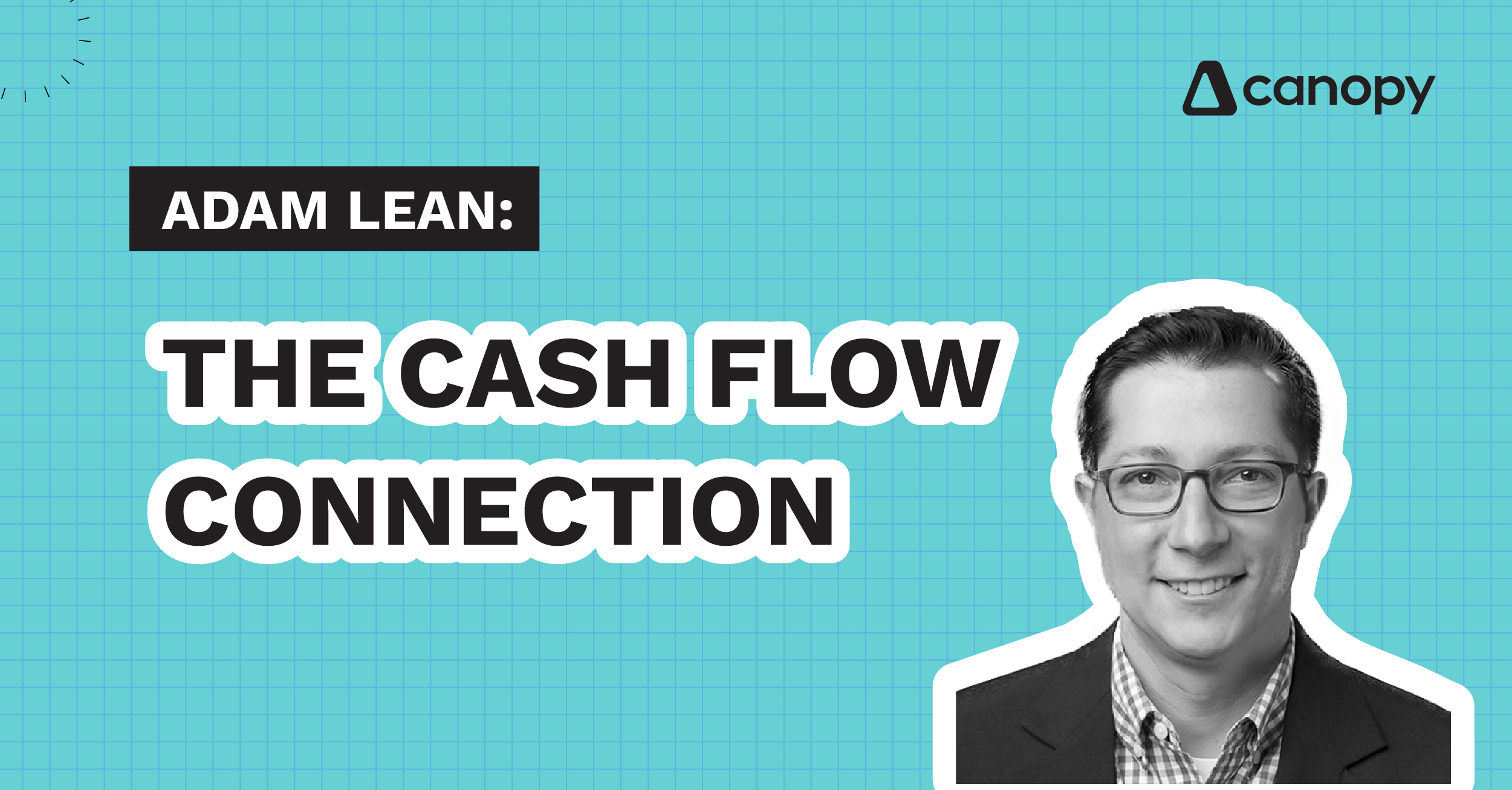
Adam Lean: Accounting with Impact, How to Become Indispensable




Transcript
(00:05) Canopy Host
Hi, welcome to another episode of Canopy Practice Success. I’m your host, Canopy Host, and I’m here with Adam Lean.
Adam, it’s great to meet you and have you on the podcast.
(00:15) Adam Lean
I’m really excited to be here. Thanks for having me.
(00:18) Canopy Host
You have a unique background—unlike anyone we’ve had on the podcast. Tell us about it.
(00:27) Adam Lean
I started as an accountant. I got my accounting degree and figured I’d follow that path.
But I quickly realized I didn’t enjoy most of the work. I didn’t like just recording the past—I wanted to help businesses grow. But that wasn’t really what I was being asked to do.
So I started a business on the side—an e-commerce company—and it grew quickly. Within a couple of years, I was able to leave my accounting job.
(01:11) Adam Lean
As I started meeting other business owners, I realized something:
I understood the numbers in my business—cash flow, profit, what was working and what wasn’t. But most business owners were flying blind.
They started their businesses because they were good at their craft—not because they understood financials.
And that’s a problem—because a business lives and dies on cash flow.
(01:56) Adam Lean
So I started asking business owners:
“Do you want help understanding your numbers and improving your cash flow?”
Of course, they said yes.
I eventually sold my e-commerce business and launched what is now known as a CFO advisory service.
Within a year and a half, I had 17 clients—just me.
(02:41) Adam Lean
Looking back, they hired me for one key reason:
I spoke like a human—not like an accountant.
Most accountants use jargon:
- Ratios
- Forecasts
- Financial statements
But business owners don’t care about that.
They care about one thing:
Is my business going to succeed?
(03:30) Adam Lean
Business owners are not lying awake at night thinking about clean books.
They’re thinking:
- Will my business survive?
- How do I make more money?
- How do I avoid failure?
So I positioned my service around that.
(04:08) Canopy Host
That’s such a simple but powerful shift.
Most business owners fail:
- 20–24% in year one
- 40–50% in five years
- 60–70% in ten years
So what does success look like to them?
(04:34) Adam Lean
Every business owner has their own definition of success.
Our job is to help them achieve:
- Their definition of success
- Our definition of success (positive cash flow)
(05:00) Adam Lean
For example, I had a client—a doctor—whose goal wasn’t money.
He wanted to be published in the New England Journal of Medicine for a new procedure.
To do that, he needed:
- Time
- Resources
- Financial stability
So I helped him improve cash flow so he could step away from operations and focus on research.
(06:00) Adam Lean
That’s the key:
Cash flow solves almost every business problem.
- Hiring better people
- Fixing bad products
- Surviving downturns
Without cash, businesses fail.
(07:34) Canopy Host
That resonates. Accountants want to help—but they may not connect those two definitions of success.
(08:54) Adam Lean
Exactly.
Most accountants either:
- Give surface-level advice
- Or don’t give advice at all
Because they’re paid for compliance—not strategy.
But business owners want help—they just don’t know how to ask for it.
(10:35) Adam Lean
The problem is:
You can do your job perfectly as an accountant—and your client can still go out of business.
So what’s more valuable?
Recording the past—or improving the future?
(11:04) Adam Lean
We teach accountants to:
- Offer advisory services
- Delegate compliance work
- Focus on high-value strategy
(11:30) Canopy Host
There’s a lot of imposter syndrome around that shift.
How do accountants make that leap?
(12:13) Adam Lean
Most accountants think being a CFO means operating at a Fortune 500 level.
That’s not what we’re talking about.
We’re talking about being a CFO advisor to small businesses.
You’re already qualified to do that.
(13:05) Adam Lean
We combine:
- CFO thinking (financial strategy)
- Coaching (helping clients take action)
And we package it as a productized service.
That means:
- Clear deliverables
- Clear value
- Clear pricing
(14:20) Adam Lean
Our model typically looks like:
- ~4 hours per client per month
- ~$2,000/month pricing
That’s about a $500/hour effective rate
(14:45) Canopy Host
That’s a huge shift compared to traditional accounting rates.
(15:00) Adam Lean
Exactly.
Most accountants are stuck at $35–$75/hour because:
- Services are commoditized
- Clients don’t differentiate quality
So pricing becomes the only differentiator.
(16:00) Adam Lean
But advisory is different.
You’re not selling bookkeeping—you’re selling outcomes.
(17:31) Adam Lean
The problem is, accountants measure success differently than business owners.
Accountants say:
- “We’ll do your books better, faster, cheaper”
But business owners want:
- A successful business
- Peace of mind
- Growth
(19:28) Canopy Host
And there’s a morale shift too—doing more meaningful work.
(19:41) Adam Lean
Absolutely.
You’re helping clients:
- Reduce stress
- Gain clarity
- Build confidence
That peace of mind is priceless.
(21:00) Adam Lean
And real advisory means more than reviewing reports.
It means:
- Identifying what matters
- Getting the client to act
- Driving real results
(22:19) Canopy Host
That’s the difference—connecting insight to action.
(22:46) Adam Lean
Exactly.
And we teach firms to:
- Apply this to their own business first
- Then roll it out to clients
(23:10) Adam Lean
If done right:
- Clients stay long-term
- They look forward to meetings
- They see real value
My very first client is still with me today.
(23:34) Canopy Host
That says everything.
(24:00) Canopy Host
Adam, this has been incredible.
For anyone listening, check out:
- The CFO Project
- Adam’s podcast
- And his work helping firms adopt advisory services
(25:18) Adam Lean
Thank you—this was great.
Hosts & Guests

Adam Lean
Guest
About the Podcast
Share
Discover more like this