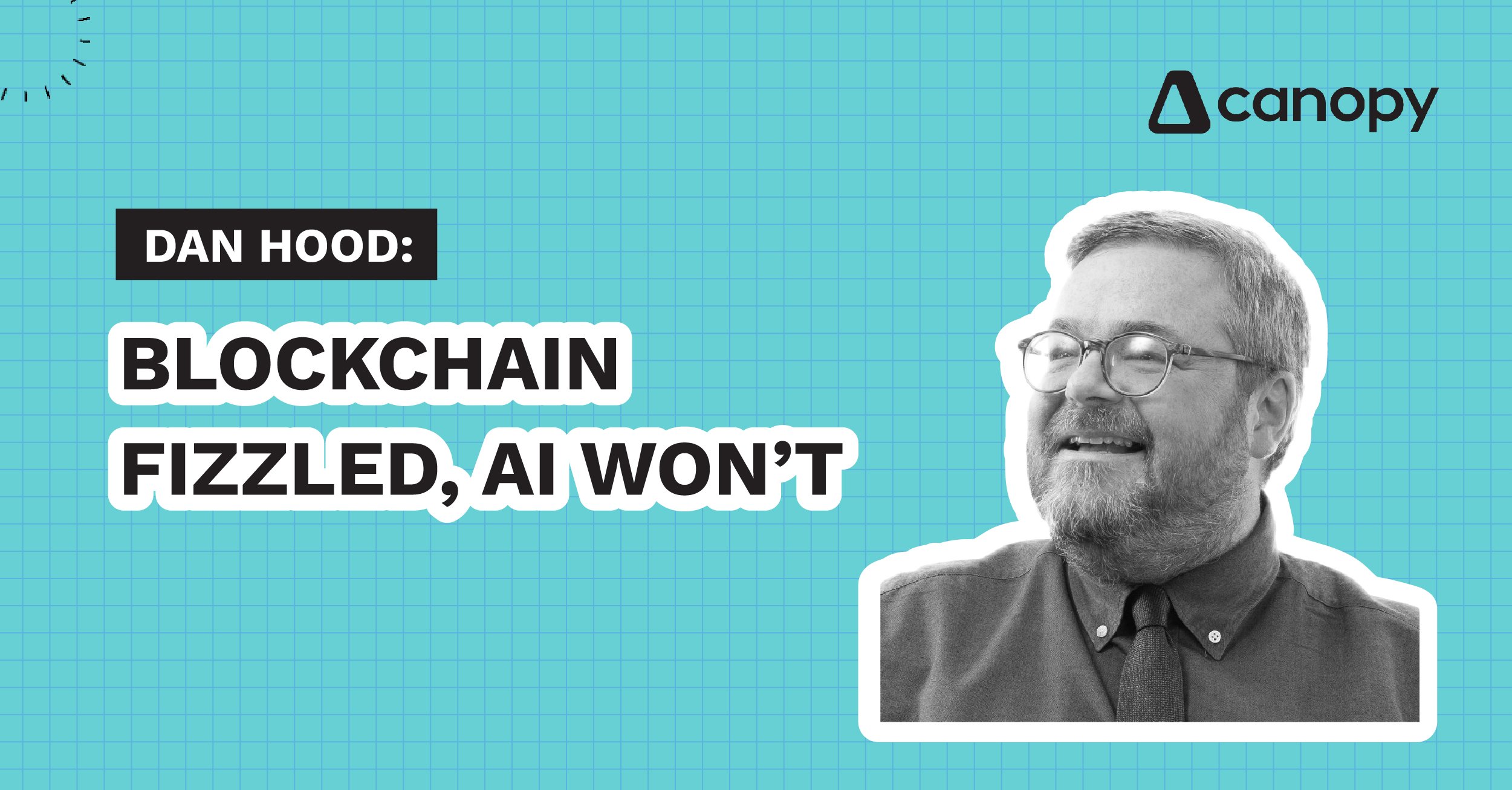
Dan Hood: Blockchain Fizzled, AI Won’t




Transcript
Canopy Host (00:00) Welcome to another episode of Canopy Practice Success. I’m here with the one and only Dan Hood. Hello, Dan.
Dan Hood (00:08) Hey, what’s going on?
Canopy Host (00:09) Not much — I’m excited for today. You’ve been with Accounting Today for over 20 years as editor, and editor-in-chief since 2011.
Dan Hood (00:19) Right, right.
Canopy Host (00:20) Your knowledge of the industry, your access to the trends, the failures, everything — it’s astronomical, I’m sure.
Dan Hood (00:31) We’ve seen a lot. A lot of change over the years.
Canopy Host (00:35) Even in that 20-year span — that takes us back to the early 2000s, which predates social media. Accountants looking to each other and building communities, using it for marketing. Facebook looked very different when it launched than it does now, and that same thing applies to tech in general.
I’d love to start by hearing a few stories of things you’ve seen through the years that started as whispers — where you thought, hmm, what’s going on here? — and then built into a larger conversation. And maybe one example of something that faded out, and one that crossed the chasm and is now in the accounting canon.
Dan Hood (01:29) There are a lot of examples. We have a rule of thumb here that anything that’s going to change in accounting takes about five to ten years. It goes through this period where everyone in accounting says, “Nope, don’t need that, not going to adopt that, that’s not going to change our firm” — whether it’s technology, how you run a firm, employee policies, anything. It takes five to ten years to go from “never going to do that” to “all right, we’ll look at it” to “this is great, we should have done this five years ago.”
A good example of one that succeeded is the cloud. It took a decade for accountants to get on the cloud. Any software vendor from that era could tell you — there was a decade where they were asking, “What is wrong? Why won’t accountants move to the cloud?” This was roughly 2000 to 2012. No one would get on it. The concern was that it wasn’t secure, that client data wouldn’t be safe. Accountants felt much better having everything in their own offices — which was not actually true, but that was the feeling.
They’d say, “I’d rather drive to my client’s office at the end of every month to clean up their QuickBooks on-site.” It took about a decade before accountants got comfortable with the idea of having data in the cloud. And now, obviously, it’s huge. Your entire CAS practice is built on cloud accounting — accessing client data in real time from wherever you are.
But for a good 10 to 12 years, it was constant resistance. And for understandable reasons — they were genuinely concerned about security, client privacy, all of that. It just meant the profession took probably eight years longer than it needed to make the shift. Now it’s enabled modern practices in ways we couldn’t have imagined in the early 2000s.
Canopy Host (03:37) Were the early cloud providers not addressing those concerns well, or were accountants just more risk-averse than most buyers?
Dan Hood (03:46) Mostly the latter — accountants are significantly more risk-averse. There was some element of vendors not fully realizing how serious the resistance was. Vendors would say, “You do your banking online. You shop on Amazon. Why wouldn’t you trust this?” But they underestimated how risk-averse accountants are, how change-averse they are, and how fiercely protective they are of client information.
Canopy Host (04:14) And to your point — with banking and Amazon, it’s your own information. It’s a completely different thing when it’s someone else’s data you’re responsible for.
Dan Hood (04:26) Exactly. But there was also genuine knee-jerk change resistance on top of that. Vendors were used to consumers rushing online and couldn’t understand why accountants weren’t doing the same.
Canopy Host (04:44) Funny enough, as an employee of one of these vendors, we still list “cloud” as a value proposition — which in any other industry would be table stakes. I also find myself being careful with how I message it, because I never want customers to feel like being in the cloud means they’re expected to be available around the clock.
It’s an interesting crowd to talk to about this because with CAS especially, you get people who are fully embracing remote work. And it’s not uncommon to hear someone say they actually like taking their work on vacation.
Dan Hood (05:52) A lot of accountants genuinely want to be accessible. When a client calls, they want to be able to answer — it comes from a real desire to serve clients well. It’s just a little ironic that the same people who wanted to serve clients all the time were also the most resistant to the tools that would let them do that.
Canopy Host (06:14) Okay, so what’s an example of something that didn’t make it past the whispers?
Dan Hood (06:19) My favorite example is blockchain. The entire profession was convinced it was going to destroy the audit. With that kind of certainty about immutable records and the audit chain, there was a real fear — not necessarily well-grounded, but a widespread assumption that blockchain would make audits self-executing and render auditors obsolete.
It disappeared. There was a period where accountants were talking about it constantly, going to conferences, trying to learn everything about it — kind of the way they’re approaching AI now. And I do think AI will probably pan out similarly to blockchain, which isn’t to say blockchain disappeared entirely. It just got built into products. Auditors and accountants didn’t have to adopt it themselves — it became infrastructure. It actually created some useful tools for the profession without ever becoming a direct challenge.
One day it was on everyone’s lips, everyone was attending sessions about it — and now I genuinely can’t remember the last time I heard it mentioned in an accounting context.
Canopy Host (07:48) And I’d make the same argument about AI. Accountants won’t have to learn it the way our engineers do, because software companies like Canopy have board members and shareholders pushing hard on AI adoption. We’re already getting internal training on use cases and applications. My hope is that for accountants, it becomes less about learning AI and more about evaluating which tech has it built in well.
Dan Hood (08:38) I think you’re right that a lot of the heavy lifting will be done by software vendors. But I do think accountants will need to engage with AI in a way they never had to with blockchain.
Blockchain just got built in and was never heard from again. With AI — particularly as agentic AI becomes more prevalent — you won’t have to build anything, but you will have to learn how to work with it. It’ll be less of a technology skill and more of a management skill. You’ll be tasking agents, understanding what they can and can’t do, verifying their outputs.
I heard someone at an AI conference say that the next couple of years will probably be the last time managers solely manage people. Going forward, they’ll be managing both people and agents — delegating to them, reviewing their work, the same way you would with junior staff. And we’re already not great at human management, so I’m fascinated to see all the ways we’ll find to be bad at managing agents. At least the agents won’t take it personally.
Canopy Host (10:04) That leads me to where I wanted to spend the bulk of our conversation — what are the whispers today?
I’ll list a few and then I’d love to hear ones you’re picking up that I haven’t mentioned. CAS still feels like a whisper to me. I just met with someone yesterday for whom it was completely new — and we’ve been talking about it for years. So I think it’s nearing the end of that five-to-ten-year adoption curve, hopefully.
PE, mergers, acquisitions — that’s another one. And AI, though I agree with you, it’s not going anywhere. Any others you’d add before we dig in?
Dan Hood (11:10) I’d throw in ESG. It’s on the back burner in the US right now — not a priority for the current administration — but the rest of the world is deeply focused on environmental, social, and governance reporting. And it’s a massive opportunity for accountants.
Think about it this way: financial auditing and financial statements are a huge business for accounting firms. There’s an equally large opportunity emerging around ESG reporting and auditing. It’s a whole other service line — potentially bigger than financial auditing — and it’s a natural fit because who’s better at building new reporting systems than accountants?
Canopy Host (12:21) Is that only for large companies, or does it trickle down?
Dan Hood (12:26) It’ll reach companies of all sizes eventually. The reporting requirements often flow down through supply chains. If you supply to Walmart, you may inherit some of Walmart’s reporting requirements — even as a small local contractor. The SEC’s original proposal, now shelved under the current administration, included requirements that reached all the way down to suppliers of public companies.
It’s on hold in the US for now, but the rest of the world is adopting it, and it will come here eventually. California already has some state-level requirements. If the federal government doesn’t act, we’ll likely see it move state by state — and at that point, it applies to companies of all sizes directly, not just through trickle-down.
If accountants don’t position themselves for this, someone else will. It doesn’t have to be them, but they’re the obvious fit.
Canopy Host (14:40) Okay. Anything else to add before we go through my three? No? Let’s start with PE.
Dan Hood (14:49) PE is interesting. When I first joined Accounting Today in 1998, there was actually a very similar frenzy happening — what they called consolidators or roll-ups. Companies like H&R Block and American Express were going around the country buying up accounting firms, rolling them into bigger organizations. Hundreds of firms were acquired. It was going to completely change the face of accounting.
By 2004, it was essentially gone. The only real remnants were UHY and CBIZ, which held onto their alternative practice structures. RSM had some connections to H&R Block, but partners eventually bought back their firm. By 2009, there was almost no trace of this wave that had seemed so transformative just a few years earlier.
So when you look at the current PE frenzy, you have to ask: is this the same pattern?
Canopy Host (16:55) Did the partners just buy back from the acquirers?
Dan Hood (17:00) Essentially, yes — though it wasn’t technically private equity back then, it was public companies and strategic acquirers like Amex and H&R Block. But the dynamic was similar. They came in, spent a lot of money, and ultimately discovered it wasn’t delivering what they’d hoped.
The difference today is that PE’s motivation is simpler. Back then, Amex and H&R Block wanted to cross-sell other financial services through accounting firms — and it just never panned out. PE firms today mostly just want returns.
They see accounting as a steady earner. The traditional PE model is buy ten companies, nine fail, one is a home run that covers everything. What PE firms started to realize is there’s value in also owning reliable, steady cash-flow businesses — ones that hold up even in downturns. Accounting fits that profile well.
The other big driver is fragmentation. Accounting is a highly fragmented market — even the top 100 firms are relatively small companies. PE sees an opportunity to aggregate, rationalize, build economies of scale, and create a larger, more valuable organization they can eventually sell. It’s much cleaner to sell one large firm than ten separate ones.
Canopy Host (20:08) And then you layer on the talent crisis — the gap between the number of accountants entering the market and the demand for services. That’s not going away. Demand is outpacing supply, firms are looking for better pricing strategies, and AI will help with efficiency but won’t eliminate the need. That’s a pretty attractive investment thesis.
Dan Hood (20:42) And it’s much easier to manage capacity constraints at scale. A larger organization can build out HR infrastructure, attract talent, manage workload distribution in ways that a small firm simply can’t.
And the pricing piece is huge. A lot of accounting firms are leaving significant money on the table right now. If you rationalize your pricing, you could see much bigger returns with no extra work and no extra time. That’s genuinely appealing to any investor.
Canopy Host (22:11) Okay, let’s wrap up with some quick predictions. ESG — here to stay or will it fade?
Dan Hood (22:21) Here to stay. It’s a whisper in the US right now, but it’s going to be much bigger.
Canopy Host (22:25) AI — grow or die?
Dan Hood (22:30) Totally going to grow.
Canopy Host (22:32) PE — grow or die?
Dan Hood (22:34) Genuinely torn. I could see it going either way. My actual prediction is that it won’t stay “PE” — what it’ll do is open up the whole structure of what an accounting firm can be. PE-backed, venture-backed, pension-backed, independent network, hybrid law firm, embedded in a wealth management firm. We’re already seeing some of that in Arizona and with a few larger firms.
My guess is we end up with a much wider range of ownership and organizational models — and the question you’ll ask about any firm won’t be “are they PE-backed?” but “what kind of firm are they, and how are they structured?”
Canopy Host (23:50) Last one — cloud hosting. Grow or die?
Dan Hood (23:55) If it dies, it’ll take a long time. There are a lot of smaller firms that rely on it and don’t have the tech infrastructure or the bandwidth to manage everything themselves. Hosting will be around for a while.
Canopy Host (24:12) I’ll be honest — that one surprises me as someone who came up in tech. But you made the case earlier about change resistance and security concerns, and I can see how that sticks around longer than it should.
Dan Hood (24:33) There are still a lot of baby boomer firm owners who are thinking, “Do I really want to undertake a major technology overhaul before I retire?”
Canopy Host (24:44) Which actually leads to my prediction — the next two or three years are going to be fascinating because of generational ownership transfer. I think we’ll see a surge of it, and with it, a resurgence in tech adoption from the people who’ve been waiting for the more change-averse generation to step back. And PE might actually accelerate that, because it gives owners a path to cash out now without waiting for retirement.
Dan Hood (25:30) And I think we’ll also see a lot of people who were waiting for change say, “You know what, I’m just going to start my own.”
Canopy Host (25:36) We’re already seeing that. Is it a whisper or has it gained real traction?
Dan Hood (25:40) It’s been gaining for longer than we’ve probably tracked it. PE is turbocharging it a little — some people just don’t want to work for a PE-backed firm, and that’s pushing them toward independence.
Canopy Host (25:55) The barrier to entry for starting your own firm is so low right now. Whether you’re leaving a Big Four firm because of the hours, or leaving a smaller boutique because the senior partner is stuck in their ways — the tools exist to do it lean and do it well.
Dan Hood (26:29) The barriers really are incredibly low. And one thing I’d add — it’s a bit of a whisper now, but I think it’s going to become significant — is the idea that you don’t have to run a firm that looks like every other firm. There are more and more accountants saying, “I just need to make enough to live well and offer good opportunities to my team. I don’t need to take every client that comes my way. We don’t need to grow just to grow.” People are starting to give themselves permission to think that way, and I think that’s going to become much more common.
Canopy Host (27:12) I love that. It’s going to be much healthier for everybody. We need more happy accountants — they do incredible work, and I’d love to see that change. Give them good tech, automate what doesn’t need their attention, and let them go home at five.
Dan Hood (27:33) Yeah.
Canopy Host (27:34) Excellent. Thank you, Dan.
Dan Hood (27:35) Cheers — thank you, Casey. It was great.
Hosts & Guests

Dan Hood
Guest
About the Podcast
Share
Authors
By: Chrissy Rutledge
Chrissy is the Social Media & Content Marketing Specialist at Canopy.
Read more by ChrissyDiscover more like this