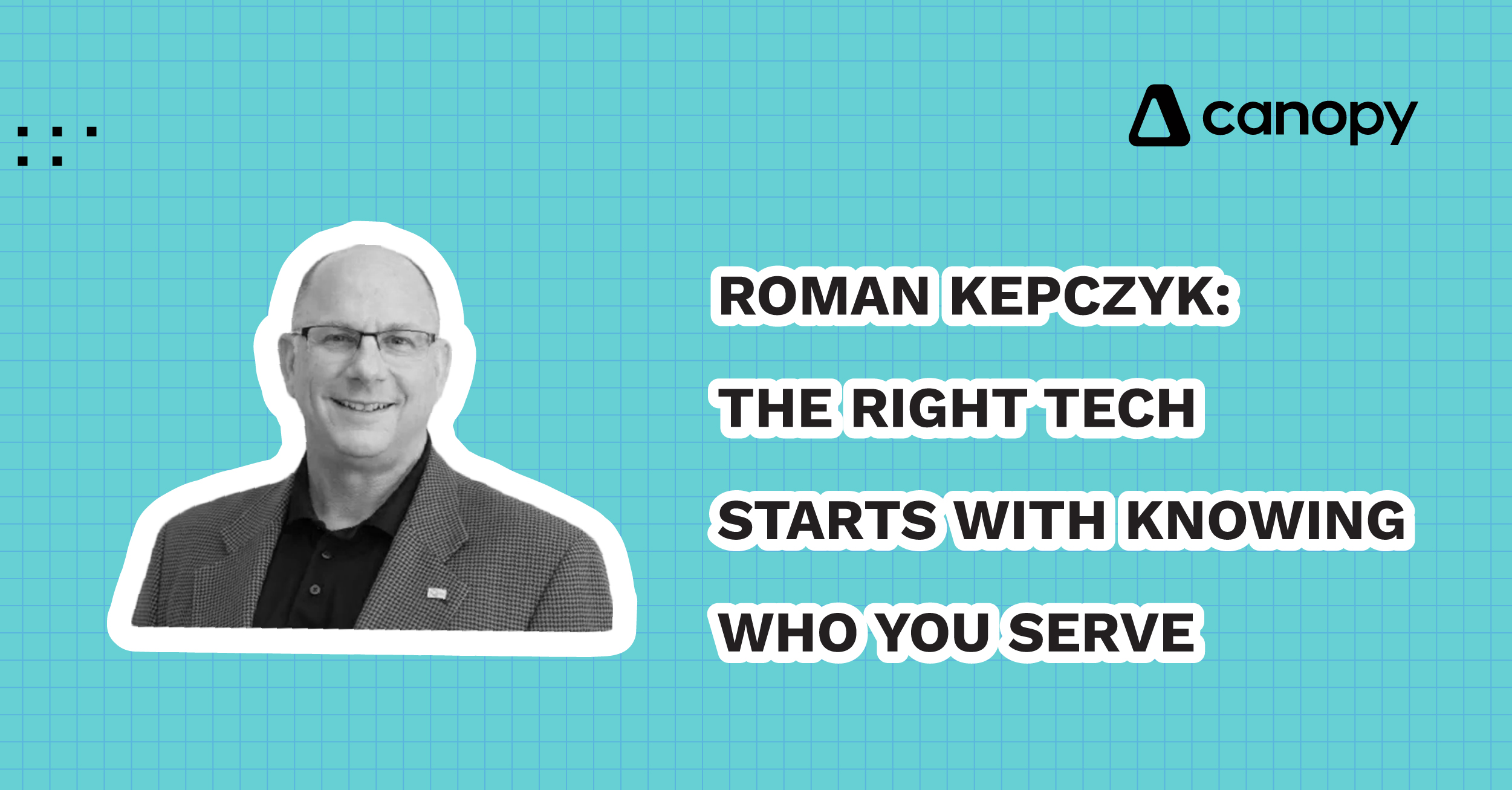
Roman Kepczyk: Your Firm’s Tech Stack Starts with Your Client Strategy




Transcript:
Canopy Host (00:05) Hello, welcome to the next episode of Canopy’s Practice Success podcast. I’m Canopy Host, your host. Today our guest is Mark Canopy Host (00:01)
Welcome to another episode of Canopy Practice Success. I’m your Canopy host. Today’s guest is someone who’s been shaping the accounting industry for 30-plus years.
Roman Kepczyk is the Director of Firm Technology Strategy at RightWorks and one of the most respected consultants in the accounting profession. He’s helped hundreds of firms streamline their operations, go digital, and use technology to boost efficiency, profitability, and client experience. He’s a multiple-time Accounting Today Top 100 Most Influential People in Accounting winner, a published author, and a Lean Six Sigma Black Belt.
Welcome, Roman.
Roman Kepczyk (01:15)
Thank you very much for having me.
Canopy Host (01:17)
You are a tech expert. You’ve been doing this for 30 years. I want to dive in and have you speak openly and honestly about tech — about tech selection, how firms go about evaluating their current stack. Do they start with one piece? If they do, is there a cascading effect?
Where do you want to start?
Roman Kepczyk (01:56)
When you talk about a firm’s tech stack, the most important thing is making sure it’s tailored specifically to your client base — the clients you’re trying to serve or expand into.
There’s a lot of generic information out there. A lot of surveys throw information at you. But the real differentiator in selecting your tech stack is first understanding what type of clients you’re trying to serve — and then the tools that are optimized for those clients, the ones that are expanding and evolving for the future needs of that client base.
That can be very different. In our industry, the big three are Thomson Reuters, CCH, and Intuit Lacerte from a tax perspective. But they’re very different products optimized for very different use cases — whether you’re a 1040 production shop, a wealth management group that deals exclusively with high-net-worth individuals, or a firm that does nothing but school district audits.
It really comes down to having a discussion about what work you’re trying to do, what the bottlenecks are around your current processes, and how other firms have solved those issues.
Canopy Host (03:19)
I love that you start there. That’s also where I start as a marketer thinking about workflows.
If you haven’t established an ideal client profile — your ICP — and defined who you work with, that’s step one. And it’s not just impacting tech. It impacts procedures, workflows, being able to template things, and marketing. Marketing works best when it’s targeted. The same principle applies to your workflow. And if it’s applying to your workflow, it’s applying to the tech you’re using to execute on it.
Roman Kepczyk (04:49)
Absolutely.
Canopy Host (04:52)
Okay. First step: identify your clients. Slow down to speed up. I know we’re recording this in November, and people might be listening in December — you’re probably not going to evaluate your client segments during tax season. But please calendar it for sometime soon with your team.
Roman Kepczyk (05:07)
Right now firms are fine-tuning their workflow tools — making sure projects are assigned correctly, risk levels are current, and the right staff are available for the right levels of work. That’s the pre-season work before things kick into gear.
But what we recommend every firm do is after April 15th, conduct a detailed tax season debrief, and make sure you include everybody. Part-time people who haven’t been shaped by how things have always been done — they’ll say things like, “I work at different places, and what you do here is unusual.” Remote employees, outsourced employees — include them.
Even if you do a survey with open-ended questions, you’ll get input on what worked well, what didn’t, what improved the client experience, and what detracted from it. We have a listing of debrief questions on the RightWorks website.
What happens next is that within each department, you can prioritize the issues that came up across all levels — and figure out what you need to fix moving ahead.
Canopy Host (07:04)
There’s a saying: what got you here won’t get you there. You don’t have to repeat how last tax season went. There’s good, better, and best — even if it wasn’t bad, there are always ways to fine-tune.
I’ve always called these postmortems. I’ve even run premortems — especially before big projects with high exposure. I’ll sit down with the team and say, “It’s three months from now and we’ve all lost our jobs because we failed miserably. Why did we lose our jobs?”
Roman Kepczyk (08:18)
That’s actually a classic Lean Six Sigma approach. The example we use: if you wanted to lose a race, what are all the things you could do? Flat tires, no gas, driver not showing up. It identifies all the things you should fix and naturally formulates the targets for improvement.
Canopy Host (08:54)
And here I was doing something right without knowing it had a name.
Roman Kepczyk (08:57)
You could be a Lean Six Sigma Green Belt right now.
Canopy Host (09:01)
Have you seen trends around what catalysts cause firms to evaluate their tech stack — or parts of it?
Roman Kepczyk (09:26)
Often the first catalyst is a client or employee who has a bad experience. That brings things to the surface quickly.
But looking at the profession overall, the biggest catalyst in the last two years has been the advances in machine learning and generative AI being integrated into applications.
Most of the firms I work with — I just ran two training sessions, one for an IT association and one for managing partners — and the disconnect between what technology is available and what people think is available is striking.
When we talk about building your AI approach, rather than trying to create high-level robotic process automation on your own, listen to your vendors who have vetted solutions for specific functions. Whether it’s responding to an email, generating KPIs, or pulling from a bank account for reconciliation — those vertical integrations of AI, vetted by your vendor, secure and stable, and already used in other firms, will be more successful than an employee inadvertently exposing client data because they didn’t know how to redact it or turn off the learning model.
That’s why half of my presentations these days are about security and AI and how the two intersect.
Canopy Host (11:15)
Security is a topic that stays relevant because of the data accountants naturally store, interact with, and have access to.
I’d add: unless an accountant wants to learn how to build custom GPTs or custom Gems in Gemini, you don’t have to. Because vendors like Canopy are under pressure to build AI in. If we don’t, we’ll fall behind and lose our business. So look for vendors that have AI built in elegantly — in a way that doesn’t require a steep learning curve.
Our philosophy at Canopy is that you almost shouldn’t notice it’s there. I was in a meeting with our CEO talking about exactly this — how much do you show in the product versus how much do you leave invisible? He brought up the Dyson vacuum: there’s a reason they made the container clear. It’s satisfying to see the dirt getting pulled up.
You won’t always see what AI is doing, but you’ll feel it — in your time savings, in your efficiency.
Roman Kepczyk (13:31)
One important component, whether it’s a vendor or individual implementation, is making sure you train your people that there always has to be a human accountable.
Just like when we review audits or tax returns, someone signs off — validates the information the AI gave them, confirms it’s reasonable, and agrees with it. That training piece has been lacking in firms. People seem to bypass it quickly and say, “the AI just did it.” Even knowing about hallucinations and errors, they still don’t validate the math or the sources. That’s mission critical.
Yes, it’ll save you an hour. But spend five minutes verifying before you release it.
Canopy Host (14:31)
We’ve heard that described as “work slop.” If you care about your personal brand, don’t put out AI content you haven’t checked. It will destroy your credibility fast.
And then there’s the bigger question — will AI take my job? I don’t see it as doomsday. I think we’re in an AI revolution, the way the industrial revolution got rid of some jobs but created net new ones. You — the accountant — still have the context. AI doesn’t. Context is what makes AI work the way you want it to, not hallucinate.
Roman Kepczyk (16:01)
Agentic AI — agents that go out, collect data, and bring it in — I think that’s the future of accounting.
But here’s the distinction: a bookkeeper who key punches data and does manual reconciliation could become obsolete. But if they learn to use the agent to import the data, they keep their most valuable skill — the judgment.
Accountants, tax preparers, and auditors have years of history and experience. When they look at something, they can sense if it’s wrong. AI can’t determine that unless it’s been specifically trained on those variances. So anything that’s rote and repeatable — yes, that can be automated if it’s logic-driven. But tax law is not logic-driven.
Give five accountants the same data and you’ll probably get three different answers. One will be flat-out wrong, one will be better than the others — and right now, the ability to identify which is which lives in the mind of the tax partner or auditor who knows the client.
We went through the dot-com era, the spreadsheet era, blockchain. We said each time it would replace accountants. Every time, the profession evolved, adapted, and moved up to higher-level work.
Canopy Host (18:10)
Okay. We need to move on from AI as much as I hate to. A tech stack is a stack — you really can’t run a business on a single piece of software.
Let’s say there’s no catalyst. No pain. The firm just has a growth mindset and says, “This is fine, but I think we need to reevaluate.” Especially if you’ve got younger partners who know tech moves fast and aren’t afraid of the change management. How would you recommend people audit their stack?
Roman Kepczyk (19:06)
First, not everyone keeps timesheets, but if you take an honest self-assessment of what your people do, you’ll find that seniors, managers, and partners have picked up a lot of tasks over the years that are low-value and low-risk — tasks that could easily be assigned to someone else. They hold onto them out of habit, not necessity.
A good example: when workflow tools first rolled out — I think XCM was one of the first, which became CCH’s workflow tool — they allowed firms to transition components of work that higher-level people were doing down to administrative staff. And those administrative people did the job more consistently, at a lower cost, and with lower risk to the firm.
Billing is another one. A lot of partners want to handle billing themselves. But a trained administrative person who knows to flag anyone with more than 7% write-offs for review? The other 90% of bills can flow through without the partner touching them. That’s a systematic approach that works.
And collaboration tools — document requests, tax return delivery — partners used to insist on personal delivery meetings. That’s well below their pay grade. Automated delivery tools handle it.
The goal is to make sure the right people are doing the right level of work for their clients. Anything that can be optimized or handed to a lower level, there should be a tool managing that.
Canopy Host (21:50)
What you’re describing is a very common problem — senior people in firms doing work that can be delegated. That’s an entrepreneur problem in general. And it’s hard when you’ve been doing something for years and you’re not sure someone else will do it as well as you.
But here’s the thing: if you haven’t identified your ideal client profile, do that first. If you have, the next step is documenting your SOPs — your standard operating procedures. Even just getting them on paper shows you who does what and who could do what.
And I think the industry needs more of this, frankly, because of what I hear around work-life balance, morale, and losing talent to other industries. When you give someone a clear path to move forward, they thrive.
I’ve been referencing Arthur C. Brooks recently — a Harvard professor who talks about how we aren’t made to arrive. We’re made to progress. Even Olympians who win gold medals, even accountants who make partner — there’s still a sense of “what’s next?” When you can provide that clarity for your staff, you get more engaged, more productive people.
Roman Kepczyk (25:03)
Absolutely. Whether it’s becoming the best in their tax practice, their audit practice, or what they’re doing in their personal life — I’m a triathlete and a sandcastle builder. Progress matters. It gives you the satisfaction of finishing things.
It’s almost like a badge of courage at the end of tax season. People complain all the way through, but they’re proud when they’ve made it.
Canopy Host (25:42)
Okay. So we’ve emphasized: identify your clients. Then evaluate the allocation of work — are the right people doing the right things? That sets you up for better tech selection. Is there a third step?
Roman Kepczyk (26:16)
Community.
When you’re ready to evaluate specific applications, go to your peers first — the ones who’ve already solved the problem. Every time someone does an evaluation in a vacuum, they miss a lot of what’s out there.
I’m in a group called CPA Firm Management Association — CPAFMA.org. They have a community that shares successes on applications, tools, and processes. At RightWorks, we have our own community too. If you’re a QuickBooks user, all those users come together and evaluate everything from payroll to timesheets to reporting tools.
That community input validates capabilities. And from there, you can narrow your search down to two or three products instead of ten. If you’re evaluating ten products, it gets confusing and you end up doing a lot of work you could have eliminated upfront.
Talk to people first. Get references. If a vendor can’t give you at least three firms that have used their product for a year or more, it shouldn’t be on your list.
Canopy Host (28:30)
I’ll add: when you take recommendations, make sure they’re coming from firms in your same tribe — ones that have dealt with the same issues and found solutions that apply to you. I personally don’t go to a restaurant someone recommends unless I know our food preferences align.
And once you’ve done the work of steps one and two — knowing your firm, knowing your clients, knowing your processes — the recommendations you hear will land differently. You’ll know what to filter for.
Roman Kepczyk (30:02)
Absolutely. There’s more work out there than any of us can handle. Sometimes you’re looking to transition work to another firm that may not fit your current client base — and they may have work they’d send your way too.
There are a lot of CPA firm associations doing this — BDO, RSM, DFK, BKR, Impact America, CPA America, and they all share community. At RightWorks Cloud, we’ve broken our communities out by firm size. We’ve recently been working with private equity groups, and our largest firm used to be 300 members — now it’s 1,500. We’re building communities for those larger firms too.
Canopy Host (31:31)
That’s a good three-step, approachable framework — especially for this time of year when people are mentally prepping for what they want to do differently. Get ready now so you can execute when things free up.
I do have a few questions to close out. First: what’s the biggest myth about accounting technology you’d love to debunk?
Roman Kepczyk (31:57)
Throwing out your timesheets.
The concept is right — you shouldn’t bill clients based on hours. Ron Baker and Michelle Golden are right that value pricing is the future, and you should price based on the value you deliver to the client.
But when people hear “throw out your timesheets,” they take it to mean you shouldn’t track time at all. That’s wrong. Time tracking is important for understanding utilization, realization, and staff development. If it takes someone too long to complete a certain type of work, either they need more training or they may not be suited for that work. You can’t manage what you don’t measure.
The message is: don’t base your billing on hours. But keep the data. It’s too valuable to lose.
Canopy Host (33:30)
Ron Baker has said it well: “Hourly billing is dead. We just haven’t had the funeral yet.”
Roman Kepczyk (33:48)
Exactly. And the firms that have moved to tiered pricing — platinum, gold, silver, bronze — have structured and standardized their service levels. That eliminates the constant question of what to do for free. If it’s in the next tier, you either bill for it or move the client up. It creates clarity for everyone.
Canopy Host (34:33)
Last question. Any overrated tech trends you’re seeing?
Roman Kepczyk (34:36)
Vendors throwing AI into everything.
They’re labeling things as artificial intelligence when, if you drill down, it’s robotic process automation — something scripted, an automated API process. It’s not necessarily innovative, and it’s not AI the way the profession perceives it.
When we talk about AI in accounting, half the vendors are overstating the capabilities. So when you evaluate tools, look for a real explanation of what the tool is actually doing — not just a label.
Canopy Host (35:30)
I’ll confess I might be a perpetrator of that. I simplify messaging so people understand that things are happening — whether or not they can see it. Our automations carry a similar value prop to AI, but you’re right to draw the distinction.
Roman Kepczyk (36:03)
And that’s actually where agentic AI is different. A true agentic AI solution uses robotic process automation and APIs as the execution layer, with generative AI on top to reason and produce the output. So when Canopy responds to an email — using APIs to pull the data, then generative AI to draft the response — that’s a real AI stack, not just automation with a label.
But at every conference — AICPA Engage, Xero Evolve, all the big ones — vendors are throwing AI out there. At the end of the day, we should ask: does this reduce risk, improve delivery, and standardize work so it gets done more efficiently?
Canopy Host (37:12)
The end. Thanks again, Roman.
Roman Kepczyk (37:15)
Of course. It was great talking with you.
Hosts & Guests

Roman Kepczyk
Guest
About the Podcast
Share
Authors
By: Chrissy Rutledge
Chrissy is the Social Media & Content Marketing Specialist at Canopy.
Read more by ChrissyDiscover more like this