

When busy season ends, do accounting firm owners become less busy?
(Ha.)
If you’re reading this, you already know the answer.
Busy season doesn’t end.
It just… morphs.
The tax deadlines are gone, sure.
So you hit the ground running and attack the to-do list.
But here’s the problem with that.
You’re exhausted, and your judgment is off.
And when exhausted people try to make up for lost time, they usually end up solving the wrong problems fast.
You don’t have to do a lot of things to come out of busy season successful.
You have to do the right things.
In this guide, I’ll show you how to figure out what that is.
Why Busy Season Leaves Firm Owners Feeling Stuck
A lot of people might say that an accounting firm owner’s job is only difficult during tax season.
Sure, it gets easier in some ways.
The frantic client emails slow down and the filing deadlines disappear.
But the moment busy season ends, an entirely different kind of pressure shows up at the door.
During busy season, your job is actually straightforward.
Do the work, hit the deadlines, and repeat.
It’s stressful, but it’s focused, and the priorities are obvious.
There’s no ambiguity about what needs to get done today.
After all of that, you’re once again a CEO who needs to think about:
- Growth strategy
- Pricing
- Client management
- Sales pipeline
- Marketing
- Hiring
And you’re trying to process all of this while running on fumes.
The dangerous part is not only the exhaustion but also that it hits right at the moment you need to make some of the most important strategic decisions of the year.
Decisions made in that state are usually the wrong ones.
So before you do anything else…
Let’s talk about what you should do first.
Why You Should Slow Down (Even When It Feels Counterintuitive)
Here’s advice no busy firm owner wants to hear.
Slow down.
(Not permanently, and not even for long.)
Right now, after months of sprinting, the worst thing you can do is keep sprinting in a new direction.
You’ve been heads-down since January, and the rest of the business has been on pause.
It feels like falling behind, so the natural response is to go fast to make up the difference.
But fast without a clear direction isn’t progress.
And if you set your goal to be doing as many things as you can, you might end up doing barely anything at all.
My COO has a phrase for this:
Shorten the stride.
You should be doing less instead of more, but it has to be the right less.
When you shorten the stride, you slow down enough to see what’s in front of you.
You stop reacting and start choosing.
You stop solving the loudest problems and start solving the most important ones.
Slowing down isn’t laziness.
It’s a tool to help you make sure the next move is the right one.
How to Identify the One Priority That Will Move the Needle
Once you’ve slowed down, the next question is: what must you focus on?
The answer to that is the project that will improve your Effective Hourly Rate the most.
You can compute your Effective Hourly Rate (EHR) like this:
- Take what the business pays you (profit plus salary)
- Divide it by the hours you put in
For example, if the business pays you $200k a year and you work 2,500 hours to get there…
Your EHR is $80 an hour.
It’s a simple number, but it captures not only how much you’re earning, but also how much you’re earning relative to your time.
To improve your EHR, you need to earn more, work less, or both.
When you look at the firm through that lens, the right priority can become obvious pretty fast.
The projects that move EHR the most often fall into a few familiar categories:
- Getting rid of clients who aren’t worth the time they consume
- Charging prices that reflect the value you deliver
- Making the hire that removes you from work that shouldn’t require you
Whichever of these moves the needle most for your firm right now should be your main focus.

What Do High-Impact, Post-Busy-Season Priorities Look Like?
A needle-moving project looks different for every firm, but there are a few categories that come up again and again.
Here are a few common ones, and how each of them makes an impact on the firm’s trajectory.
Pruning Clients That Are Dragging the Firm Down
Post-busy season is the best time of year to look at your client roster with clear eyes, because you just spent months working closely with them.
You know exactly who was a pleasure to work with and who had you dreading every email.
Start by doing a simple audit:
Score each client on how profitable they are and how pleasant they are to work with.
This gives you four buckets:
- A clients: High profitability and easy to work with
- B clients: Solid but have room to grow in one area or the other
- C clients: Take more than they give right now, but some of them are worth a conversation before you make any decisions
- D clients: Just draining your team’s time, energy, and morale
Your D clients are the ones to let go.
Low profitability, high friction, and no real path to changing either.
Your C clients are a different conversation.
Some of them might have potential, but the relationship needs a reset.
Go through them one by one and consider if you can raise your prices to reflect the value they’re getting from you.
Perhaps there’s a conversation to be had about how you can work together better.
Some C clients might even become B clients with a good discussion
Either way, your C and D clients are likely consuming a disproportionate share of your firm’s capacity.
That capacity could be going toward better clients, better work, or building something that moves the firm forward.
Raising Your Prices
This is my favorite one on this list.
It’s also the one that has made the biggest business impact for a lot of the accounting firm owners I’ve coached at Future Firm.
This move is worth making at the same time you’re auditing your clients.
And when I say “raise your prices,” I’m not saying bump it up by 3 to 5%…
I’m talking about a real price increase in which you take a hard look at what you’re charging and asking whether it truly reflects the value you’re delivering.
If you’re charging $200 a month for bookkeeping, the honest answer is no.
Why?
Because these services should be at least $500!
(I would even argue that they are $1,000 services.)
The other benefit you get from a meaningful price increase is that it acts as a natural filter.
Some clients will push back or walk away, and that’s okay.
The ones who leave were likely your C and D clients anyway (i.e., the ones who were already price-sensitive, high-maintenance, and not particularly fun to work with).
The ones who do stay are the clients who respect your work and see the value in what you do.
This lets you retain the same revenue while working much less…
Or earn much more at the same workload.
Upgrading Tools That Are Slowing Your Team Down
Bad software is easy to ignore because it rarely results in catastrophic failures.
(It just creates a hundred small ones, every day.)
Using the wrong tools will not break your processes, but it will make your team miserable.
On the other hand, using the right tools will amplify your workflows.
Post-busy season is the right time to audit the tools your team uses and think whether they’re helping or just getting in the way.
Start by asking your team where they’re losing time.
Where are the manual workarounds?
What are the things that take much longer than they should be?
The answers will point you in the right direction.
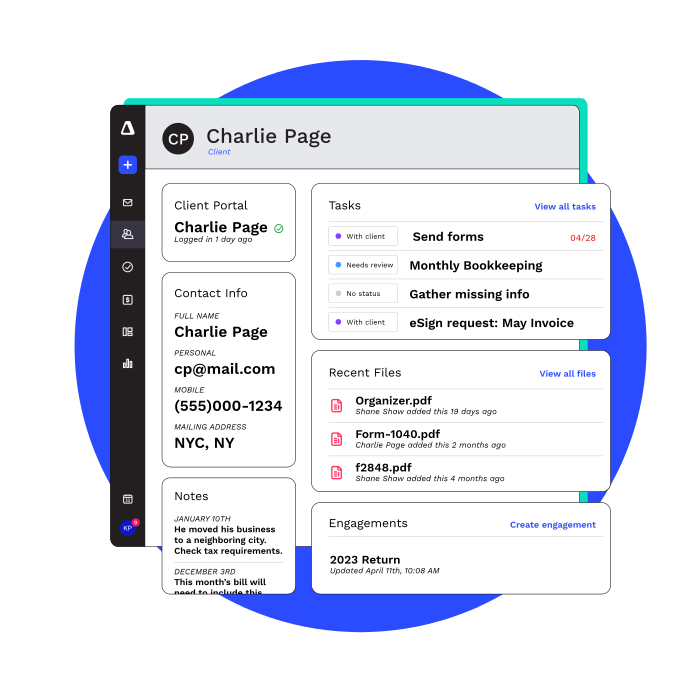
For example, if your team is constantly losing track of where client work stands or who owns what, that’s a practice management problem.
A tool like Canopy helps keep everyone in sync on client tasks, deadlines, and communication without the owner having to be the one holding it all together.
Or, if you’re dealing with a lot of back-and-forth emails and manually chasing down signatures during onboarding…
You might need to look into a dedicated proposal tool that can automate that process.
Hiring Someone to Get You Out of the Bottleneck
If everything in your firm runs through you, no tool or strategy will fix that.
If the bottleneck is you, and the only way to remove it is to hire someone.
You don’t have to write a wish list of hires.
You have to identify the one role that would have the biggest impact on your capacity right now.
Start by asking where your time goes that it shouldn’t:
- What are you doing every week that doesn’t actually require you?
- What decisions are being escalated to you that someone else should own?
- What is sitting on your plate not because you’re the best person for it, but because there’s nobody else?
For example, I hired a COO at Future Firm because a lot of operations tasks were pulling me away from work that only I could do.
That not only freed up my calendar but also meant that side of the business finally had someone whose full-time job was to run it well!
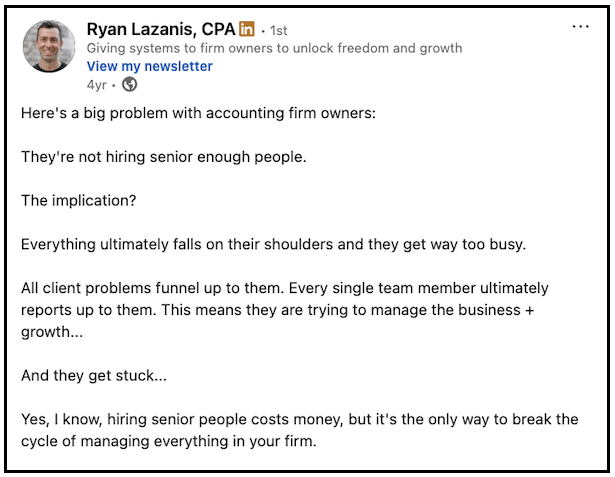
For a lot of firm owners who are stuck in the bottleneck, the problem is usually that they’re doing senior work, review work, client relationship work, and administrative work all at once.
That is why, in a lot of cases, the most impactful hire you can make is a senior accountant.
They can review the work coming from your junior staff, own client relationships, and handle the day-to-day communication that currently flows through you.
A LinkedIn post I wrote years ago still holds true today:
Now, will a senior hire be expensive?
Yes.
But it will absolutely be worth it.
When I was running my previous accounting firm, Xen Accounting…
I made sure to hire a senior accountant early.
Financially speaking, it was difficult at first, but it helped create a foundation for a profitable and scalable business.
What’s Your Next Big Thing After Tax Season?
The decisions you make from a clear head will always be better than the ones you make on fumes.
So, rest first, then pick one thing.
Find the one that would genuinely change your firm’s trajectory if you got it done before the next busy season.
You’ll be surprised how much of an impact it can make!