
If you’ve ever heard that a practice management platform is “too expensive,” the real question is: expensive compared to what? A price tag only tells you what a firm pays on day one. Total cost of ownership tells you what a firm actually pays — and gets back — over the life of the platform.
Total cost of ownership (TCO) is the full cost of owning and running a piece of software over its useful life and not just the purchase price. It includes acquisition cost, implementation and training, day-to-day operating costs (including any tools you still need alongside it), the cost of scaling or switching platforms as the firm grows, and the cost of managing risk and security.
What’s the best way to evaluate accounting practice management software? Don’t start with the price tag — start with total cost of ownership (TCO).
- Total cost of ownership (TCO) is the full cost of software over its lifetime — acquisition, implementation, day-to-day operation, growth, and risk — not just the number on the invoice.
- IT analysts estimate that purchase price is only a fraction of what software actually costs a business over time; the rest surfaces later, in training, integrations, downtime, and the eventual cost of switching platforms.
- Canopy is rated #1 on G2 in both Tax Practice Management and Accounting Practice Management in the 2026 Best Software Awards — placing it in the top 0.63% of more than 179,500 vendors on the platform.
- The single largest hidden TCO event for a growing firm is re-platforming — migrating data, migrating clients, and retraining staff when software can’t scale with the business.
- The clearest way to talk about TCO is in hours, not just dollars, because firms already measure their business in billable hours and capacity.
Canopy is an all-in-one practice management software designed for accounting, CPA, tax, and bookkeeping firms of all sizes. With good, better, best pricing, firms can start with what they need today and scale as they grow — without switching platforms, re-migrating data, or retraining their team. That scalability is itself a TCO advantage: firms that stay on one system as they grow never absorb the hidden cost of a platform switch.
For most CPA, tax, and bookkeeping firms, Canopy comes out ahead on a TCO basis: it’s top-rated on G2 in both Tax Practice Management and Accounting Practice Management in the 2026 Best Software Awards, and it consolidates the implementation, adoption, AI, and scaling costs that a lower sticker price often hides.
Compare Canopy vs. Karbon · Compare Canopy vs. TaxDome
Industry insight: At the average accounting firm, manually collecting client documents — requesting files, following up on missing items, and matching submissions to the right engagement — consumes an estimated 20 to 50 minutes per client engagement.
Multiplied across a full client roster, that’s weeks of non-billable staff time a year spent on work that practice management software is specifically built to reclaim — one of several ways implementation and adoption costs quietly outweigh the number on the invoice.
Why Sticker Price Is the Wrong Way to Evaluate Software
Most firms compare accounting practice management software the way they’d compare office supplies: by the number on the quote. That’s a reasonable first instinct, but it measures the smallest, most visible piece of what software actually costs a firm.
There’s a name for this: the total cost iceberg. The purchase price is the tip — the part everyone sees and compares first. The rest of the cost sits below the surface: implementation, training, integrations, staff time, downtime, and the eventual cost of switching platforms when a firm outgrows its software.
None of that shows up on the initial quote, and nearly all of it shows up in the firm’s actual budget within the first year.
This is exactly the gap behind outdated “not worth it” comparisons of practice management platforms — they compare the visible tip of the iceberg and stop there, ignoring everything below it.
The Five Layers of Total Cost of Ownership
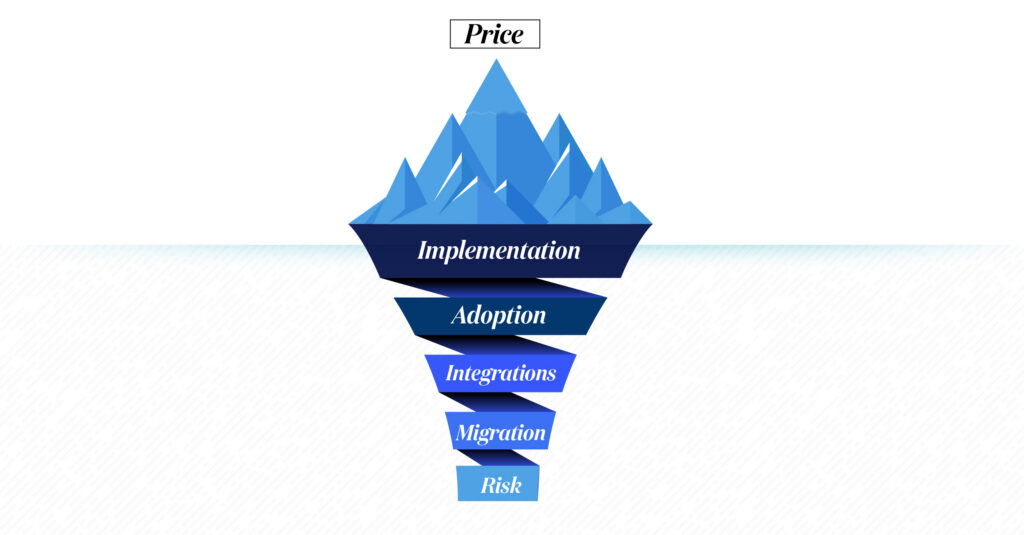
Once a firm moves past the sticker price, TCO breaks into five layers. Canopy calls this framework Below the Line — the line being the waterline on the iceberg, and everything below it being the cost most buyers never price out until they’re already living with it.
Layer 0 — Acquisition Cost
This is the number on the quote: the license or subscription price. It’s the easiest number to compare across vendors, which is exactly why it gets so much weight in buying decisions. But that’s exactly why it’s the least predictive of a firm’s actual cost three years in.
Layer 1 — Cost to Start (Implementation & Service)
Bad implementation, low adoption, or inconsistent service quietly reinflates a “cheap” price tag by delaying the point at which a firm actually gets value from the software. A platform that takes six months to fully roll out is more expensive than a pricier one a firm is using productively in six weeks. Canopy’s implementation and service model is built to shorten that time-to-ROI so the payback clock starts sooner.
Layer 2 — Cost to Run (Consolidation & AI)
Disconnected point solutions each carry their own subscription, login, integration maintenance, and support relationship — costs that never appear on a single invoice but hit the budget every month. An all-in-one platform consolidates that into one system, one login, and one vendor relationship. Firm-aware AI built natively into the platform compounds the savings further, automating the manual work that used to require a human — or a separate bolted-on AI tool with its own subscription and security profile.
“The investment in Canopy has been priceless. It has saved us so much time. It has saved us so much money. […] Some of the main reasons we decided to go with Canopy was cost. Also, the all-in-one kind of platform where we can have the client portal, the billing, the tracking of the projects, all of that in one system”. — Shelly Lingor, CEO of Financial Solution Advisors
Layer 3 — Cost to Grow (Scalability)
The largest hidden TCO event in software ownership is re-platforming: migrating data, migrating clients, retraining staff, and absorbing downtime when a firm outgrows what it’s on. A platform built to scale from a small firm to a large one on the same tech — with the same adoption and no data or client migration — means that growth event, and its cost, simply never happens.
Layer 4 — Cost of Risk (Security & Data Exposure)
Bolt-on AI tools and fragmented stacks widen a firm’s attack surface and compliance exposure That cost that only shows up when something goes wrong, which makes it easy to underweight during a purchase decision.
Firm-aware AI built natively into one platform keeps client data inside a single, governed system instead of scattered across a patchwork of third-party tools.
“Canopy has helped me improve the remote part of my business, so I can serve clients around the world, even when I am not in the US. The better-than-bank security made the choice a no-brainer.” — Joshua G., Canopy Customer
The Currency of TCO: Why Time Matters More Than Percentages
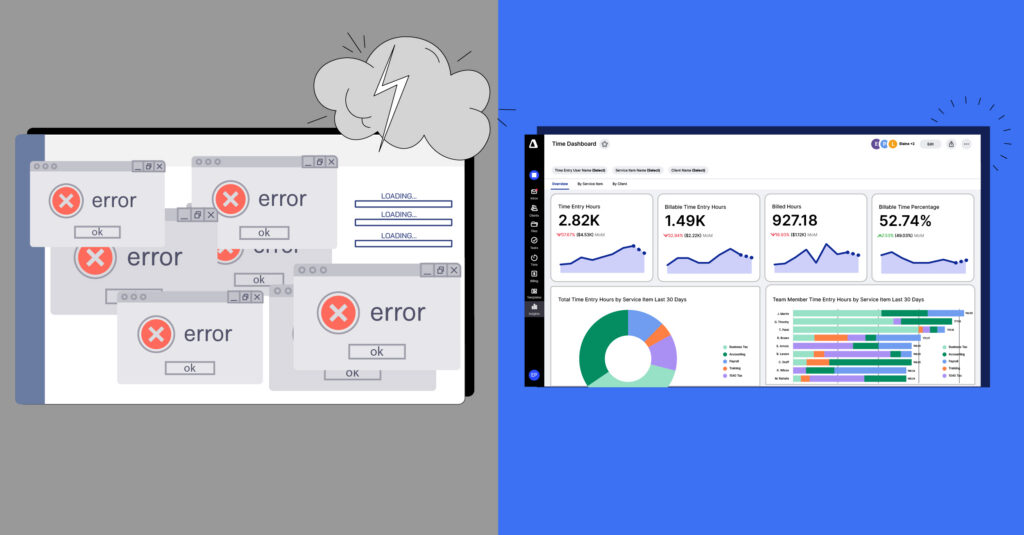
Every layer above eventually converts to the same unit: hours. Accounting firms already think in billable hours, capacity, and realization rates — which makes time the most credible way to talk about TCO, more credible than an abstract cost-savings percentage.
When evaluating a platform’s TCO, ask what it gives back in hours per employee per week, then translate that into billable capacity. That’s a number a managing partner can actually act on.
A Practical TCO Checklist: 5 Questions to Ask Before You Buy
This checklist works for evaluating any practice management platform. Not just Canopy:
- What’s the total time from purchase to full team adoption?
- How many separate tools or subscriptions does this replace, or does it require alongside it?
- What does it cost (in time and money) to switch platforms if the firm outgrows this one in three years?
- Where does client data live, and how many third-party tools have access to it?
- What’s the realistic time savings per employee per week, and what does that convert to in billable hours?
Comparing Platforms on Total Cost of Ownership, Not Price
Acquisition Cost
Often lower per tool, but adds up across 5-10+ subscriptions
Single, transparent subscription with good, better, best pricing
Cost to start
Separate onboarding for every tool; no single point of accountability
One implementation, one service relationship
Cost to run
Ongoing integration maintenance; multiple logins and vendors
One login, one system, natively built-in AI
Cost to grow
Re-platforming risk grows with every added tool
Scales from small firm to large firm on the same tech
Cost of risk
Data scattered across every connected tool
Data governed inside a single platform
See how this plays out platform to platform:
Compare Canopy vs. Karbon · Compare Canopy vs. TaxDome · Compare Canopy vs. CCH Axcess.
The Bottom Line: Evaluate Software on What It Actually Costs
A price tag is a snapshot. Total cost of ownership is the whole picture — what a firm pays to get started, to run the platform day to day, to grow on it, and to keep its data safe, measured in both dollars and hours. Firms that evaluate software this way consistently land on a different answer than firms that stop at the quote.
See what total cost of ownership looks like for your firm: explore Canopy’s interactive tour or view good, better, best pricing.
Frequently Asked Questions
Can't find the answer you are looking for? Reach out to our
Total cost of ownership is the full cost of owning and running software over its useful life, including the purchase price plus implementation, training, integrations, scaling, and risk — not just the number on the initial quote.