Michelle Voyer: Why Timely Financials Are Table Stakes, Not the Destination, for CAS

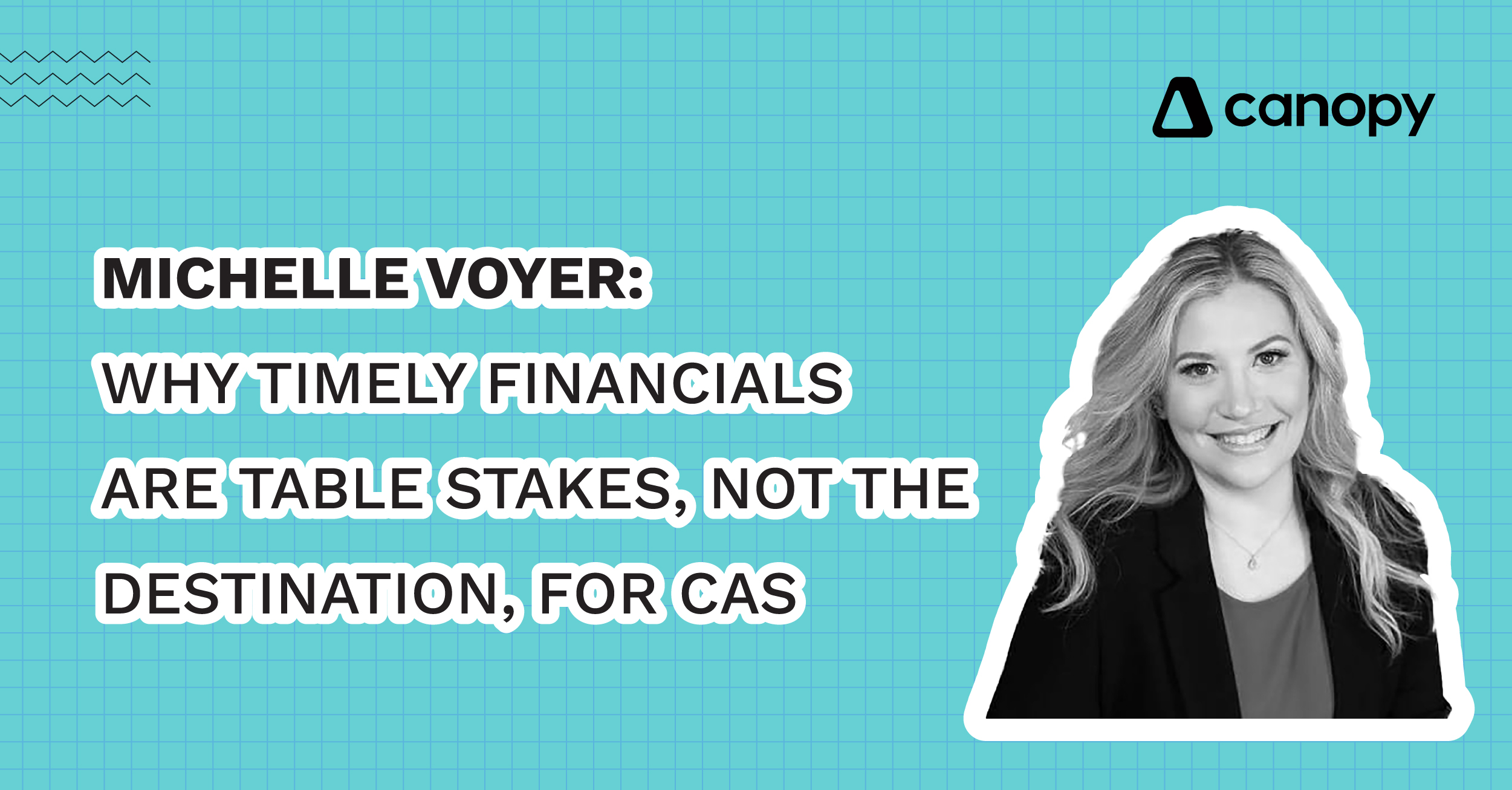



Michelle Voyer — Canopy Practice Success Podcast
Canopy Host (00:01)
Welcome back to the Canopy Practice Success podcast. I am your host, Casey Brothers. Today I am joined by Michelle Voyer, CPA and MBA, and Director of Client Advisory Services specializing in technology and automation at CohnReznick Advisory.
Michelle has spent more than 17 years building and scaling CAS across small firms, tech platforms, and national organizations, long before it became a buzzword. She brings a practical, grounded perspective on technology, automation, and how firms can use AI without losing the human side of advisory.
Michelle, welcome. We are excited to have you.
Michelle Voyer (00:38)
Thank you so much, excited to be here.
Canopy Host (00:40)
You are our second CohnReznick specialist expert. CohnReznick is a very large firm and has been in CAS for a long time. So not only you individually and your career, but you’re now at an organization that is highly specialized in CAS.
If you had to break CAS down to its bare bones, what would you say you have to have in order to say you’re doing CAS?
Michelle Voyer (01:25)
That’s a great question. I would say you have to have the desire to advise your clients, because that’s the true essence of CAS.
In our practice, everyone decides what they want — how many A’s they want or what the A stands for. Historically, I’ve always been the client accounting services gal. But here we purposefully say we are client advisory services, which includes client accounting services.
A lot of people, when you’re describing what CAS is, make the realization and relate it to something they know in their own life. And they say, “Bookkeeping — you do bookkeeping.” A lot of people in CAS take offense to that. I can understand why.
Canopy Host (02:25)
I heard someone recently say it’s a four-letter word, and I was like, is it?
Michelle Voyer (02:29)
I think the reason some folks feel that way is because it has been used in a derogatory manner — maybe not intentionally, but it’s like, “You’re just doing bookkeeping, how hard could it be?” Luckily it’s no longer like this today, but it was really a lack of understanding and appreciation for the work.
Personally, I think of bookkeeping as relatable. I don’t hesitate to use that word to help explain what we do. Bookkeeping is a part of it — that’s the core that feeds into the ultimate CAS work. But CAS is so much more than that.
Canopy Host (03:35)
Accounting gives you access to so much rich data on a business and their behaviors. As a college student in an English writing class, I argued for adding a financial literacy requirement to general education. I felt insecure in my own financial knowledge for a long time, and I saw that in my peers too.
You take people who aren’t practicing those skills and make them entrepreneurs or business owners. There’s so much information in accounting data — where’s your money going, where is it not going, what do you say yes to, what do you say no to. Tying that to goals is crucial for small business America.
Michelle Voyer (05:40)
At times it’s surprising — now I kind of expect it, but sometimes people can be surprised by how large of organizations can still be getting by with such weak information about how their business is running.
Canopy Host (05:59)
Weak information, poor practices, or both?
Michelle Voyer (06:04)
Both. And I’d throw technology in there too. When we think of poor financial literacy, we often picture the entrepreneur, the startup, the sole practitioner. But even recent incoming clients — not small business owners — are saying, “I don’t quite trust my P&L, but I roughly know how much I’m making because I know what’s in my bank account.”
Clients also come to us self-conscious, saying, “We don’t really have procedures or policies yet — we need to get our house in order before we can work with you.” And we always say, no, that’s what we’re here for. We’ll help develop your policies and procedures, get your technology straight, help with your financials.
Too often, both clients and practitioners treat all the work we do as a means to the monthly financial package. Everyone exerts their time, energy, effort, and resources to delivering a timely and accurate financial statement. That is the baseline — I’d say it’s table stakes, but I don’t want to undermine how much goes into that.
That’s why it’s been a challenge for advisory practices to truly get to the point of advising clients. They’re exerting everything they have to get to that monthly package. That’s why we’re so excited about what AI and automation can do to speed up that process.
Canopy Host (08:16)
What is in that package, and do clients get it? Or do they look at you and say, “What?”
Michelle Voyer (08:26)
It depends. Understanding your client’s goals is so important. Our standard is a monthly package at minimum — backed up by a weekly close, or even a perpetual close. The goal everyone’s racing toward is the zero-day close, where data is flowing in at such high quality that it’s real time.
Real time is a very serious promise to make, and a lot needs to happen to get there for every single client. The banking industry in the U.S. is so decentralized — accounts are subject to hundreds if not thousands of different banking platforms run by each institution individually. Some clients may only need quarterly financials. If you’re chasing them for weekly information and they’re not getting things to you until quarter, there might be a reason for that.
You need to understand your client and what’s important to them. Clients come to us because it’s reliable, accurate, and timely. When clients come to a larger firm with deeper industry expertise, it’s not just for themselves — they have investors, banks, covenants, and stakeholders to report to.
Canopy Host (11:42)
When clients come for your services, do they know what they want? Do they ask for a faster horse, or do they know they want the Model T?
Michelle Voyer (12:08)
That’s interesting. With the rise of AI, a growing number of prospects and clients are coming to us who actually care how it’s getting done. They want to make sure we’re not just going to throw hours and labor at it — they know that can break over time, with knowledge transfers and staff turnover. The more automated the workflows, the better for everyone. They’re willing to pay to know you’re committed to automation.
That said, most clients come to us and the ask is simple: timely, accurate financials. That’s the table stakes. Because they’re asking for that, it becomes the golden egg that everyone puts everything into — “Here’s your timely and accurate package, this is what you wanted.” Yes, it’s what they wanted, but the real value comes after that. Don’t just be content that you’ve got them timely and accurate financials and repeat that every month for the next 10 years.
Canopy Host (13:54)
That’s so important. Clients are asking for a faster horse. They know they need better data, but they aren’t necessarily jumping to the next step themselves. The opportunity is there to take them further — with passion and excitement — beyond what they even imagined was possible.
People in this space express imposter syndrome a lot. Having an industry vertical or two is so crucial. Is there anything else you’d recommend to help someone get past it?
Michelle Voyer (14:59)
I think imposter syndrome is higher in women naturally. I think the way through it, particularly at a firm, is to question why you’re feeling that way and ask: are you surrounded by the right people?
You can’t wing it or fake industry expertise, or deep technical accounting expertise. The same is true for technology and automation — you really cannot fake that either. What’s so important is knowing what you know and knowing what you don’t know, then surrounding yourself with the right people and bringing the right people to the table. Don’t be afraid if you have the right expert but they’re not on a call — bring them in for the next one. You don’t have to have all the answers. It’s your ability to navigate and be a shepherd for your client.
I’m very fortunate being at a firm like CohnReznick, where our industry verticals are strategically aligned with the firm’s verticals. But I’d give the same advice to anyone in a smaller firm or working independently — the networks and alliances are out there. You can still be that shepherd for your client, bringing maximum value because you’re bringing in the right expert.
Canopy Host (18:32)
You have such great expertise in technology, automation, and AI. Another way to add to your expertise is through systems. There’s so much data richness in finance. What are some ways CAS individuals or firms can deepen their differentiation and value through systems, processes, automation, and AI?
Michelle Voyer (19:33)
My feeling on that is similar to getting into an industry vertical — look at what you already have. Really understand your team and their expertise, and your current client base. Some of our staff are doing excellent work in a vertical they have experience in, in an industry we’re not even touching yet. Use that to decide whether it’s an industry vertical or a system you already know well.
I’m a fan of starting small and expanding from there. When it comes to technology, there are so many systems out there and it’s easy to fall in love with more than one. Once you’ve vetted something and you’re ready to go, run a client, two clients, three clients through it. Be hands-on. If you’re a leader and want to speak to the technology, go to the demos, go to the kickoff, stay close to the team. That’s the only way to get a deep understanding of the products.
Take the calls, take the demos. We’ve sat through so many demos and it takes time in an already back-to-back day. But I can’t recommend it enough — knowing the systems you didn’t select is just as important as knowing the systems you did. Clients come to you having been pitched on something else, and you don’t want a deer-in-the-headlights moment.
Canopy Host (23:09)
What are one or two of your favorite automations recently?
Michelle Voyer (23:13)
There’s one system I am constantly name-dropping because I just wish them nothing but more business: DataBlend. I remember they approached me at Digital CPA and it was one of those moments where I was like, “What? You do what?”
Canopy Host (23:44)
I’ve just started learning about iPaaS software — integration platform as a service. It enables your ability to tie into open APIs. But keep going.
Michelle Voyer (23:53)
Exactly. And honestly, this is one of the reasons I keep automation and AI separate. They provide a lot of the same value, but the functionality — what’s actually happening on the backend — is very different.
What I love right now is that AI is still not extremely trustworthy. We all know that if you use ChatGPT or Copilot in your daily life, it’s not just fully doing things for you. You still need to review it.
Canopy Host (25:03)
If you’re not familiar with the term “work slop,” it’s a thing. Please do not pass along anything from ChatGPT, Copilot, Gemini, or Claude without reviewing it first. It can embarrass you. It saves time — I lean on it every day — but you need human eyes on it.
Michelle Voyer (25:07)
You can use it to give your work a real lift, but you need it in your own tone. It will learn your tone over time if you coach it. Even if something sounds really good, if it doesn’t sound like me, I keep coaching it and tweaking it until it feels like something I would have written — but clearer, because AI is helping convey what I actually meant. My favorite instruction to give it: “Smooth this out. Keep my tone, keep my language, keep my style, but smooth it out.”
Canopy Host (26:04)
Something we did recently as a team at Canopy that you’d love: we built digital twins. If you post things or record transcripts, you’re capturing your voice. I uploaded transcripts of this podcast behind my digital twin and it knows how I talk. That’s your homework.
Michelle Voyer (26:28)
I love that. There’s so much untapped potential in Copilot alone. I was just speaking with someone highly respected in AI and automation, and they said: “Seriously, Copilot. There’s so much you can do with it.” We have Copilot committees. We’re going a million miles an hour. But 100% — we’re trying to do more with agents and things.
Someone made a funny point though: everyone wants an agent for everything now, and it’s not always the right fit.
Canopy Host (28:04)
Seriously. There are lots of wins and potential, but you still need a human touch with everything.
Canopy Host (28:18)
As we wrap up, I’ve got a few rapid-fire questions. Are there any buzzy things happening in CAS that you think will fade? Or a trend you’re fully on board with?
Michelle Voyer (28:36)
AI. It’s such a buzz right now and everyone’s racing to get there. This year was such a year for the rise of AI. At our firm, we went through all the proper security and compliance steps to fully go all in on Copilot. One year of this has been absolutely transformational.
So I’d say it’s buzzy, but it’s real and it’s not going away. Just be careful with what you’re hopping on and the decisions you’re making. We’re still in the process of vetting the right tool to power our CAS department, and it won’t be just one tool. It’s identifying where the gaps are, because we have different clients on different ERPs with different third-party systems.
We listed out all the things we actually want AI to do for our CAS work — not what vendors told us was possible, but what we genuinely need. Copilot handles a lot of the administrative stuff: emails, communications, all of that. But we need to automate the CAS work itself — the monthly close, transaction categorization. Transaction categorization automation is a huge time suck. We’ve been vetting solutions and we’re in the final stages now.
Canopy Host (32:04)
The future of accounting is advisory. Machine learning, AI — generative and future models — is going to get so good with numbers and data. But you as the accountant, as the expert, still need to decode that for the client and take care of the relationship. There are exciting things ahead that are just going to push people to be better and better at their craft.
Last rapid-fire question: what’s one thing CAS leaders should stop doing immediately?
Michelle Voyer (33:14)
Don’t pressure yourself so much. If you’re fortunate enough to attend some of the CAS groups at conferences, don’t assume everyone is light years ahead of you, because they simply aren’t.
And don’t prescribe things to your team without making them feel involved. What came up in a conversation this week is the concept of “enduring change” — you don’t want your team to feel like this is another thing we’re enduring this year. We’ve been keeping our team informed, including them in demos, making them part of forming the requirements for what we want AI to do. They’ve been on the demos so they can see the platforms. We’ve been very open about our journey.
Don’t forget about your team. And don’t feel like you’re behind if you haven’t started yet. There’s a whole year ahead, and a lot of folks have paved the way in asking the hard questions. Some of the providers we’ve been looking at — if we talked to them at the beginning of this year versus the middle versus now, and saw how far they’ve come in developing something truly viable for our clients. We’re benefiting from others who had the time and patience to work with these up-and-coming AI-native tools. Getting into it next year only means more of those solutions are ready for your clients.
Canopy Host (35:45)
People have gone before you — vendors, advisors, whoever. There’s no longer a blank page. That makes all of this way more approachable, and lowers the barrier to entry. Thank you, Michelle.
Michelle Voyer (35:49)
My pleasure. Thank you so much.
Hosts & Guests

Michelle Voyer
Guest
About the Podcast
Share
Authors
By: Chrissy Rutledge
Chrissy is the Social Media & Content Marketing Specialist at Canopy.
Read more by ChrissyDiscover more like this