Jennifer Witts: People, Process, or Tech: What Scaling Firms Need First

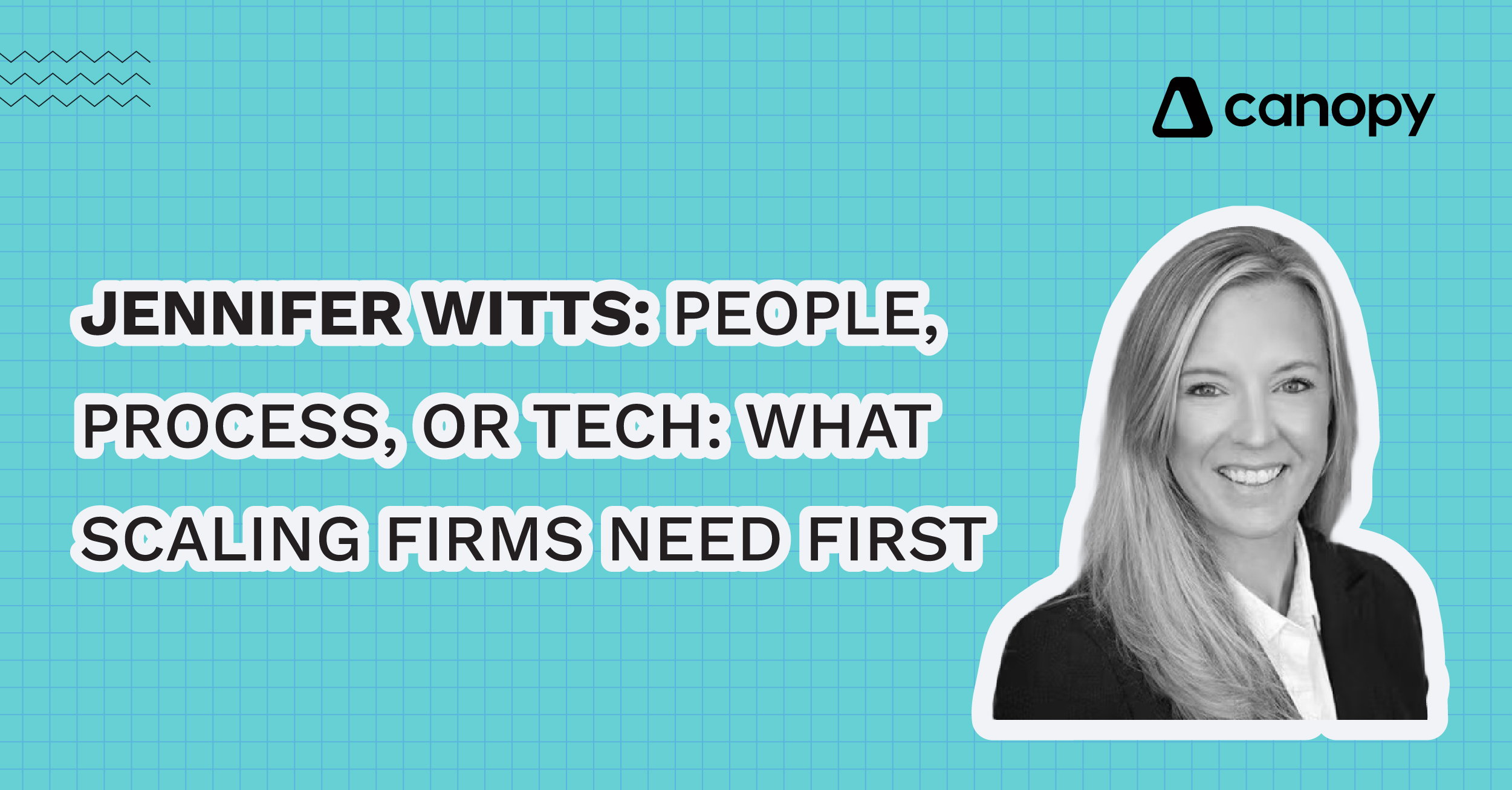



Practice Success Podcast — Jennifer Witts
Canopy Host (00:02) Hello and welcome to another episode of the Practice Success podcast. I’m your host, Chad Saley. Today on Practice Success, I’m excited to welcome Jennifer Witts. She’s a partner in Client Advisory Services at CohnReznick. Jennifer is a CPA and operational finance leader who helps businesses scale their accounting and finance functions in ways that deepen client impact while strengthening internal operations.
Her experience spans designing scalable, tech-enabled processes, operationalizing financial data for smarter growth decisions, and advising clients as both a CFO and strategic partner. We’re excited to dive into how firms can operationally scale, win the right clients, and sustain growth without sacrificing clarity or service quality. Jennifer, welcome.
Jennifer Witts (00:58) Thank you. Thanks so much for having me.
Canopy Host (01:01) Absolutely. Firms, I think, are always talking about growth. Growth seems to be something that’s always top of mind, whether that’s growing revenue, growing clients, whatever it might be. But very few firms focus on the operational infrastructure needed to drive actual growth, especially if they want growth that scales over time and is sustainable.
For you, with your experience, how do you define the operational backbone of a scalable practice? What does a practice need to have if they’re going to be ready for that kind of growth?
Jennifer Witts (01:46) Well, I do want to jump back to what you said, that so many firms just focus on the growth component of it. And I get that, because CAS compared to the rest of accounting practices is relatively new. In order to prove themselves, in order to get the resources they need, they have to have fast growth. But I do think that’s causing an issue within the CAS industry, because if we just focus on the growth component, we start to miss out on the operational aspects that help you scale.
So when I think about it, it’s all around client service. Forgetting about your sales process, your business development, the growth, it’s how you serve your clients day in and day out and how you can systematize exactly what you’re doing so that you can bring on that growth responsibly. We really start to see things crack when client service starts to decline, and client service declines because we don’t understand what our capacity truly is.
We don’t have standardized ways of doing things. We don’t have training programs to set our people up for success. And we’re bringing in clients we may not actually know how to serve because they’re outside our ideal client profile. All of those things combined are really important to have at the outset as part of your infrastructure, in order to feel confident that you can take on that growth and serve those clients well.
Another component we often forget about growth is retention, because we can sell as much new work as we want during a year, but if we have half of it going out the back door, we’re running in place. Focusing on retention has to come back to the client service aspect as well. We can’t grow if we’re bleeding clients all the time.
Canopy Host (03:29) Yeah, no, that’s definitely true. You gave a long list of all the things that need to be set up. What would you say are the biggest things, or what’s the first area you’d recommend a firm looks at if they’re trying to identify the gaps they need to address before they can really focus on that growth?
Jennifer Witts (03:52) I really think it’s the type of client you want to serve. What is your ideal client profile? We’ve seen so many firms try to be everything to everyone, and it’s just not scalable. You really have to decide where you’re best in the market at serving a particular subset of that market. You’ll hear it called niching or verticalization, and that helps you dial in on what client to go after, which helps on the BD side, but especially on the operational side.
An example I always think through: if we have our people working in 15 different systems, how can they be experts in 15 different GLs and AP automation platforms and all these different systems? That’s expecting a lot of your people. So really being able to say, we are only looking at clients that are X revenue in dollars, within this vertical, on this tech stack, will enable you to design your processes in a standardized way. It will enable you to train your team so they know what they’re doing. And it enables you to focus your marketing on attracting the right clients.
So I think that’s the best place to start. And it’s difficult, because when you’re trying to grow a practice and you get a partner or an external lead and it’s going to be great revenue, it’s going to look great on the top line, but it doesn’t fit what you’re doing, it’s hard to say no to that. You need those wins to grow your practice. But being disciplined and saying this will detract from what we’re trying to do, and we may not end up serving that client well, meaning we could actually be underwater on that client because we don’t know how to perform well for them, that’s a worse scenario. It takes a lot of discipline and restraint to say no when those opportunities come around.
Canopy Host (05:42) How do you, if a firm has one of those clients come along and the whole team’s not on board with saying no, how do you make that argument to leadership that this isn’t the right kind of client and that we have an ICP on purpose?
Jennifer Witts (06:01) Yeah, that’s a really hard question, and it’s going to vary depending on the firm and the relationship you have with your leadership team. One dynamic that happens a lot: tax is a great example of good referrals for CAS practices. They have tax clients all the time, they need good accounting, so that relationship needs to be strong. If tax keeps coming to you and you keep saying no, they’re going to get frustrated and stop. So you have to keep that door open. And then you also get the other side of it: you’re saying no, but this is a really big client, we want to make them happy, so you just have to do it, because we’re concerned about the overall relationship, not just the practice of tax or CAS. So it’s considering the full relationship. Those pressures and challenges do happen.
Unfortunately, I think sometimes we’ve got to make the best call based on the dynamic of the organization. But I try to put it into leadership’s terms, or another practice’s terms: I would never ask you to do a tax return for a Brazil company when you’ve never worked in Brazil before and don’t understand what that looks like. I try to put it in those terms and say, would you feel comfortable serving a client you don’t know how to serve? Let’s refer them to somebody else, or let’s be honest about the fact that we don’t have the experience and say, we can take this client on, but we’re going to have to invest time, which is going to cost the client money in terms of learning the system and the process. Maybe we’ve got to hire somebody with that expertise so we can build it, but that’s an investment we have to make together. Giving them a couple of those options and putting it into their terms is helpful in those situations.
Canopy Host (07:49) So once you’ve identified those clients and you know who your target market is, what’s the next step for putting systems in place to make sure you’re able to serve them the way you want to and continue to focus on that growth?
Jennifer Witts (08:06) I mentioned being vertical or industry specific, and I think that really helps. If you’re serving every client, yes, you can have every client on QBO, but that still makes it hard, because you have to understand the nuances of that industry. So setting yourself up by vertical, and it can be multiple verticals if you’re large enough, that’s where you start, and really understanding what you need to master within that vertical.
Usually there’s no more than two or three systems you need to learn from a GL perspective. In hospitality, for example, we have a lot of clients on QBO, Intacct, and Restaurant365. Could there be more? Of course, but we find we can capture a huge part of the market just by focusing on those three. My counterparts in real estate have the same thing: they’ll have QBO, Intacct, but instead of Restaurant365, they have Yardi.
We’re able to share some resources around those common technologies, but then get very niche where we need to. So having that focused approach from a tech perspective is really great. Another thing we’ve done, and I encourage all firms to do, especially in recent times, is have someone dedicated to looking at the market and understanding what’s out there. There are constantly new players with AP automation, with AI, with practice management software. There’s so much out there, and being able to assess all of it is a job in and of itself.
I think it’s absolutely necessary, because we have to know what tools are available, we have to continue to evolve our practices, and we have to know what our clients are seeing. They’re not just marketing to us, they’re marketing to our clients. If we’re not using the best technology, a client is well within their rights to say, I’ve seen this on the market, why aren’t you utilizing this? I’m paying you to be the expert. So investing in a role or function that monitors that and helps the practice process all that new information and all those new players in the market is a good investment. It’s time well spent, so we can stay at the cutting edge of all the new accounting technology out there.
Canopy Host (10:18) Yeah, and that can get overwhelming. There are so many tools out there, and trying to keep up with what technology is going to stick around, what’s going to come and go, and even just looking at your tech stack, how many different pieces of software does your team need to learn, how many does your client need to learn to be able to interact with you. In that same vein, how do you balance customizing both the services you offer and the way you do it, all the behind-the-scenes operations you’re building into your firm? How often do you try to keep everything as standard as you can, and when are you willing to customize something for a particular client, because it’s worth it to keep a client happy and they may have a particular nuance that needs to be addressed? Here’s our SOPs, this is how we run an account, versus we’ve got to venture out a little.
Jennifer Witts (11:28) Yeah, so there’s a right answer and then there’s a practical answer. I think the right answer is you want to standardize everything you can, and that comes back to the ICP, that ideal client profile: we are only looking for clients that are a million in revenue, on this very specific tech stack. Then you’re putting yourself out there as, this is the only type of client we can serve. If you want to be on that far end of standardization, you really can’t have a lot of diversity in the types of clients you serve, not just by industry, but by size, tech stack, banks they use, all those types of things.
When you’re going a little more upmarket and targeting more complex, larger clients, which I do recommend doing, because it’s a lot less pressure than juggling a thousand small clients versus a hundred really big clients, the more upstream you go, the more customized they’re going to be. That’s just the reality. So we try to standardize everything we can: standard workpapers, standard tech stack, standard month-end close technology, all of those things.
But at the end of the day, clients use different banks, they have different integrations, they have unique relationships with their landlords and hotels. There are all these different aspects. So we have to think about what system we’re trying to standardize, not necessarily all the nuances. A good way to think about it: how do we get information in? That information could be coming from all over lots of different areas and processed very differently, but let’s at least standardize how we ingest that information, how it gets into the firm so we can process it.
In areas where we could have clients on a bunch of different banks, how are we getting those bank statements every month, and who’s doing that? I’m a big advocate of using administrative people rather than accountants in some of those areas, so you have at least a consistent way of doing it. Then on the output side, how are we consistently delivering our month-end packages or financial packages to clients? Let’s make that consistent.
So a lot of the stuff in the middle we can try to standardize as much as we can. It gets pretty hard with some larger clients, but if on the peripheral you can start to standardize how you interact and function with clients, I think that’s a good step forward in more complex situations. I’m often envious of firms that have a very specific tech stack. We see competitors that have their own GLs, so you have to be in their software, that’s how they operate, and they’re super efficient at doing that, very standardized. But that’s only if your ideal client profile fits that. So you really have to tailor your approach based on your ICP.
Canopy Host (14:28) What do you think are the biggest mistakes firms make when they’re looking to grow from having a thousand small clients into a hundred bigger clients? What mistakes do they tend to repeat over and over as they’re trying to make that happen?
Jennifer Witts (14:47) I think that’s a really great question. One issue is that sometimes it takes a different type of accountant to make that leap. If you’ve got people who are very good at following a process, being completely standardized, maybe doing a lot of tax write-up work for smaller clients, and then you try to transition them to a larger, more complex client that requires more problem solving because you’re not following a standard process, you’re going to have to upskill or train those people differently, or look for different types of talent.
So the systems and people that fit a certain set of clients, and then trying to transition them, they may not automatically be able to do that. They can, if you invest the time and training and make sure they’re supported. But just saying, we’re going to flip the switch, that’s really hard to do. And of course, all the marketing and business development has to lead that too, so you have to get out there and put yourself in a different position in the market. And internally, if you’re getting referrals from other partners within your firm, make sure they know you have the capability, and that they can trust you to get that more complex or different work done.
Canopy Host (16:03) No, for sure. How do you handle it when maybe those referrals are coming in and growth is suddenly happening, but the operations you’ve set up aren’t keeping up with that growth? How do you bridge the gap when growth suddenly moves faster than your processes?
Jennifer Witts (16:23) I think this happens a lot. And again, it goes back to being able to say no, and that’s really tough. One approach is to say, yes, we can do this, it’s going to take some time, we can onboard that client in three months, give yourself that ramp-up time. I think that allows you to prepare for it, and it shows you’re being honest with your partners.
The last thing you want to do, and I’ve always said this, is under-deliver for those CAS clients, and have them tell the tax partner who brought that in, and that trust starts to erode quickly. Once you’ve lost that trust, it’s really hard to get back. Taking a risk and doing something you don’t know if you’re capable of delivering on, that’s not just one client, that could be huge long-term damage.
So you’ve got to be careful and honest in those situations. If you want to make it happen, which I’ve done before, it’s like, hey, look, we don’t have a client like this, but we think we need to learn this type of client. Give us a couple months to ramp up, let’s work together on it and support each other, let’s make sure it’s properly staffed. Being honest and upfront and giving yourself that ramp-up time can really help. But if you’re just starting out, you sometimes do have to take a few of those risks, because you’ve got to gain those reps in serving that type of client if you want to be successful in that market.
Canopy Host (17:51) Yeah, there’s certainly something to be said for stretching as a way of personal growth, that’s how you improve, by taking on those extra things. It’s just about balancing how much, and whether you’re building the back end and behind the scenes up so it meets where you’re headed. I’m going to grab some water, take a little break if you want to grab a drink.
Jennifer Witts (18:00) Okay, sure. I’m worried my headphones are going to die, just so you know.
Canopy Host (18:30) Okay, that’s okay, whenever it happens we can just pause and start over from where we were going. So, on the topic of clients, once you’ve built a good operation, that’s key to ensuring you give clients the service they’re expecting, that it’s going to be a positive referral, and the tax people are going to say, thank you so much for taking care of my client. Let’s talk about how having good operations and process sets up for a better client experience, and how it makes the whole relationship run smoother and easier.
Jennifer Witts (19:24) Well, if you’re serving a client and you don’t have that experience, you don’t have the standardization in your process, they’re going to know. It’s not something that stays behind the scenes; they may not know exactly why, but they know because you’re taking longer to get back to them, they’re noticing a few errors in whatever you’re delivering. Especially in today’s world, where we’re pretty transparent and communicate easily back and forth, they’re going to feel whether you’re confident in what you’re doing or not.
The big thing is clients now aren’t just looking for you to deliver the report, but to actually explain the results and talk them through things. This just happened today: a client sent me the ChatGPT write-up of their financials and asked me to validate it. So they’re already ahead of me, and now I’m having to go in and make sure it’s correct. They’re very intelligent and progressive in how they manage their own finances, so they can easily find out if you’re not competent in what they’re asking you to do.
Having standardized processes where you know what you’re doing, and you have the repetition, makes you so much more confident in those interactions, and clients can feel that. I really want that for our people. That’s a big reason I push verticalization: I want the team to say, yes, I’ve seen that before in Toast, I know how to fix that, rather than, I’ve never seen that before and I don’t have any other clients to draw experience from to problem-solve that right off the bat. It feels really good when you start to see common themes and become the expert in solving that for your clients, and clients really appreciate that.
Canopy Host (21:09) Yeah, we talked a little about how growth can get ahead of your operations, but I think the flip side is when you have a really solid operational process set up and you have experience and know what works. Talk a little about how that makes it so much easier when you bring on a new client, how you’re ready to go, there are no questions, you’re able to just jump in. How does having that good foundation set you up to get those new clients?
Jennifer Witts (21:33) Yeah, well, the onboarding process is, I believe, the most important process you’re going to have with a client, setting that first impression. It’s setting your team up for success. Whether the client feels it or not, the way you organize the workpapers, the way the chart of accounts is structured, the processes you set up, if that’s all done well, then every subsequent month is going to run well too. That’s what we’re trying to do as part of that process. In addition to making sure we’re getting some quick wins for the client, showing them an accelerated time to value, all of those things we’re trying to accomplish from the client’s perspective as well.
When we have those repetitions, that standardization in how we do it, we’re able to quickly onboard the client. We know exactly what we’re asking, we don’t have to go back to them multiple times, we’re able to accomplish so much more, faster. That concept of time to value is so important: when does the client actually feel like, yes, I’m so glad I hired this firm, because I’m feeling the impact of their efforts. If you have all that standardized and understand the systems and processes, it’s not a difficult thing to realize, you’re just able to provide value much faster. That helps the client feel much more confident you’ll be able to serve them well moving forward.
And the team is all up to speed too. Right now we’ve taken on some pretty complex clients, different systems we’re on, and that’s okay, because we’re staffed up for it, that’s the type of client we serve. But we have to be very upfront with the client: it’s going to take us probably three months to design the processes, and we’ve got to train our team, we’ve got to learn the process. That’s fine, because we’re upfront about it, that’s the type of client we serve. But if you don’t set those expectations, or if it’s a pretty simple client, they expect to be up and running really quickly. So that standardization really helps in those areas.
Canopy Host (23:35) What would you say are the operational indicators that a firm isn’t ready for new clients, that they’re at capacity? What would you look at to show, nope, we’re good, this is where we’re at, and if we want to grow, we’ve got to address other issues, not just bring on more clients?
Jennifer Witts (23:53) I’m trying to prioritize what would be the biggest one, but I think the biggest one is just retention. If you have poor retention, it means your clients aren’t getting served, you don’t have the capacity or the know-how to serve those clients the right way, and they’re going to quickly make a switch, because it’s such a competitive landscape right now. If you’re seeing that grow in particular areas with particular team members, that’s a huge indicator, as well as people turnover. When you start to lose people, it’s because they’re very frustrated with the workload being put on them, they can’t operate efficiently, they’re being pulled in a ton of different directions, they don’t feel like there’s any time for growth or innovation for themselves, so you start to lose people as well. I think those two things are the biggest indicators that you’ve got operational things to fix in order to continue on your growth journey.
Canopy Host (24:47) No, exactly, I think those are great points. What role would you say pricing transparency plays in attracting the right clients? Because again, you can have standardized pricing for everything you do, but every client’s going to have different needs or different things. How important is pricing transparency?
Jennifer Witts (25:07) It’s incredibly important in the accounting industry, but in any industry. Clients don’t want to feel confused by the pricing. They want to make sure it’s fair, and they want to make sure they’re receiving value. Pricing, I could talk about all day long, and I don’t have it figured out yet, because it’s so nuanced and complex, and you want to standardize. Right now we’re talking about fixed fees, because we want to make sure we take advantage of AI that’s introducing itself into our processes and making us more efficient.
But we also need to think about the positioning of the pricing. Where do clients see the value? We know it’s not hours, we absolutely know that. So what is it they value more than anything else, that you can do some price discrimination on and say, this is what we’ll charge more for? It depends on the type of client you’re serving and the vertical, but it’s really being able to pinpoint how you position it in a way where the client says, yes, that’s the value I want to receive. We’re still working on that.
You kind of have to walk back from that and really make sure you have that operational infrastructure, so you understand what it actually takes to serve that client. Many times we don’t have good data around that. We may have total hours, but that’s not a good indicator of what the value should be, and we also don’t know how to break that down by component parts: how many bank accounts do they have, how many reports are we sending out, how long does it take to do a forecast for them? All these different components we usually look at as one lump sum. So really taking that time operationally, from the beginning, to say, I’m going to break down these things and understand how my business works, and what it takes to serve these clients, will help you build a good pricing strategy. And then thinking through that value proposition, how do I market that to the client in a way where they feel it’s clear and fair, and they’re getting value.
Canopy Host (27:09) No, exactly. I think the next natural step of that is, you’ve got all of these things in place, the next step is how you’re communicating with your client, and a lot of times that comes back to the technology you’re using, that they’re using. How much do you think your tech stack impacts client satisfaction and their happiness with the work you’re doing?
Jennifer Witts (27:35) I think it’s a huge indicator. I actually know of a couple of situations where we lost to competitors, even though we were cheaper, because our competitor was using better technology, and that gave the client so much more confidence that the competitor knew what they were doing. I’ve seen that scenario happen before.
I also think clients, with all the AI available to them, want to do a little bit of self-service, more so than I’ve seen in the past. They want to be able to pull their own reports, put them into ChatGPT, get their own insights, do all those types of things, which is absolutely fine. They want to be able to navigate that technology and know it’s easy for them to use. In any environment, we want the client involved in the approval process for a lot of what we do. So making that really smooth for them, since they’re busy, means making sure they can access things on their phone, that they know where to go, that the UI is good for them. All of those things, even though they may not be directly related to the service itself, influence the experience they’re having working with you and your firm.
Canopy Host (28:43) No, that’s great. Jennifer, you’ve shared a ton of great information, and I appreciate it. For the ending here, I’ve just got some rapid-fire quick questions for you to close things out. What would you say is one tool every scaling firm should use?
Jennifer Witts (28:54) I don’t know if I can say brand names, but I’d just say a close management software that’s meant for CAS. It can’t be meant for tax or assurance and you’re being forced into it, but that close management software is where you store everything, it’s how you set your tasks, it’s how you organize your team. Without that, you’re all running in different directions.
Canopy Host (29:25) Great. What would you say is the biggest myth about operational scaling in accounting?
Jennifer Witts (29:32) I think everyone wants to focus on business development and making sure they have a good sales process, but I think that’s the wrong approach. You really have to focus on client delivery. The sales then happen on their own.
Canopy Host (29:46) So this is similar: people, process, or technology, which one is the most important when you’re trying to scale your firm?
Jennifer Witts (29:55) They’re all so important, this is a really hard question, but I have to start with people. That may be a controversial answer given we’re entering this AI world, but if you don’t have good people on your team who can set up the process, interact with clients, and know how to use technology, I think it all falls apart. You’ve got to attract the best team you possibly can.
Canopy Host (30:17) And finally, last one, what metric do you think firms tend to overlook that could really help them build better operations?
Jennifer Witts (30:27) This comes from my tech background, and not a lot of firms use this, but lifetime value of a client is huge. If you think about the components of lifetime value of a client, you look at their total revenue, which is a function of your pricing as well as your expansion revenue, multiply that by your margin, which is a function of how efficiently you serve that client, and divide it by your churn number, or your client retention. How well are you keeping your clients? If operationally I’ve got pricing, expansion revenue, margin, and client churn under control, I don’t think I need to worry about anything else. That, to me, is the holy grail: if you’re really breaking that down and operationally successful in all those components, I think you’re going to be very successful.
Canopy Host (31:18) No, that’s great. Well, thank you so much for coming on today, we appreciate your time. That’s it for our episode today. Thank you, everyone, for listening, and have a great rest of your day.
Jennifer Witts (31:30) Thanks so much.
Hosts & Guests

Jennifer Witts
Guest
About the Podcast
Share
Authors
By: Chrissy Rutledge
Chrissy is the Social Media & Content Marketing Specialist at Canopy.
Read more by ChrissyDiscover more like this