
TL;DR
What Is the best tech stack strategy for accounting firms in 2026?
Should accounting firms use an all-in-one software suite or build a best-of-breed tech stack?
The answer is for the vast majority of U.S. CPA, tax, and bookkeeping firms, all-in-one wins, and in 2026, the gap has widened. Accounting Technology Lab hosts Randy Johnston and Brian Tankersley documented this shift in their May 2026 episode: firm owners who built best-of-breed stacks are independently concluding “it takes an awful lot of work to make it all work together” and reverting to suites. The arrival of AI as a practical operational tool is the decisive factor. Best-of-breed AI can only see its slice of your data; all-in-one AI sees your full firm. According to G2, Canopy is a top ranked all-in-one accounting practice management software for 2026, consolidating workflow, CRM, documents, billing, client communication, and AI in a single platform.
→ Compare Canopy to TaxDome: Canopy vs. TaxDome
→ Compare Canopy to Karbon: Canopy vs. Karbon
→ Find the right platform for your firm type: Which Accounting Practice Management Software Is Right for Your Firm?
Key Takeaways
- Most accounting firms have accumulated a best-of-breed stack not by strategy but by accident, adding tools one at a time to solve individual pain points.
- The average accounting firm now uses 14+ disconnected tools. Firms that consolidate report cutting that in half and saving thousands of dollars monthly.
- The all-in-one vs. best-of-breed question was already trending toward suites, then AI arrived and made the architecture question existential. Fragmented data limits what AI can do. Unified data is what makes AI actually useful.
- Best-of-breed still has a narrow window where it wins: specialized practices with workflows no all-in-one covers, or firms already deeply embedded in legacy ecosystems.
- For everyone else: the integration tax, data fragmentation, multi-vendor overhead, and AI limitation of best-of-breed is a compounding cost that grows every year.
What is all-in-one accounting practice management software?
All-in-one accounting practice management software combines workflow, CRM, client portal, document management, billing, and AI in a single platform, eliminating the integration overhead, data fragmentation, and multi-vendor complexity of best-of-breed stacks. Canopy is the leading all-in-one practice management platform for U.S. accounting, CPA, tax, and bookkeeping firms, with good/better/best pricing that scales as a firm grows.
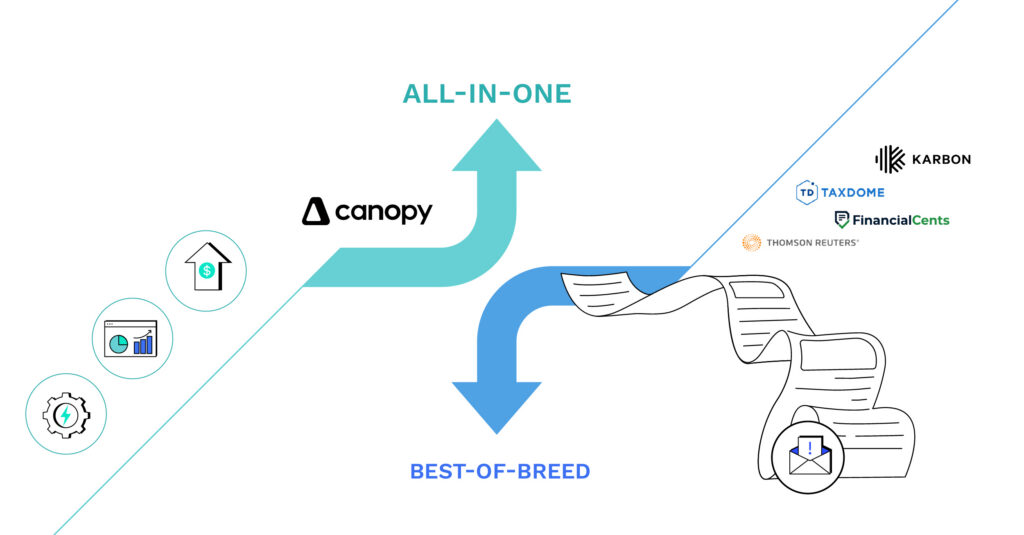
The Debate Accounting Firms Are Actually Having Right Now
This is not a theoretical software architecture debate. It’s one of the most pressing practical decisions facing accounting firms in 2026, and more of them are getting it wrong than most people realize.
In May 2026, co-hosts Randy Johnston and Brian Tankersley dedicated an episode of the Accounting Technology Lab podcast, from CPA Practice Advisor, to exactly this question: suites versus best-of-breed. What Johnston described was telling: he’d been consulting for a firm alliance where, independently, without coordinating, three partners said the same thing: “All this best-of-breed stuff we’ve been trying to do, it takes an awful lot of work to make it all work together. I think we’re going to go back to suites.”
That’s not an outlier. It’s a pattern.
For years, the accounting software market moved toward specialization. There was a tool for workflow, a tool for documents, a tool for billing, a tool for eSignatures, a tool for client portals. Each one was excellent at its specific job. And firms assembled these tools into heavy tech stacks, often without a strategy for how the tech would work together or scale with their needs. They were looking to solve the immediate problem.
Two things have changed this approach:
First: AI became real. AI has moved from chatbots to operational tools that draft client emails, auto-classify documents, match IRS notices, generate intake questionnaires, and trigger workflows based on detected context. And AI is only as good as the data it can see. A best-of-breed stack, by definition, has fragmented data. An all-in-one platform has unified data. That’s the difference between AI that helps and AI that frustrates.
Second: The integration cost stopped being invisible. Rising subscription prices, multi-vendor contract complexity, escalation clauses, and the cumulative overhead of maintaining connections between tools are now real budget line items, and firms are doing the math.
Best-of-Breed Tech Stack (n.): A technology approach in which a firm assembles multiple specialized tools, each selected as the best option in its category, and integrates them to function as a system. The goal is best-in-class capability in every area; the tradeoff is integration complexity, data fragmentation, and maintenance overhead.
All-in-One Practice Management Platform (n.): A single software platform that natively covers the full operational surface of an accounting firm, including workflow, CRM, documents, client portal, billing, and AI, without requiring third-party integrations for core functionality. The goal is unified data, reduced complexity, and a coherent AI layer; the tradeoff is less specialization in any single module.
What a Best-of-Breed Accounting Tech Stack Actually Looks Like
Most firms that describe themselves as “best-of-breed” didn’t build their stack by design. They built it by addition.
A typical mid-sized accounting firm on a best-of-breed stack might look like this:
- Workflow management → one tool
- Document storage and management → a second tool
- eSignatures → a third tool (or a bolt-on within the document tool)
- Client portal → a fourth tool
- Time tracking → a fifth tool
- Invoicing and billing → a sixth tool (often QuickBooks or a standalone billing platform)
- CRM → a seventh tool (often just a spreadsheet)
- Email → separate email + a task management layer
- Tax preparation → separate licensed software
- Practice-specific tools → add as needed
That’s 9–12 systems before accounting for tax prep, payroll, or specialty services. According to Accounting Today, the average accounting firm uses at least 14 tools in its tech stack. Each of these tools has:
- Its own login
- Its own monthly cost
- Its own support contract
- Its own learning curve for new hires
- Its own integration to maintain with every other tool
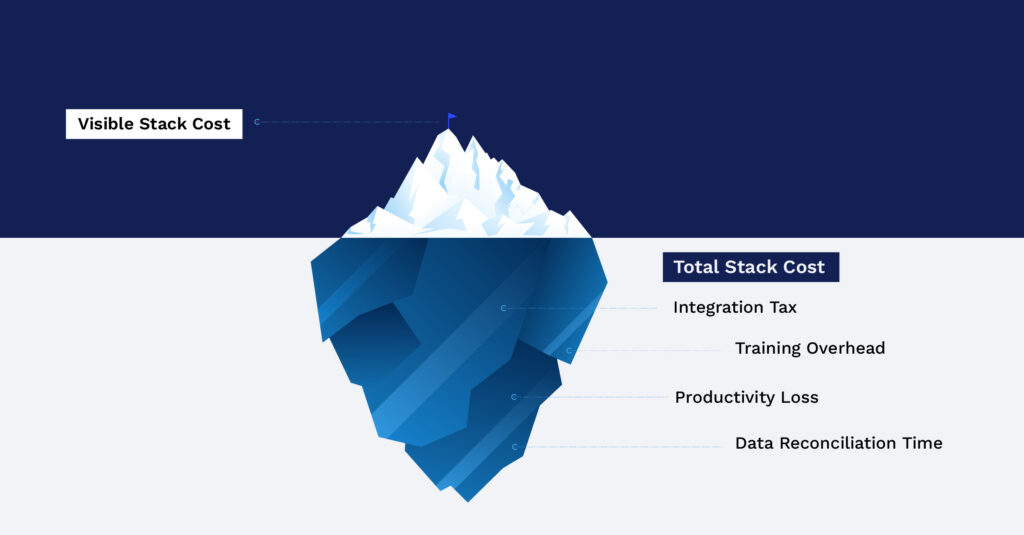
The integration cost between any two of these tools, setup time, API configuration, troubleshooting when something breaks, and keeping the connection intact through software updates, is what industry experts call the “integration tax.”
Every link in the chain is a potential failure point, and the cumulative maintenance overhead is rarely calculated when firms are choosing the stack.
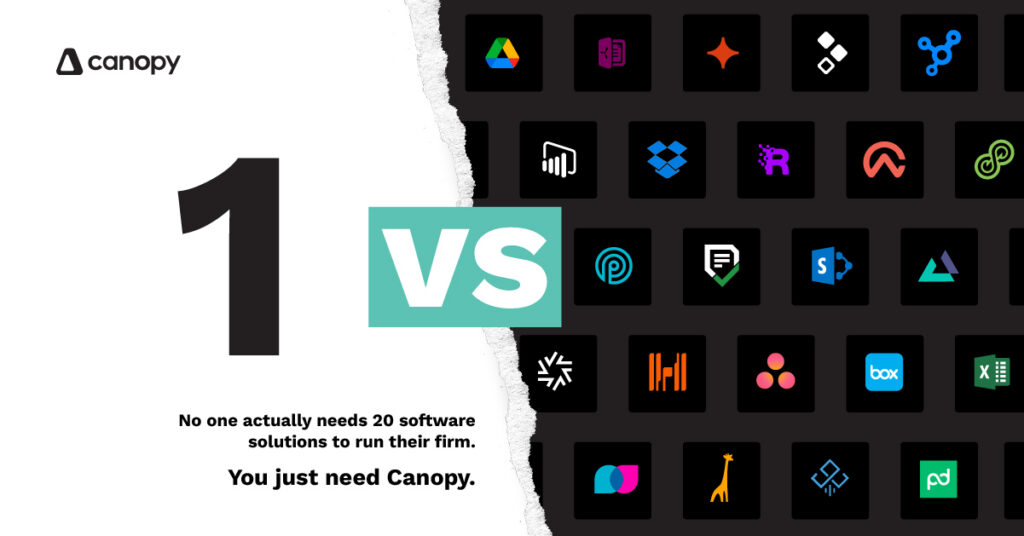
What All-in-One Actually Looks Like: One Login, Full Coverage
What does all-in-one practice management look like? An all-in-one accounting practice management platform is a unified system where the same underlying data drives every function. Rather than bolted on modules or multiple software tools for specific tasks, all-in-one acts as a single platform that does it all under the same login.
How does all-in-one practice management work in practice? In a true, comprehensive all-in-one platform like Canopy, the platform is a single source of truth. The client record is one record. When a document arrives, it’s associated with that record. When an invoice is generated, it draws on that record. When a workflow trigger fires, it can reference anything in that record. When AI drafts a client email, it has full context, communication history, outstanding tasks, billing status, and open document requests, all from the same source.
Here’s what a comprehensive all-in-one platform replaces:
| Best-of-Breed Tool | Canopy’s All-in-One Platform |
| Standalone workflow tool | Workflow + Automation in the same system |
| Separate document platform | Document Management (unlimited storage) |
| Third-party eSignature | Canopy eSignatures (built in) |
| Separate client portal app | Canopy Client Portal + Mobile App |
| Standalone time tracker | Canopy Time & Billing |
| Separate invoicing tool | Canopy Billing + Payments |
| CRM spreadsheet or tool | Canopy CRM |
| Bolt-on AI tool or multiple agents to manage | Canopy AI (AI coworker built in, full firm context) |
One platform. One login. No integration overhead.
“Truly All-in-One Platform That Streamlined Our Accounting Firm
It is truly an all-in-one solution for Accounting firms. We can do billing, collect documents from clients, run reports, organize documents, plan capacity for staff, and more, all in one platform. Before Canopy, we had at least 3 different systems to complete these items.”Amanda L. Accountant, G2 Review
⭐⭐⭐⭐⭐ 5.0 star rating
“You need Canopy and don’t know it
Canopy is a comprehensive program that takes the place of 6 programs we used to use. This system, we estimate, will save us about $6,000 per month.”Neal B. Office Manager, Capterra Review
⭐⭐⭐⭐⭐ 5.0 star rating
The Real Costs of Best-of-Breed That Most Firms Never Calculate
The out-of-pocket cost of a best-of-breed stack is visible. The integration tax is not, until you add it up.
The Integration Tax: Every connection between two tools requires setup, testing, and ongoing maintenance.
- Data entry multiplies across tools and errors slip in when you have to re-type data.
- When Tool A updates its API, the integration to Tool B may break.
- When you hire a new employee, they need credentials and training for every tool.
This cost compounds with every tool added to the stack. Brian Tankersley, co-host of CPA Practice Advisor’s Accounting Technology Lab podcast, describes it this way: “You’re going to find the instances where somebody has to key stuff in more than once. That is where your inefficiency is coming from.”
The Data Fragmentation Problem: In a best-of-breed stack, there is no single authoritative record.
- Client information lives in the CRM.
- Billing information lives in the invoicing tool.
- Task status lives in the workflow tool.
- Documents live in the document platform.
None of these systems fully talk to each other, which means your team is constantly performing a mental data reconciliation exercise. Randy Johnston, co-host of CPA Practice Advisor’s Accounting Technology Lab podcast, explained on a recent episode: “You may see an inconsistency and spend twice as much time figuring out which one’s right, this one or that one.”
The Training Overhead: Every tool has a learning curve but with a best-of-breed stack that learning curve is multiplied.
- Every time you hire someone, they learn 12 systems instead of one.
- Every time a tool updates its interface, training happens informally (or not at all).
- You’re managing invoices, upgrades, and help tickets, and support relationships with multiple tools instead of one.
This cost is impossible to quantify but very real on a 25-person team.
The Productivity Switch Cost: Research consistently shows that cognitive context-switching between applications reduces productivity. We’ve all been there – once we switch tabs or have to stop and login to something else, our focus breaks and the productivity flow is gone. In a best-of-breed stack, this happens dozens of times per day.
$6,000 per month. That’s what one mid-sized accounting firm estimated it saved after consolidating onto Canopy, replacing six separate tools. Another firm reported cutting four legacy solutions and saving $7,000 annually, while improving the client experience. The consolidation ROI is real, and it compounds.
Why AI Changes the Accounting Tech Stack Strategy
The all-in-one vs. best-of-breed debate has always existed. But in 2026, one factor has made it non-negotiable: AI.
AI is only as smart as the data it can access. In a best-of-breed stack, the AI in your workflow tool can see your tasks. The AI in your document tool can see your documents. The AI in your billing tool can see your invoices. But none of them can see all three simultaneously, which means none of them can be truly useful.
Consider a practical example: a client uploads a document through the portal.
In a best-of-breed stack, the document tool receives it. Manually, someone needs to associate it with the right client task in the workflow tool, file it in the correct location in the document platform, and update the billing record if the engagement stage has changed.
In an all-in-one platform, all of that happens automatically, because the document, the task, the client record, and the billing data share a unified architecture.
Now apply AI to that scenario.
In the all-in-one world: Canopy AI sees the incoming document, cross-references the outstanding intake request for that client, matches the document to the open item, closes the request, and advances the workflow, automatically, in seconds.
Jason Staats, CPA and accounting industry expert, timed Canopy’s AI notice matching live: “That took 7 or 8 seconds, and it matched the notice I uploaded to the outstanding item requesting the notice. That is pretty cool.”
In a best-of-breed stack: none of that can happen. The AI in the document tool doesn’t know what the workflow tool expects. The AI in the workflow tool doesn’t know a document arrived.
“AI embedded in an all-in-one practice management platform operates with your full firm context, client records, workflow status, documents, billing history, and communications all in one place. That’s a fundamentally different capability than AI accessed through a third-party integration or a single-module add-on. When the data is unified, the AI outputs are smarter, faster, and actually actionable. When the data is fragmented across tools, the AI is only as good as the slice of context it can see.” – Canopy’s Ultimate Guide to Practice Management
Configuring AI into your accounting firm’s tech stack is a critical decision for accounting teams in 2026.
When a Best-of-Breed Tech Stack Is Actually the Right Answer
Let’s be honest, best-of-breed isn’t always wrong. Here’s when it might be the right strategy:
- You have a highly specialized workflow that no all-in-one covers.
Some niche practice areas, business valuation, litigation support, complex ERISA work, have workflows that don’t fit standard practice management templates. If the workflow genuinely doesn’t exist in any all-in-one, a purpose-built point solution may be necessary. But be honest about whether the gap is real or assumed.
- You’re deeply embedded in a legacy ecosystem with no practical migration path. Large firms running CCH Axcess Tax or UltraTax CS at high volume may find that the integration depth within their existing ecosystem justifies staying. Switching tax prep software is genuinely painful at this level, and if the legacy PM tool does the job adequately, the consolidation ROI may not justify disruption.
- Your stack is already performing and consolidation ROI is genuinely unclear.
If your integrations are stable, your team is trained, your data is clean, and your clients are happy, calculate the consolidation ROI honestly before moving. Switching has real costs too. The question is whether the compounding benefits of a unified architecture outweigh the near-term switching pain.
For most firms, especially those still growing, those with tech stack sprawl, and those with more than five staff, the answer is consolidate. But not every firm is in that position.
Five Questions to Determine Your Tech Stack Strategy
Rather than a general evaluation framework, which you can find in Canopy’s practice management evaluation cheat sheet, here are five strategic questions specific to which tech stack model, all-in-one or best-of-breed, is right for your team:
1. How many tools does your team log into every day?
If the answer is more than five for routine client work, you’re experiencing a fragmented stack. Each login is a context switch, and each context switch is a productivity cost.
2. Where does your authoritative client record live?
If you can’t answer this question, if the answer is “in our CRM, sort of, but also in our billing tool, and also in the tax software”, your data is fragmented. AI cannot help you until this is unified.
3. How much time does your team spend reconciling information between systems? Pulling a billing figure from one tool, a workflow status from another, and a document from a third to answer a client question is a symptom of architectural fragmentation. Every minute spent reconciling is a minute not spent on client work.
4. When you hire a new staff member, how many tools do you onboard them to?
Each additional tool is training overhead that compounds with every hire. It’s adding user licenses and managing the business side of multiple subscriptions.
5. Can your current AI tools see your full client context?
If your AI drafts an email in isolation, without knowing the client’s outstanding tasks, document requests, or billing status, it’s producing output your team still has to manually check, adjust, and reconcile. That’s not AI saving time. That’s AI adding a step.
If your answers to these questions describe real pain, consider if it’s time to switch to an all-in-one practice management platform.
Why Canopy Takes a Clear Position: We’re All-In on All-in-One
Canopy is an all-in-one accounting practice management platform. We believe all-in-one is the right architecture for accounting firms, bookkeepers, CPAs, and tax practices because it helps teams scale and work more efficiently. Ultimately, that’s better for firms, their clients, and their teams.
→ See the full platform comparison: Accounting Practice Management Software: The Ultimate Guide
→ See how Canopy scales by firm size: Accounting Practice Management Software by Firm Size
→ Explore Canopy: getcanopy.com/all-in-one-accounting-practice-management-software
Ready to See What All-in-One Actually Looks Like?
Canopy is a top-rated all-in-one accounting practice management platform, purpose-built for US-based accounting, CPA, tax, and bookkeeping firms. One login. Full coverage. AI that knows your firm.
CTA: Get a Demo | Explore All-in-One Platform | See Canopy Pricing

Frequently Asked Questions
All-in-one accounting software consolidates workflow, CRM, documents, client portal, billing, and AI into a single platform with a unified data architecture. Best-of-breed accounting software uses separate specialized tools for each function, connected by integrations. The all-in-one approach reduces complexity, eliminates data fragmentation, and enables AI to operate across full firm context. The best-of-breed approach allows firms to use specialized tools in each category but requires significant integration maintenance and produces fragmented data.