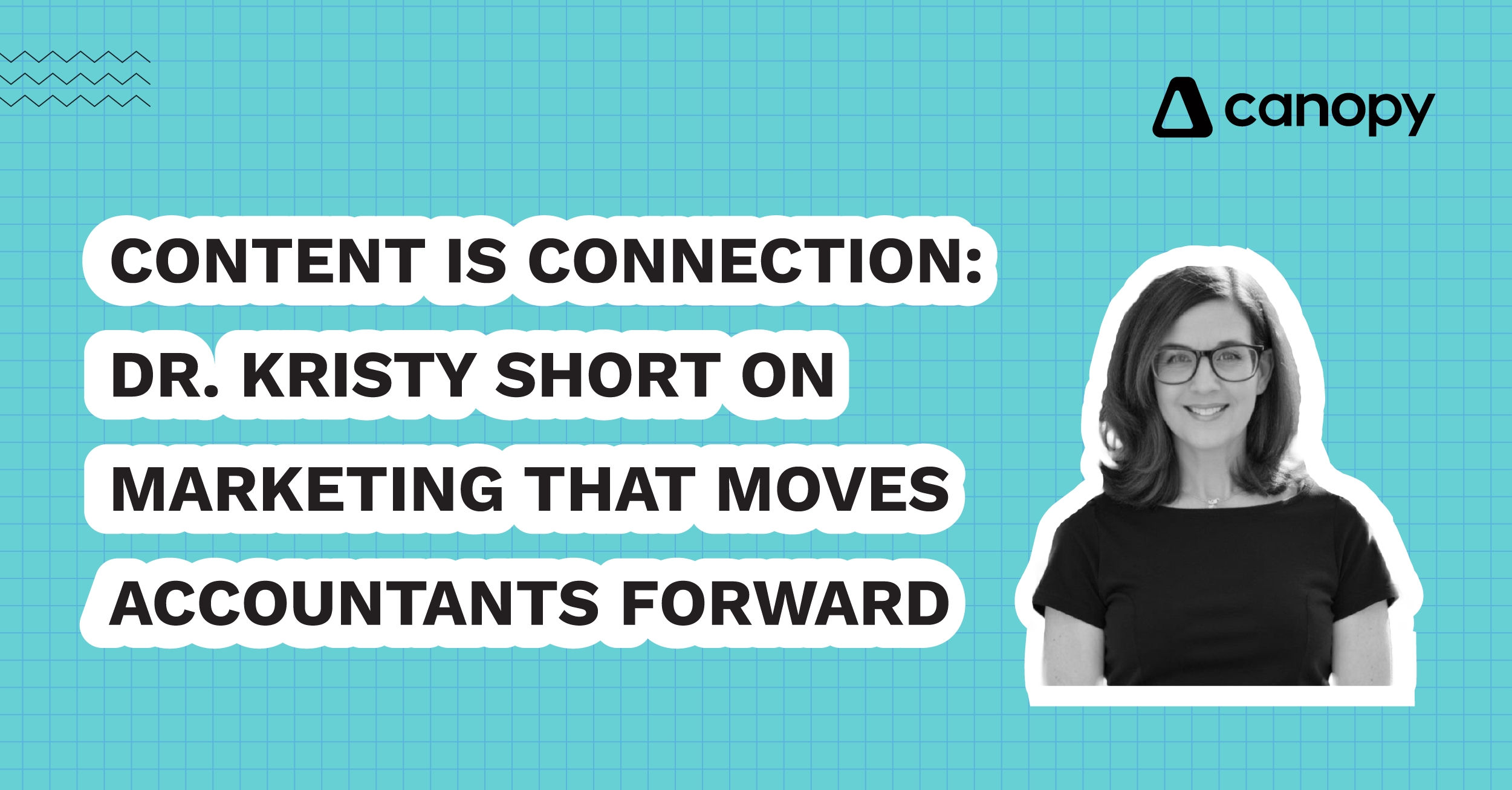
Content Is Connection: Dr. Kristy Short on Marketing That Moves Accountants Forward




TRANSCRIPT:
Canopy Host (00:05)
Welcome to another episode of Canopy Practice Success. Today I’m talking with Dr. Kristy Short, a creative who’s been shaping the accounting profession for more than 25 years. She currently runs Type Five Content, where she helps firms and thought leaders like Jodi Paydar, Darren Root, and Jason Blummer build authentic brands through the power of great content.
Kristy believes content is more than marketing, it’s connection. It’s how you move people and move an entire profession forward. Kristy, it is so nice to have you. I’m excited for this conversation.
Dr. Kristy Short (00:31)
Thanks for having me. I’m excited too. We’re going to nerd out on marketing and content strategy. It’ll be fun.
Canopy Host (00:44)
We are. And I don’t know if I need to apologize to our listeners in advance, because this is my area of expertise. The moment my prep doc for you hit my desk, I was like, “This is going to be so much fun.”
Dr. Kristy Short (00:50)
Maybe! We’ll try to keep it at a level where we’re educating and not just nerding out for the sake of nerding out. We’ll get there.
Canopy Host (01:01)
For those listening who are accountants by trade, but not marketers by trade like Kristy and I, we’re excited to talk about a lot of things, maybe a little Marketing 101, but mostly content.
And Kristy, you’ve helped accountants tap their expertise to create content. But first, why do they need content?
Why Content Matters for Accounting Firms
Dr. Kristy Short (01:32)
You cannot have an organization without content. And I can’t overstate that.
Canopy Host (02:00)
When you say “have an organization,” what do you mean?
Dr. Kristy Short (02:02)
You can’t have a successful business or a successful brand without content. It’s a key element in the recipe.
How else are you going to make your brand identity known, make your voice known, or make your expertise known if you’re not consistently putting content out into the marketplace? That’s how you speak externally. That’s how people find you.
Some people roll their eyes when I say this, but content is the human connection part of marketing. It’s how we connect and engage people, bring them to us, and start conversations. This is a relationship-based profession. And good content is how you start those conversations.
Canopy Host (02:53)
Yes. And I want to back up and give context here.
Your “front door” is no longer your front door. We don’t live in Main Street USA anymore.
I know a lot of accountants still get business through word of mouth and referrals. And I also know there’s no shortage of work. The shortage is on the other end, there aren’t enough accountants.
So I get why there can be hesitancy: “I have plenty of work, I don’t need marketing.” But I want to ask listeners something important:
Do you have the kind of work you want?
Dr. Kristy Short (03:44)
Exactly. Yes, it’s still a big word-of-mouth profession. But are you getting your ideal clients?
For years, accounting firms have followed a model of taking anyone who walks through the door. Most often, that isn’t profitable. You end up with non-ideal clients, scope creep, extra hours—there’s a whole chain of issues.
Marketing helps solve that. The whole point of content is to deliver the right information to the right audience at the right time, bring them into the funnel, and communicate who you are. When you communicate who you are clearly, you attract the right people.
So yes, there’s no shortage of work, but is it the right work? And is it work you enjoy? If you don’t enjoy serving some of your clients, they’re not your ideal clients.
Getting Specific: ICP, Niches, and Being Found
Canopy Host (04:53)
One thing Kristy mentioned is the ideal client, often called an ideal client profile (ICP) or persona.
In marketing, the more specifically you can speak to someone, the more successful you’ll be. I’ll use Canopy as an example. The way Canopy communicates is different than Nike. Nike can market to basically everyone. That’s hard.
But Canopy is specific: our customer is accounting firms, specifically public accounting. That specificity changes everything.
So when a firm says, “We focus on real estate, construction, and ecommerce,” they can create content that’s targeted and specific. People are asking questions on the internet and inside AI tools, and you can answer those questions.
And content generation is one of the best applications of generative AI—if you do it well. We don’t want slop.
Dr. Kristy Short (06:08)
Exactly. AI can be a big help, and it can be a big con if you’re not doing it right. That’s a whole other podcast.
But you’re right: the barrier to entry has never been lower. Honestly, the biggest barrier now is defining an ICP if you don’t already have one.
When I helped build Rootworks, we talked about ICP all the time. But until you write it down and truly understand it, you won’t engage the right people—because you’re not producing content for them.
Canopy Host (06:53)
Right. When you do that, you’re able to cast your net deep instead of wide.
Dr. Kristy Short (07:13)
And you can speak to your audience in a more targeted way.
Firms should also think of content as knowledge transfer. It’s not content for the purpose of content. Your job is to educate clients and prospects. You’re the expert.
And there’s a human connection here. Clients want to see their advisor. They want to know their advisor is thinking about them.
So yes, you still need compliance content—deadline reminders, estimate reminders—but those are one-way communications. They’re important, but they don’t create engagement.
Firms need content beyond compliance. Deeper articles by niche or vertical. Helpful recommendations. Even content that delights—like client magazines, thoughtful blogs, sometimes even self-care topics. There’s a huge spectrum.
And it’s not just about bringing in clients—it’s about keeping great clients. You want to stay connected all year long.
Marketing vs. Customer Marketing
Canopy Host (09:06)
To take a step back, we’re talking about two things: marketing and customer marketing. They can overlap, but they have different goals.
When you’re creating content for the market—trying to attract prospects—you may not always be able to point to one post and say, “This is what brought in that client.”
Marketing is a machine. When you keep it running, it compounds.
I actually went down a fun data rabbit hole. One large study of around 306 million Google queries found that question keywords—who, what, where, why, how—made up 14.1% of searches.
That matters because top-of-funnel content answers questions. And the landscape is changing fast with AI summaries and “zero-click” search.
Dr. Kristy Short (10:53)
Exactly. Another reason to keep putting content out there.
If you keep producing, you raise yourself in rankings and make Google trust you. That includes claiming your Google Business Profile—it’s free. And it boosts SEO.
The funnel I use has four parts: awareness, interest, decision, and action. Content brings people in at awareness, and then moves them through to conversion—case studies, demos, success stories, and more.
And because these are professional services, people make big decisions. It takes time. That’s why marketing needs to be on all year.
“Don’t Give Away Trade Secrets” and Why That’s the Wrong Mindset
Canopy Host (15:34)
And it’s not like you’re disclosing trade secrets. Sometimes people worry about giving away too much information.
But content has to provide real value. You can’t write fluff.
Dr. Kristy Short (16:36)
I’d say: give away everything you can.
If I’m a dental practice and you share the top five KPIs I should track, am I going to do that myself? No. I’m going to come to you.
A great example is Best Buy’s Geek Squad. Early on, they created “how-to” videos—how to fix small issues. Leaders worried they were giving away too much information.
But the marketing team said: “We don’t want the small jobs. We want to build trust.” And it worked. Content built trust, and people came to them for bigger, higher-value work.
That’s the mindset: share knowledge. People will trust you, and they’ll still come to the expert.
How Firms Can Start When They Don’t Feel Like Writers
Canopy Host (19:12)
In our last few minutes, I want to help break down the barrier to entry. A lot of accountants may not think they’re good writers. How do you tell them to get over it—nicely?
Dr. Kristy Short (19:26)
I say, “Get over it.”
Firms usually just need guidance. When I go into a firm, I tell them: I’m here to guide you. I’m going to teach you how to fish.
With Type Five Content, we create content bundles like client magazines and blogs—high-level awareness content that makes firms look great. But I also teach people how to atomize content so they become a content machine.
Take one article, run it through AI, break it down into 50 social posts. Turn it into two additional blogs in your voice.
And I also help firms create custom GPTs so AI starts writing more in their voice. But my biggest caveat is: don’t let AI do everything or you’ll lose your voice. You still need the human element.
And if you don’t want to do it in-house, outsource. There are great writers who understand the profession.
Canopy Host (21:33)
I’m glad you said that. Don’t get in your own way. You don’t have to do everything yourself.
To have a good business, you need sales and marketing—but that doesn’t mean you personally have to be the CFO and the marketing team and the sales team. Find experts.
Dr. Kristy Short (22:06)
Exactly. I’m a writer, but I rely on my CPA. I’m not doing my own accounting work.
Firms shouldn’t wear every hat either. Find experts to help guide you.
Why Content Can Be Joyful
Canopy Host (23:18)
And you might be surprised at how much joy you get from sharing your expertise.
When you put content out and people respond with, “That helped me,” it’s so rewarding. It’s genuinely joyful.
Dr. Kristy Short (24:33)
It really is. I don’t go on podcasts to make money—I go on podcasts to share what I have.
I recently had a firm tell me they didn’t even know they could claim their Google Business Profile, and that it has a social function. They were so grateful. That’s what it’s all about.
Canopy Host (25:12)
If you’re feeling the barrier to entry because you’re not a writer—some people love writing, some people don’t. But don’t make another excuse to “plant the tree tomorrow.”
Marketing is going to be more important as accounting modernizes. AI is pushing accountants into more strategic roles. AI can hallucinate. It doesn’t replace your expertise.
And the more strategic you become, the more expertise you develop, which feeds your content engine, which helps you be known as an expert—so you can be found by the right people.
Rapid Fire Questions
Canopy Host (27:25)
Let’s end with some rapid-fire questions. What’s one trend in accounting or marketing you’re over?
Dr. Kristy Short (27:29)
QR codes. I’ve been over them for a long time. They bug me. People made such a big deal out of them, and they’ve been around forever.
Canopy Host (27:39)
And they’re scary now with scams. Don’t scan random QR codes in public.
Dr. Kristy Short (28:03)
Exactly. Let’s let that one die off.
Canopy Host (28:14)
What trend are you excited about?
Dr. Kristy Short (28:16)
AI. Not because I want it to write for me—I’m never going to lose my voice that way. But AI can be a strategic partner: building strategy plans, brainstorming, even helping with soft skills. There are so many ways to use it well.
Just don’t let it do everything. It can hallucinate. Humans are still the most important part of the equation.
Canopy Host (29:02)
Last one: what’s a book, podcast, or person inspiring you right now?
Dr. Kristy Short (29:09)
Alan Whitman, my client. We just finished his book Break the Mold. He took Baker Tilly from $500 million to $1.5 billion in under eight years using what he calls the “break the mold” strategy.
I’m not saying firms need to write a book—but it’s a great example of creating a flagship piece of content. Now he has content for years: speaking, podcasts, newsletters, and more. He shared his knowledge with the profession, and it’s opening doors everywhere.
Also: Jodi Paydar, Jen Wilson, and so many thought leaders. And I’m inspired by those who keep the narrative going around mental health and self-care, too.
This profession has been so good to me for 25 years, and I love helping move it forward.
Canopy Host (30:14)
When you say it’s been so good to you, I think about how good accountants have been to small businesses—and how it’s time for it to be good for the accountants, too.
Dr. Kristy Short (30:21)
Yes. It’s a relationship-based profession. That’s why many of us stay so long.
I’m a creative. I’m a musician. If someone told me 25 years ago I’d still be in accounting, I would’ve said they were out of their mind. But I’ve loved it. I’ve never felt the need to leave.
Canopy Host (30:57)
Kristy, it’s been so good to have you on. Thank you again.
Dr. Kristy Short (31:00)
Thanks for having me. It was a fun conversation. We should do it again.
Canopy Host (31:04)
Agreed. We’ve got to talk more about AI—and make sure people aren’t producing slop.
Dr. Kristy Short (31:11)
We can help them. Let’s be the guide. Thank you.
Canopy Host (31:12)
Thanks, Kristy.
Hosts & Guests

Dr. Kristy Short
Guest
About the Podcast
Share
Authors
By: Chrissy Rutledge
Chrissy is the Social Media & Content Marketing Specialist at Canopy.
Read more by ChrissyDiscover more like this