
I’d like to talk about a mistake most accounting firms make:
Undercharging for their services.
This isn’t because the services they provide aren’t worth it…
But because they’re not presenting the value of those prices well enough.
How do I know this well?
Because when I was running Xen Accounting…
I was undercharging by 90%!
After realizing that, I increased my prices to what they were really worth — several multiples of what I was originally charging.
That resulted in higher profit margins and less working hours for the entire team!
(Plus, my firm was attractive enough for a lucrative exit just five years after starting it from scratch.)
Tiered service packages played a big role in that success.
Today, I’ve been fortunate to see thousands of firms pass through my coaching program.
And — surprise, surprise — most of them initially made the very same mistake I did:
Significantly undercharging.
My goal with this article is to show you everything I’ve learned about leveling up your pricing with attractive tiered packages that reflect the true value of your services.
Let’s get started!
Why Should Firms Move From Hourly to Tiered Service Pricing?
Hourly billing feels safe because it’s what we’re used to.
Hours worked × hourly rate = what you get paid.
Simple, right?
But here’s the problem: hourly billing caps your income at the number of hours you can sit at your desk.
On the other hand, tiered packages allow you to build profit margins into each tier, so every new client translates to real profit instead of just more hours worked.
How?
Because instead of tying your profit to your input (i.e., your time), you’re tying it to the outcome (i.e., your expertise).
This also means that you don’t have to deal with clients who push back on the number of hours you bill them or how much you bill them.
Here’s what tiered pricing gives you:
- Higher perceived value – Focusing on the outcome instead of listing itemized services lets you charge more instead of justifying every listed service.
- Protected team capacity – Clear scope boundaries mean you stop bleeding time on one-off requests that aren’t in the package.
- Clients have options – Instead of a yes-or-no decision, prospects choose which tier fits their needs best.
- Built-in upsell opportunities – When clients outgrow their current tier, moving them up is a natural conversation.
So what does this look like in practice?
How Tiered (Good/Better/Best) or SaaS-Style Pricing Structures Can Work for Accounting Firms
You’ve probably seen SaaS price packages a thousand times…
Often, they come in Bronze, Silver, and Gold plans, with increasing features at increasing price points.
It’s the model used by software companies like QuickBooks, Slack, and just about every subscription service you pay for.
This pricing approach is effective because clients can immediately see what they get at each level, which removes confusion and makes the decision feel straightforward.
For example, here is QuickBooks’s pricing page:
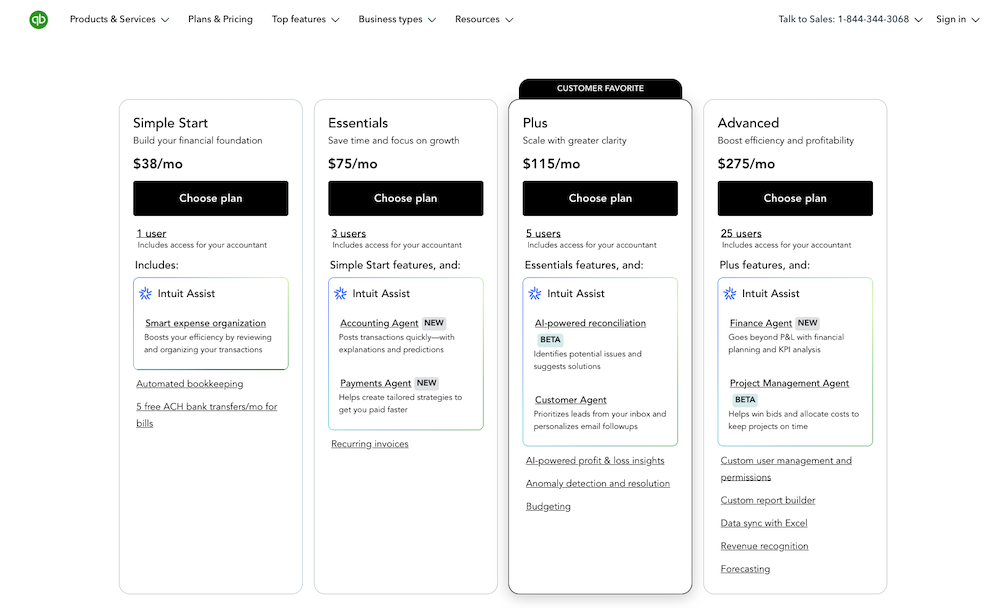
Each tier adds more features, and the pricing signals “if you need more, pay more.”
The philosophy for accounting services works the same way.
Your Bronze package might include monthly bookkeeping and basic tax prep.
Your Silver package adds quarterly advisory calls and cash flow forecasting.
And your Gold package includes everything plus proactive tax planning and CFO-level guidance.
This approach to pricing is very effective — many of the firm owners that I’ve coached at Future Firm have used it to multiply their revenues.
Here’s why this works well for accounting services:
Most clients don’t actually know what level of service they need when they first reach out.
When you show them three clear options, you’re helping them self-select based on where they are in their business journey.
You’re also setting the expectation that as they grow, their accounting needs (and investment) have room to grow.
How to Design Packages That Reflect Your Firm’s Value
The biggest mistake firms make when creating packages is focusing on what they do instead of what clients actually get.
Here’s how to design packages that clients see as valuable (and worth paying for).
1. Think About the Client’s Pain Points
It’s easy to sell individual services because you know what you can do.
But clients don’t care about what you do!
Instead, sell the transformation you can bring them.
Instead of listing “monthly bookkeeping, quarterly reviews, annual tax return,” frame your packages around what clients care about:
- “Semi-annual strategy calls to plan for growth”
- “Unlimited year-round email support”
- “On-time communications”
This change in framing makes it easier to charge premium prices.
Why?
Because instead of comparing your hourly rate to another firm’s, clients are evaluating whether the outcome is worth the investment.
2. Deliver Improvements at Every Level (Even at the Minimum)
In a three-tiered pricing plan, even your most basic plan should offer an improvement over the prospect’s current situation.
Here’s how I approach pricing:
First, I divide all my firm’s offerings to three categories:
- Services: Your firm’s deliverables to clients.
- Support: The level of access your clients have to your team.
- Technology: The tools you’ll use to provide services to your clients.
Then, with the prospect’s situation in mind, I start filling out the plans.
First, I start filling out the Bronze plan.
The Bronze plan will not be the main revenue driver for your firm — in fact, it’s designed to protect your team’s capacity more than anything.
That said, it should still be an upgrade from what your prospect currently has.
For example, let’s say that the prospect mentioned they would like to get their books in order and improve their profits.
And they also mentioned frustrations about their current accountant taking 5 days to reply to them.
Your Bronze plan could look like this:
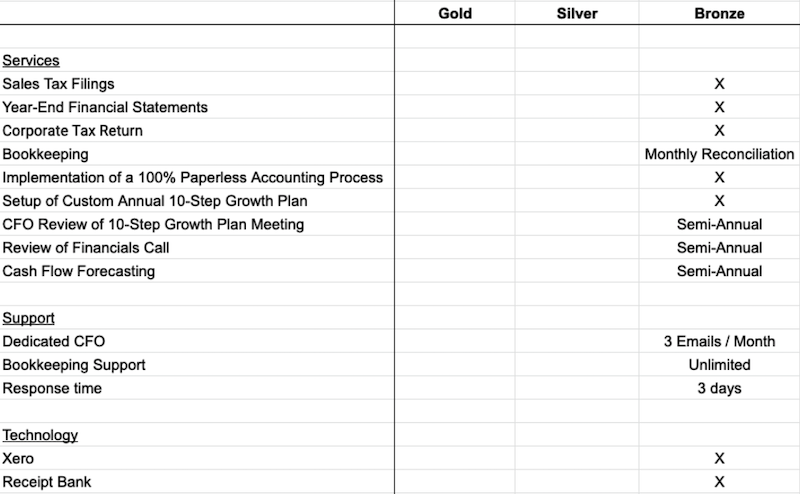
The Bronze plan, while basic, should still be designed to give them profit improvements.
Note the response time here — 3 days gives your team a lot of breathing room, but it’s still an upgrade from what the prospect is currently dealing with.
The Silver plan will be your sweet spot.
From there, I start filling out the Gold plan.
I include everything I’m happy to provide in my firm.
Then, I do the Silver plan.
The Silver plan is the sweet spot — more features than the Bronze plan but not as time-consuming as the Gold.
Again, the Silver plan should be an obvious upgrade over the Bronze plan.
(Otherwise, prospects will keep choosing the Bronze.)
The Gold plan will offer the limits of the services you’re willing to offer in your firm.
Here’s an example of a fully filled-out three-tiered plan:
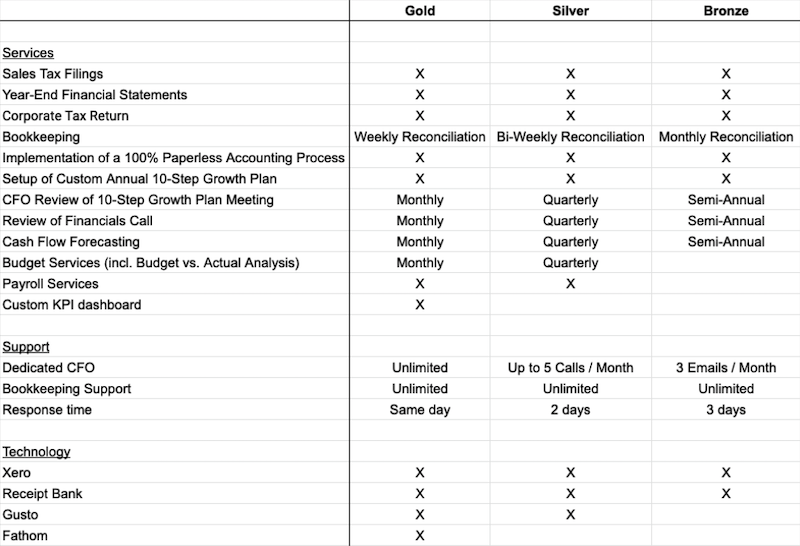
A pricing plan like this shows prospects how each plan is better than the other, which makes it easier to self-select.
(More pricing tips later!)
I regularly share tactics like this in my free Future Firm newsletter sent to 11,000+ modern firm owners — so feel free to check it out.
3. Don’t Compete on Price
Clients aren’t price-sensitive…
They’re value-sensitive!
If you’re offering real value — CFO-level guidance, proactive tax planning, unlimited support, etc. — don’t undercut yourself trying to match cheaper competitors.
A big part of this comes down to how you present your services.
Here’s an example that I shared in my newsletter:
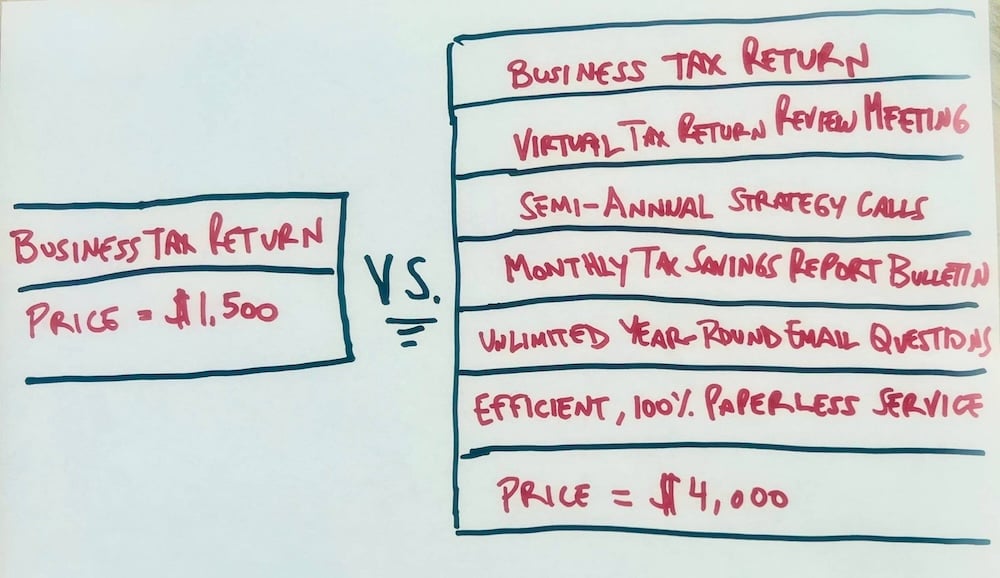
In the left column, you’ll see that a business tax return can cost $1,500.
But think about what’s really included in a “business tax return.”
(Hint: it’s mostly what’s in the right column!)
There is no way you can ever compete on price with a pricing plan like this.
Because no one is going to pay $4,000 for just a “business tax return.”
But if you flesh out what clients are going to get, a high price becomes much easier to justify.
That makes it easier to complete on value.
Firms that compete on price attract clients who only care about price.
These are clients who constantly push back on fees and leave the moment they find a cheaper firm.
Your packages should reflect the expertise and time you’re providing.
If a client isn’t willing to pay for that value, you shouldn’t be working with them in the first place.
How to Approach Engagement Templates With Tiered Packages
Most firms approach engagement templates one of two ways:
They either don’t have formal templates at all and write custom letters for each client based on whatever services the client wants.
Or, they have separate templates for each service type (bookkeeping, tax prep, advisory) and combine them based on what the client wants.
Both approaches burn hours on admin work and create inconsistency across your client base.
But when you implement tiered packages, your approach to engagement templates changes:
- You create one template– That’s it! You build one template with each of your packages directly inside it: one for Bronze, one for Silver, and one for Gold.
- Each template is self-contained – Everything a client at that level receives is already defined in the template. No pulling from multiple documents or customizing scope.
- You work with fewer templates total – Maybe you make two engagement templates: one for businesses and one for individuals. Or one for real estate agents and one for freelancers. But overall, you’re working with far fewer templates.
- Templates map to workflows – Each tier automates a specific set of tasks and deliverables, so work gets started the moment a client signs the engagement.
This approach saves you time on the admin side and protects you from scope creep by explicitly outlining what’s included (and what’s not) in each tier.
And because your prices are standardized, anyone in the firm can easily send branded and up-to-date engagements.
A tool like Canopy’s Engagements & Proposals helps here.
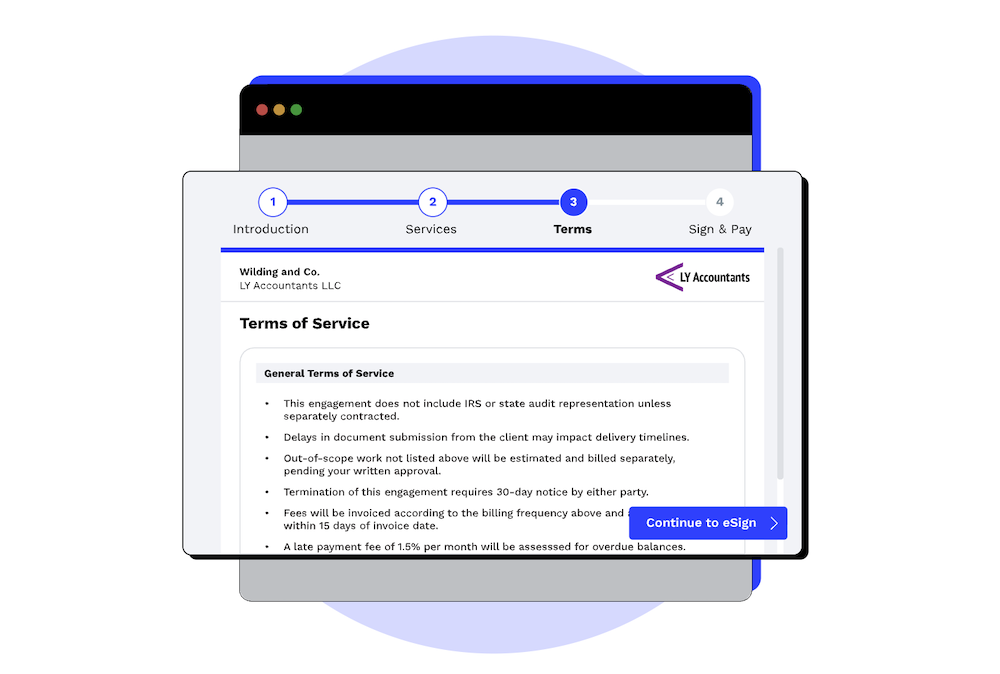
It lets you build reusable engagement templates, complete with pre-defined services, rates, terms, and billing frequencies.
You can also connect those templates directly to task workflows, so when a client accepts an engagement, the associated projects and tasks generate automatically.
Common Pitfalls When Moving to Packages and How to Avoid Them
Here are a few things to watch out for when moving to tiered packages (and how to avoid them) before they cost you clients or revenue.
Pitfall #1: Making the Packages Too Similar to Each Other
One of the objectives behind tiered packages is to make the decision easy for the client.
If your Bronze and Silver plans are nearly identical except for one minor difference, clients won’t see the value in upgrading.
You might end up with several Silver clients that take up a lot of time but pay Bronze rates.
Here’s an example of a poorly differentiated pricing plan.
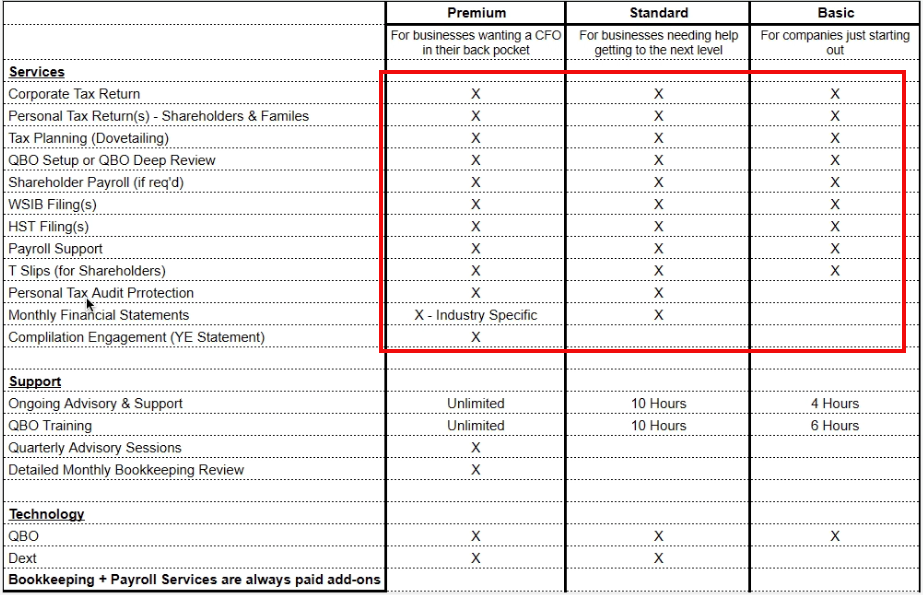
Notice how almost every service in the red box is included across all three tiers.
All pricing plans get the exact same tax returns, payroll support, and financial statements.
The only tangible and obvious differences are in the Support section below, where Premium gets unlimited advisory hours versus 10 hours for Standard and 4 hours for Basic.
This creates confusion because a client looking at these tiers can’t immediately tell why they should pay for Premium over Basic when they’re getting nearly identical core services.
On the other hand, here is a well-differentiated pricing plan.
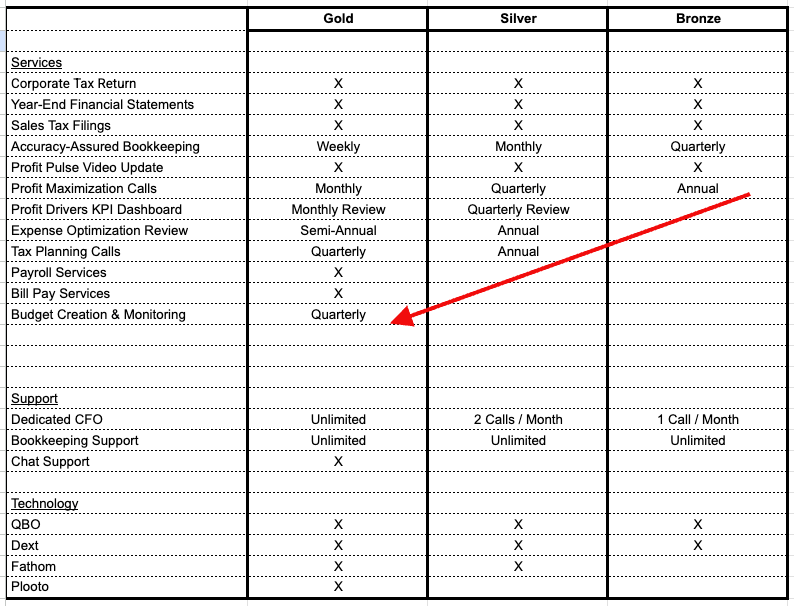
This structure works because each tier has clear, meaningful differences in the Services section.
As you’ll notice with the red arrow, as you move from Bronze to Silver to Gold, you’re not just getting more of the same…
You’re getting fundamentally different levels of service frequency and access.
A client can immediately see why Gold costs more than Bronze without having to dig through fine print.
Each tier needs clear, obvious differences that make the upgrade path logical.
Test your packages by explaining them out loud to someone unfamiliar with your business.
If they can’t immediately tell you the difference between tiers, go back and make the distinctions more obvious.
Pitfall #2: Pricing Too Low
Even after transitioning from hourly billing, some firm owners still have the reflex to underprice because they assume no one will say yes to higher rates.
This is a mistake.
You’re offering expertise, availability, and proactive guidance that saves clients money and stress.
That is worth paying for.
While there’s no straightforward answer to this, you have to think about the value your services bring to your clients.
For instance, let’s say you want to charge $3,000 a month for your Gold plan.
You hesitate because every other firm seems to be charging $500.
However, you know that you can help the client save $10,000 every month through proactive tax planning and better financial decisions.
In that context, $3,000 is a bargain!
And even if they feel that it’s too high for them, you still have the Silver and Bronze plans.
Pitfall #3: Listing Your To-Dos Instead of the Outcome
When designing your packages, don’t list out your internal checklist of tasks.
Clients don’t care that you’re doing “monthly depreciation of fixed assets” or “monthly review of intercompany loans” or “monthly review of accounts receivable.”
Those are the tasks you need to complete to ensure their books are accurate, but that’s not what the client wants to buy.
(The client wants financial peace of mind and an understanding of how their cash flows!)
So instead of listing every step of your internal process, focus on the outcome:
- “Accurate monthly financials delivered by the 15th”
- “Real-time visibility into your cash position.”
- etc.
Here’s an example of a package that lists tasks instead of outcomes:
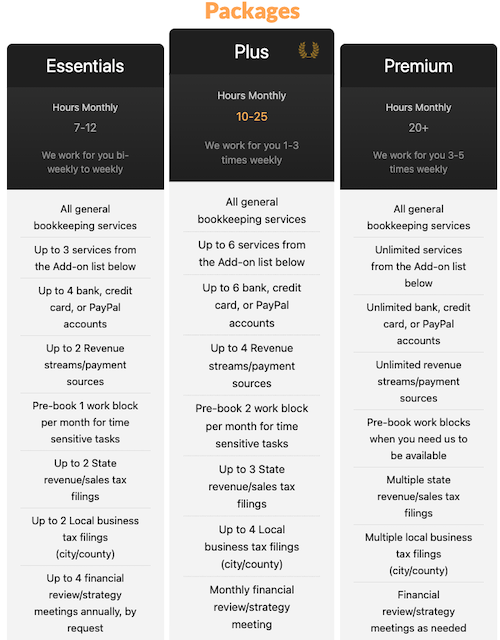
This doesn’t help a prospect understand what they’re getting — it just shows them how much work you’re doing.
This only makes them wonder if they’re overpaying for things they don’t understand.
Instead, group those tasks under clear, outcome-focused service names.
All those reconciliation and review tasks can be “Accuracy-Assured Bookkeeping.”
Here’s an example of an outcome-focused pricing plan:
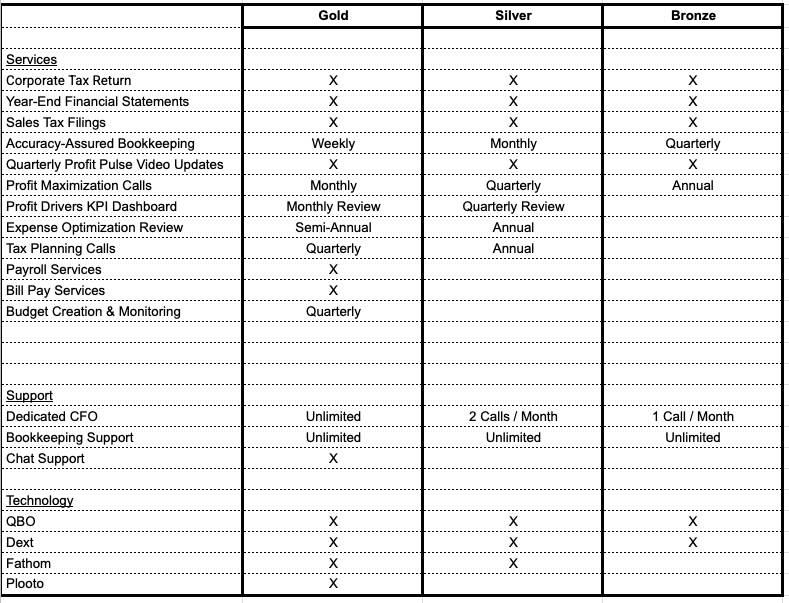
Look at each line item in your package and ask yourself: “Is this something my client asked for, or is this something I need to do to deliver what they asked for?”
If it’s the latter, remove it and replace it with the outcome they really care about.
Pitfall #4: Listing Too Many Services
When designing your packages, resist the urge to list out every single thing you offer.
This goes hand-in-hand with pitfall #3.
Here’s an example of a tiered pricing plan with too many services:
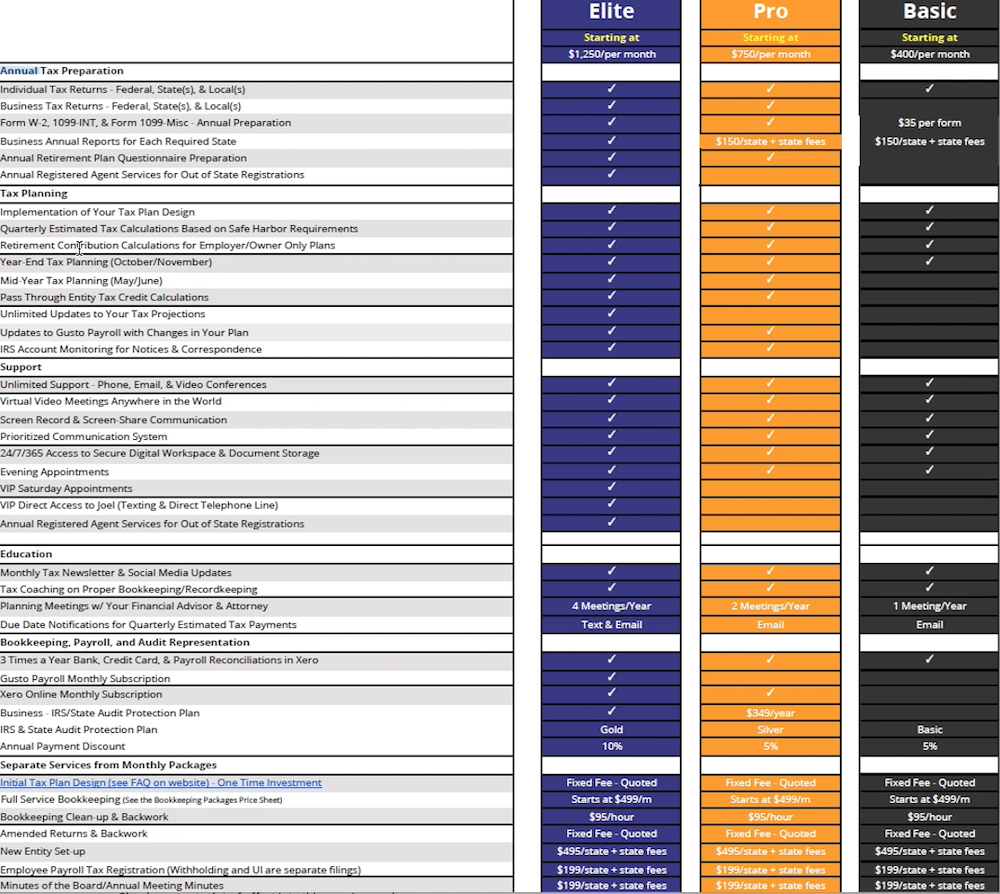
This doesn’t make you look impressive!
(If anything, it only overwhelms the prospect.)
Instead, focus on distinct services per tier.
Group related tasks under clear service names like the “Accuracy-Assured Bookkeeping” above or “Profit Maximization Calls” rather than itemizing every step of your process.
Look at your package descriptions and ask yourself if you can combine three line items into one clear service.
If “bank reconciliation,” “transaction categorization,” and “monthly close” all fall under bookkeeping, just call it “Automated bookkeeping” and save the detailed breakdown for your engagement letter.
Increase Your Profits With Tiered Service Packages
Pricing is the biggest lever you can pull to increase your firm’s revenue.
But pricing success doesn’t depend on the actual prices themselves.
Instead, it’s how clients perceive the value you provide.
Tiered pricing makes that easier.
And if you design your tiers right…
You just might find yourself charging more than twice as much!